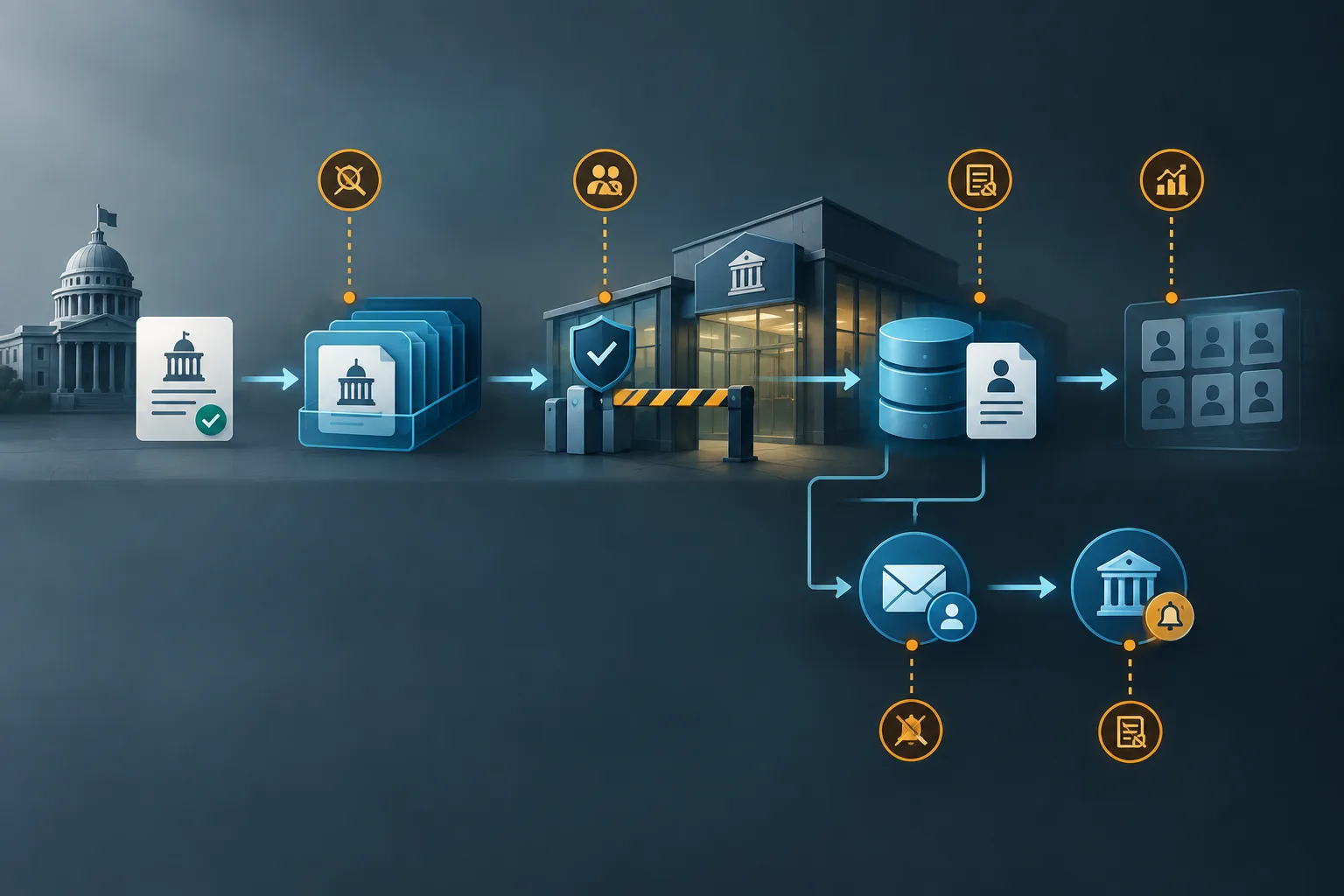

Revolut has confirmed that fraudsters obtained customer data by sending information requests from an email address on a legitimate government-agency domain, a disclosure that matters well beyond one fintech because it turns a trusted compliance workflow into the attack surface.
As first reported by TechCrunch, Revolut described the incident as a sophisticated external impersonation scam, said a limited number of customers were affected, and said it had contacted those customers directly. The company says its systems and customer funds were unaffected. It also says it blocked the address after detection and alerted the relevant government agency, law enforcement, data-protection authorities, and financial regulators.
That leaves a more useful question than “Was Revolut hacked?” The harder and more relevant question for banks, fintechs, hospitals, identity platforms, and other data-rich businesses is how to authenticate a request that appears to come from the state before anyone exports sensitive customer records.
A trust failure, not a system breach
The critical distinction in this case is the mechanism. Public reporting does not point to criminals breaking into Revolut’s core systems. It points to a high-trust authorization failure: somebody inside a data-release workflow accepted a request that carried the authority of a government domain and released information in response.
That may sound narrower than a traditional breach, but for many organizations it is the more uncomfortable scenario. Security teams often spend heavily on keeping attackers out of production environments while legal, compliance, support, and operations teams handle incoming requests that claim statutory or regulatory authority. Those requests may arrive in formats employees are trained to respect and escalate quickly.
A government-domain sender can create false confidence on its own. Yet a domain is not the same thing as a verified requester, a valid case number, proper scope, or lawful authority. The technical path is still unknown here: public reporting does not establish whether the mailbox was spoofed, compromised, or legitimately delegated. It also does not show how the request entered Revolut’s case-management process, which controls approved it, or how many customers or countries were involved.
Those unknowns matter because they determine whether the main weakness sat at intake, verification, approval, data extraction, or export monitoring. Revolut serves more than 80 million customers globally and operates as a bank in more than 30 countries, according to TechCrunch. The company’s insistence that only a limited number of customers were affected is important, but without an exact count or market breakdown, outside observers still cannot judge the blast radius.
The problem with KYC data once it leaves
The categories of data reportedly involved explain why this story carries more weight than the phrase “limited number” might suggest. According to the originating report, customer notifications said exposed data included names, birth dates, postal and email addresses, phone numbers, and copies of identity documents such as passports and driver’s licenses. The same notifications said verification selfies, account statements, and transaction histories may also have been included.
Follow-up reporting added other possible fields, including occupations, IBANs, withdrawal records, complete transaction histories, and Bitcoin transactions. Those details should still be treated as reported or possible, not final, because the full scope has not been independently pinned down.
Even the narrower set is enough to create long-tail risk. Passwords can be reset. Payment cards can be reissued. KYC records are different. A passport image, driver’s license copy, onboarding selfie, home address, and a historical record of account activity can be reused for identity theft, account-takeover attempts, synthetic identity schemes, social-engineering campaigns, and more convincing phishing for years.
That is why Revolut’s statement that funds were not compromised, while meaningful, does not end the story. Financial loss is only one downstream harm. For affected customers, the more persistent problem may be the durability of the leaked identity material. For regulated firms, the issue is that many of the most sensitive records are also the least replaceable.
Follow-up reports on September 14 and 15 also described an alleged effort by criminals to leak data and demand a ransom. Those claims add urgency, but they remain unconfirmed in the public record, as do claims about Telegram samples or any targeting of high-net-worth users. They should sharpen attention, not settle the facts.
A review checklist for banks, fintechs, and other data-rich firms
The Revolut incident is best read as a design problem. The point is not simply to verify that a message came from a recognizable domain. The point is to build a request-to-release chain that assumes even trusted-looking requests can be fraudulent.
For security, compliance, and operations leaders, that review starts with two separate questions.
First: how do you authenticate the sender and the request?
- Require independent verification through a known channel, not the contact details in the incoming message.
- Use agency portals or cryptographic signing where possible, rather than ordinary email as the system of record.
- Confirm the legal basis, case reference, and jurisdiction against known agency procedures.
- Route sensitive requests through trained specialists rather than a general queue.
Second: if a bad request does get in, how much can it actually pull?
- Use two-person approval for sensitive exports.
- Limit access so one reviewer cannot retrieve broad KYC and transaction files by default.
- Minimize fields to the narrowest lawful scope instead of sending complete customer packs.
- Log every step immutably: request received, verification performed, approver identity, query parameters, exported fields, and delivery path.
- Apply rate checks and anomaly detection to spot unusual request patterns, unusually broad queries, or repeated requests tied to one sender.
- Monitor exports as aggressively as organizations monitor logins.
Public reporting does not show which of those controls Revolut had in place or which step failed. But that is exactly why the case lands so hard for other firms. Many organizations have some version of sender-domain trust, some legal-request templates, and some manual approval process. Fewer can say with confidence that a convincing but fraudulent government request would fail at multiple layers.
Revolut’s immediate response — blocking the source, notifying authorities and regulators, and contacting affected customers — matches the basics of incident handling. The more important test will be whether this episode pushes the industry to harden the workflow itself. A legal or regulatory request channel is not just an inbox. In the wrong design, it becomes an identity-theft pipeline with official-looking stationery.
That makes this a live cybersecurity story even without evidence of a core-system intrusion. The unresolved details are not side notes; they are the heart of the lesson. Until banks and other data-rich businesses can prove both who is asking and why any one request deserves exactly the data it receives, a trusted domain will remain too much trust in too little evidence.
 By
By
 By
By



 By
By
 By
By
 By
By