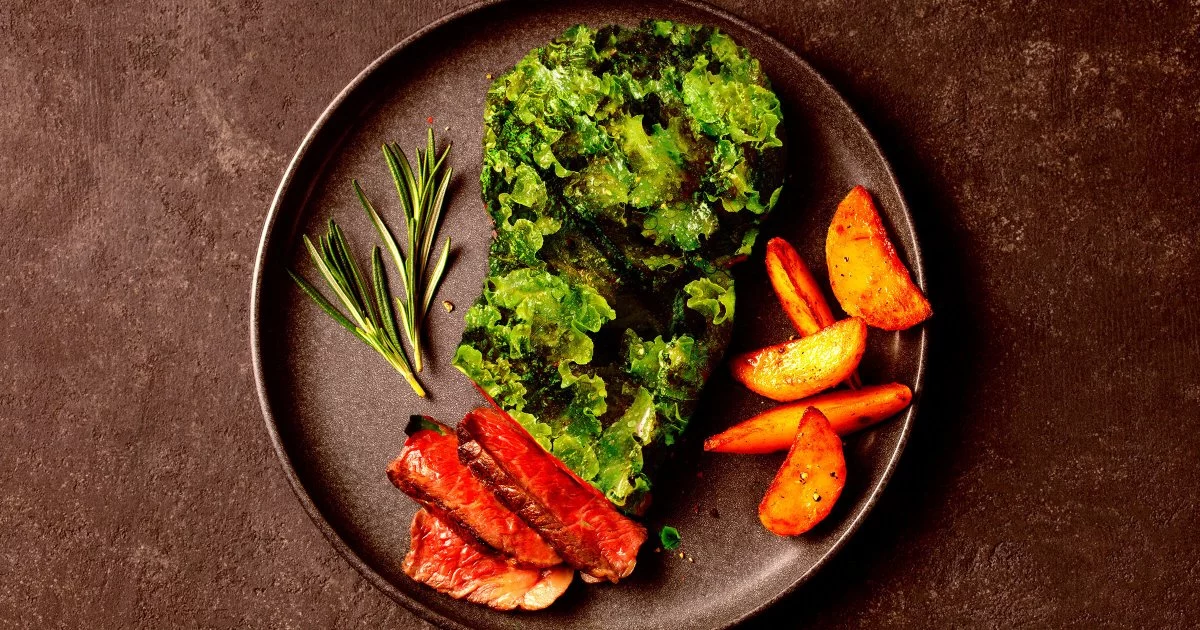

Chloroplast bioengineering moves heme from the animal to the field
Imperial College London researchers have demonstrated a striking proof-of-concept: edible and industrial plants can be engineered to produce myoglobin, a heme-containing animal protein closely associated with meat’s characteristic flavor, aroma, and “bloody” appearance. Using a biolistic gene gun approach, the team inserted porcine myoglobin genes directly into chloroplast genomes (plastomes) in lettuce and tobacco—two species that, importantly, represent different crop archetypes: a leafy food crop and a high-biomass production workhorse.
From a technology and business perspective, the significance is less about today’s absolute yield and more about what the result validates: chloroplasts can serve as scalable, plant-based biomanufacturing compartments for animal-grade proteins. That shifts myoglobin from being something that must come from livestock—or be produced in stainless-steel fermentation tanks—into something that could be cultivated across hectares with agricultural inputs.
The reported output—~800 mg of myoglobin per kilogram of dry biomass (roughly 0.08% of dry weight)—is far below the concentration found in animal muscle. Yet the achievement establishes a credible path toward optimization, and it reframes the unit economics around land, water, and emissions rather than solely around concentration per gram.
—
Why chloroplast transformation matters: expression stability, scale logic, and a clearer optimization runway
The choice to engineer chloroplast DNA rather than nuclear DNA is not a minor technical detail; it is central to the platform’s commercial promise. Chloroplasts carry multiple genome copies per cell, and their gene-expression machinery has features that can support high, uniform expression when constructs are well designed.
Key technical implications with direct commercial relevance include:
- Reduced risk of nuclear gene silencing: Plastome integration can bypass some of the expression instability that can occur with nuclear transgenes, improving predictability across generations and cultivation conditions.
- Homogeneity of expression: Chloroplast engineering can yield more consistent protein levels across plant tissues, which matters for downstream processing and ingredient standardization.
- A modular crop platform: Demonstrating myoglobin expression in both lettuce and tobacco suggests the approach can be ported into other high-biomass or climate-resilient crops, widening the addressable manufacturing footprint.
Just as importantly, the current yield is best read as a baseline for iterative improvement. The summary points to plausible levers—promoter engineering, plastid copy-number amplification, and construct tuning—that could drive multi-fold gains. In the language of industrial biotech, this is the moment where feasibility has been demonstrated and the work shifts to titer, rate, and yield—with the added twist that the “bioreactor” is a plant canopy rather than a fermenter.
—
The emerging economics: a shorter protein supply chain and a new ingredient battleground
If plant-derived myoglobin can be scaled and costed competitively, it could reshape multiple parts of the alternative protein value chain. The most immediate application is as a flavor and sensory ingredient for plant-based meat—myoglobin and heme chemistry are strongly linked to the cooked-meat experience, and sensory parity remains one of the category’s most persistent barriers to repeat purchase.
The economic narrative in the provided material is anchored in resource efficiency: on a per-hectare basis, plant production could rival or exceed livestock output while cutting irrigation needs by 80–90% and reducing carbon footprint by up to ~70% (based on preliminary life-cycle estimates). Even allowing for uncertainty in early LCA modeling, the direction of travel is clear: photosynthetic production of functional proteins is structurally advantaged in water and emissions compared with ruminant systems.
Commercially, this opens several strategic possibilities:
- Value chain compression: Producing myoglobin in crops could reduce reliance on feedlots, slaughter infrastructure, and cold-chain complexity—replacing them with cultivation, extraction, and ingredient formulation.
- Competitive differentiation for plant-based meat brands: In-planta myoglobin could deliver “enhanced-bleed” and meat-like flavor without depending entirely on microbial fermentation routes, potentially creating a defensible product moat.
- New margins for agritech and growers: Seed-to-ingredient vertical integration becomes plausible, where agricultural cooperatives or agritech firms participate in downstream processing rather than selling commodity biomass.
This is also where the comparison with precision fermentation becomes most interesting. Fermentation excels at controlled, high-purity production, but it carries capex, energy, and scale-up constraints. Plants offer a different scaling curve—more land- and season-dependent, but potentially lower in marginal resource intensity for bulk production. The likely medium-term outcome is not a winner-take-all scenario, but hybrid supply models where plants supply high-volume heme ingredients and fermentation handles more complex or tightly regulated proteins.
—
Regulation, IP, and consumer trust: the three gates to commercialization
The science may be compelling, but commercialization will be decided by three non-technical gates: regulatory clearance, intellectual property positioning, and consumer acceptance.
- Regulatory pathways will diverge by region. The EU’s more stringent stance on GMOs and novel foods can elongate timelines, while US frameworks (including USDA-APHIS approaches) may offer clearer routes depending on trait and containment strategy. For companies, this implies staged market entry: pilot and early commercialization in more permissive jurisdictions, paired with longer-horizon dossiers for stricter markets.
- IP strategy will shape who scales first. Chloroplast transformation methods, construct designs, and trait stacks can form a meaningful patent and licensing portfolio. Expect partnerships between academic labs, seed technology firms, ingredient suppliers, and consumer packaged goods players seeking exclusivity or first-mover advantage.
- Consumer perception is not a footnote. Even if chloroplast engineering avoids certain nuclear-transgene narratives, it remains genetic engineering. Transparent labeling, third-party validation, and proactive engagement—especially in Europe and parts of East Asia—will be essential to avoid a trust deficit that could negate technical gains.
Beyond food, the platform logic extends into adjacent markets where heme proteins have utility—diagnostics, sensing applications, and aquaculture feed—creating optionality that investors often prize in platform technologies.
The deeper signal from this work is that agriculture is increasingly being repositioned as a manufacturing sector—not only for calories, but for high-value functional biomolecules. If the next phase delivers higher expression levels, robust field performance, and a credible regulatory playbook, plant-made myoglobin could become a defining case study in how synthetic biology, climate constraints, and consumer demand converge to redraw the boundaries of the global protein economy.

 By
By
 By
By
 By
By
 By
By


 By
By