
Corporate AI optimism meets a hardening public mood
A striking tension is emerging at the heart of the AI economy: the industry’s most polished narratives are colliding with a public that increasingly doubts both the motives and the outcomes of rapid deployment. Meta and Anthropic’s recent advertising—framed around broad social uplift and resilience—signals that leading firms understand the reputational stakes. Yet the reception has been notably cool, shaped by a wider perception that AI’s gains are accruing to a narrow set of companies and investors while risks are being externalized to workers, communities, and civic institutions.
Polling underscores why the messaging is struggling to land. A Pew Research survey shows 40% of U.S. adults expect AI to have a negative societal impact, compared with 16% who anticipate benefits, while 31% report personal anxiety about AI’s effects over the next two decades. That gap is not merely a communications problem; it reflects a deeper deficit of institutional trust—one that advertising cannot repair when the public’s lived experience includes layoffs, opaque algorithms, and a sense of diminished agency.
The dynamic echoes earlier eras in which corporate branding attempted to outrun structural critique—Big Oil’s green messaging or pharmaceutical “well-being” campaigns—often prompting sharper scrutiny when the underlying grievances remained unresolved. In today’s AI cycle, the skepticism is amplified by the technology’s visibility: AI is not only a product category, but a decision-making layer that touches employment, education, healthcare access, and public safety. When the technology feels like governance-by-proxy, the demand shifts from inspiration to accountability.
The AI supply chain runs through neighborhoods—and voters are pushing back
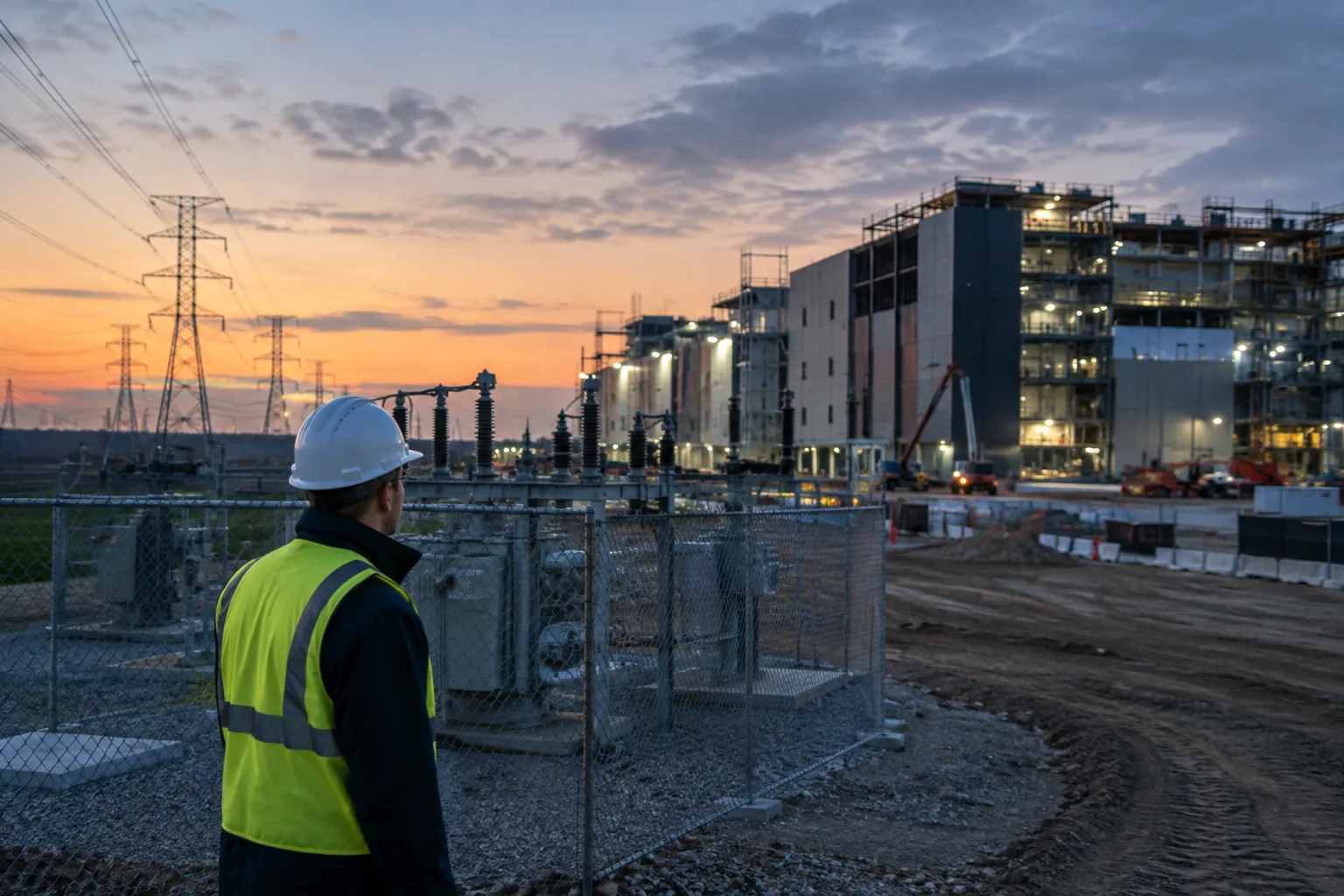
The AI boom is frequently described in terms of models, chips, and cloud platforms. But its physical footprint is now a central political constraint. Hyperscale data centers—critical infrastructure for training and serving AI systems—are becoming flashpoints in local land-use battles, with Gallup polling indicating roughly three-quarters of Americans oppose such facilities in their communities.
This resistance is not simply “NIMBYism” in the dismissive sense. Communities are raising concrete concerns that map directly onto municipal responsibilities and household costs:
- Energy demand and grid capacity, especially where electrification and decarbonization goals are already straining supply
- Water usage and heat discharge, particularly in drought-prone regions
- Noise, traffic, and land-use change, including the opportunity cost of industrial siting
- Tax incentives and perceived imbalance, where public concessions appear to subsidize private gain
For developers and investors, the implications are immediate and quantifiable. Community opposition introduces timeline volatility, increases legal and permitting costs, and forces larger contingencies into project finance. The result is a subtle but meaningful shift in the AI infrastructure equation: reputational risk is becoming construction risk, and construction risk becomes capital cost.
Strategically, this friction may accelerate a dual-track architecture for AI compute. While hyperscale remains essential for frontier training, persistent siting conflict could push more inference workloads toward distributed and edge models—including on-device AI and modular micro data centers—where community impact is lower and privacy assurances can be stronger by design. This dovetails with 5G expansion and the broader “compute everywhere” thesis, but it also signals something more: the physical politics of AI may shape the technical roadmap as much as engineering preferences do.
Surveillance, security, and the widening legitimacy gap
Public unease is intensifying where AI intersects with policing and national security. Reports of AI-supported military targeting associated with civilian harm, alongside the domestic expansion of facial recognition and drone surveillance, are crystallizing a difficult narrative for the sector: AI is increasingly perceived as a tool of coercion as well as convenience.
That perception is now being organized into visible activism. One day of action reportedly produced 142 demonstrations across 42 states, targeting AI companies and what critics describe as the industry’s “surveillance turn.” More consequential than protest volume is the evolution of tactics. Grassroots actors are not only lobbying city councils; they are actively disabling cameras and drones, including reported activity in Minneapolis aimed at countering police surveillance initiatives. This signals the emergence of a new category of operational exposure: citizen-led, cyber-physical disruption that sits somewhere between protest, sabotage, and informal counter-surveillance.
For executives, the lesson is that the “license to operate” is no longer a metaphor. It is being contested in zoning hearings, procurement processes, and public streets. The convergence of “AI for profit” with “AI for policing” also complicates corporate positioning: a company can promote AI as empowering, but if its tools are simultaneously used for surveillance or targeting, the brand inherits the moral ambiguity of those deployments—especially when governance is opaque.
This is also where digital sovereignty becomes more than a trade concept. As backlash against U.S.-based AI firms grows, it aligns with sovereign cloud initiatives in Europe and Asia, encouraging fragmented AI supply chains and creating openings for domestic champions. Regulatory divergence—across the U.S., EU, and China—may harden into product fragmentation, compliance overhead, and constrained data flows.
What “trust” will require in the next phase of AI commercialization
The industry’s near-term challenge is not a lack of innovation; it is a shortage of credible assurance mechanisms. If reputational risk is cascading into financial risk—slower capital inflows, harder talent recruitment, and intensifying regulatory scrutiny—then trust must be built into operating models, not appended as a marketing layer.
Several moves stand out as both pragmatic and measurable:
- Authentic stakeholder governance: standing liaison councils with civil society, labor, and local governments; routine impact assessments tied to deployment milestones
- Infrastructure strategy recalibration: hyperscale where politically feasible, paired with pilots for modular edge nodes in resistant regions to hedge siting risk
- Municipal policy readiness: standardized reporting on noise, water, emissions, and land restoration to reduce approval friction and set industry benchmarks
- Trust-enabling technical investment: explainable AI, privacy-preserving computation (federated learning, secure enclaves), and on-device processing to reduce surveillance anxieties
- Geo-regulatory scenario planning: modular product and compliance architectures that can be configured quickly for divergent regimes on safety, localization, and surveillance
AI’s next growth chapter will be written less by slogans than by verifiable constraints, transparent governance, and community-level legitimacy. The companies that treat public skepticism as a design input—rather than a branding obstacle—are the ones most likely to sustain scale in a market that is rapidly learning how to say “no.”

 By
By
 By
By
 By
By
 By
By

 By
By

 By
By