


A deadline-driven federal pivot toward quantum capability
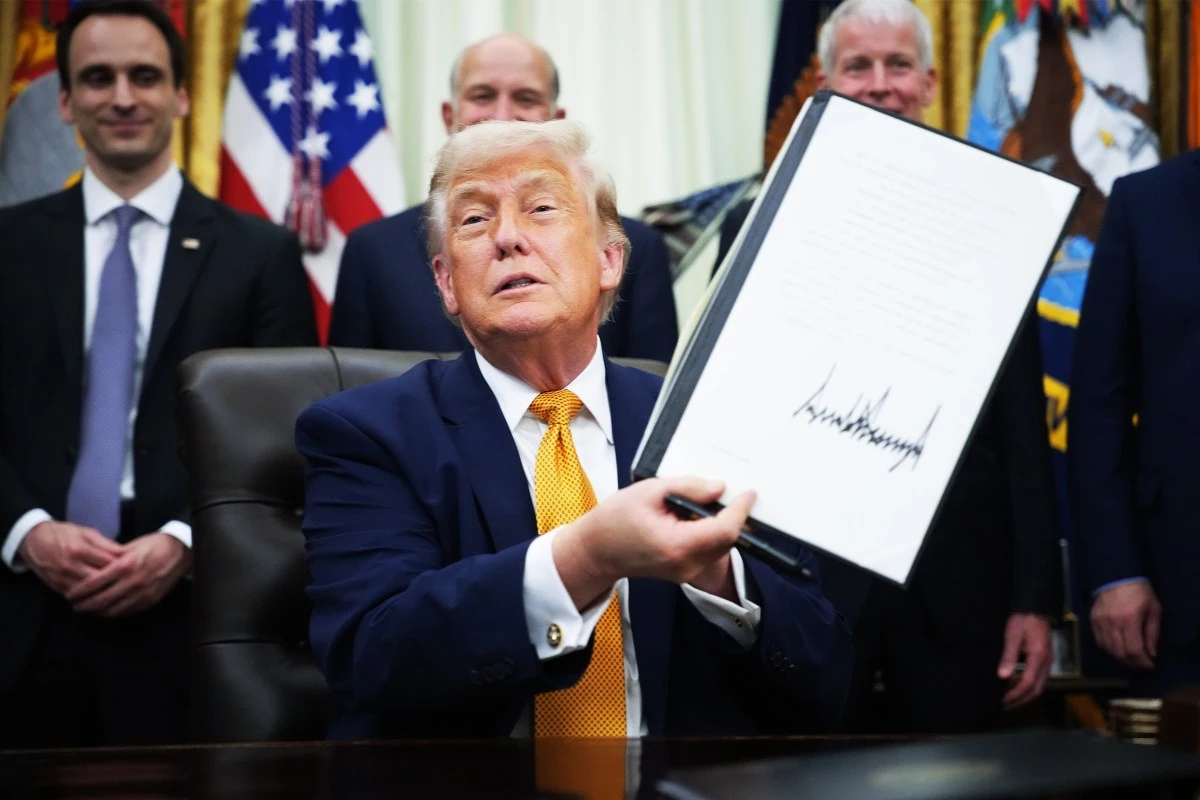
Two new executive orders signed by President Trump mark a notable shift in U.S. quantum policy: away from open-ended research ambitions and toward fixed national deliverables. The first order directs federal agencies—working alongside academia and industry—to field a demonstration-grade quantum computer for scientific research by 2028. The second accelerates the U.S. timetable for post-quantum cryptography (PQC) adoption, moving the target from 2035 to 2031.
Together, these directives signal a more interventionist posture consistent with a broader techno-industrial policy trend: the federal government is not only funding quantum information science, but also setting deadlines that force coordination across procurement, standards, and commercialization. A parallel instruction to the Department of Defense to deploy quantum sensors by 2028—positioned as an alternative or complement to GPS—extends the push beyond computing into operational military and navigation systems.
The optics of the Oval Office ceremony—where the President pledged unprecedented investment in “American quantum leadership,” despite limited technical engagement—may draw commentary. Yet the more consequential story is structural: Washington is attempting to compress the time between laboratory progress and national-scale deployment, and to do so in a way that reshapes private-sector incentives.
From NISQ fragility to “demo-grade” systems—and why 2028 is hard
Quantum computing’s promise rests on qubits exploiting superposition and entanglement to address problem classes that strain classical systems—such as molecular simulation, optimization, and certain machine-learning inference workloads. But today’s reality is dominated by noisy intermediate-scale quantum (NISQ) devices: fragile, error-prone machines that often struggle to deliver consistent advantage outside carefully curated experiments.
A 2028 mandate for a demonstration-grade system is therefore less a guarantee of fault-tolerant quantum computing than a forcing function for the ecosystem to mature across multiple bottlenecks:
- Error correction and fault tolerance: Moving from “interesting physics” to reliable computation requires scalable error-correcting codes, stable qubits, and architectures that can be manufactured and operated repeatably.
- Engineering and integration: Cryogenics, control electronics, calibration automation, and system uptime are as decisive as qubit counts.
- Benchmarking and scientific utility: A “demo-grade” machine will be judged by whether it can support credible scientific research workflows, not just headline metrics.
- Workforce and supply chain: Specialized talent, fabrication capacity, and component supply chains (from dilution refrigerators to photonics) become strategic constraints.
In parallel, the Department of Defense’s quantum sensor directive highlights a different but related frontier. Quantum sensing leverages quantum coherence for ultra-precise measurement of time, acceleration, gravity gradients, and electromagnetic fields. If ruggedized and miniaturized, these sensors could enable navigation in GPS-denied environments, improve detection capabilities, and support secure timing and communications. The challenge is that field deployment demands a level of durability, calibration stability, and manufacturability that many lab-grade systems have not yet proven.
Post-quantum cryptography moves from “eventual” to “urgent” by 2031
The second executive order—accelerating PQC timelines to 2031—may prove the most immediately disruptive for enterprises. The rationale is straightforward: sufficiently capable quantum computers could break widely used public-key cryptography, particularly RSA and elliptic-curve cryptography (ECC), undermining authentication, secure web traffic, software updates, and many forms of digital trust.
This is not only a future risk; it is also a present one due to the “harvest now, decrypt later” threat model, where adversaries collect encrypted data today in anticipation of decrypting it once quantum capabilities mature. By pulling the deadline forward, the administration is effectively compressing the migration window for critical infrastructure, government systems, and regulated industries.
For the private sector, a 2031 target implies accelerated work across:
- Cryptographic inventory and dependency mapping: Identifying where RSA/ECC live across applications, devices, vendors, and embedded systems.
- Standards and certification cycles: Faster alignment with evolving guidance from bodies such as NIST and international standards organizations, plus sector-specific compliance regimes.
- Operational risk management: PQC algorithms can introduce performance, latency, and interoperability trade-offs; migration is rarely a “drop-in” swap.
- Vendor and supply-chain readiness: Enterprises will be constrained by the PQC roadmaps of cloud providers, network equipment vendors, identity platforms, and hardware security module (HSM) suppliers.
This acceleration could catalyze new markets—PQC migration services, cryptographic agility platforms, quantum risk assessments, and managed key infrastructure modernization—but it also raises the probability of uneven adoption, rushed implementations, and fragmented interoperability if governance and guidance lag behind the deadline.
Capital, competition, and governance: the strategic stakes behind the orders
The executive orders arrive alongside a $2 billion Commerce Department commitment to nine U.S. quantum startups, a cohort that includes PsiQuantum, which has been linked via 1789 Capital to Donald Trump Jr. That connection does not, by itself, determine outcomes, but it does intensify scrutiny around conflict-of-interest perceptions—particularly in a sector where government funding, procurement pathways, and export-control decisions can materially shape winners and losers.
Geopolitically, the timing reflects a familiar strategic logic: quantum is increasingly framed as a core arena in U.S.–China technology competition, with China mobilizing state capital, research infrastructure, and talent pipelines at scale. The U.S. response implied by these orders is to reduce uncertainty for investors and accelerate commercialization through:
- Clearer federal demand signals (deadlines for systems and standards)
- Coordinated procurement and R&D funding
- Regulatory alignment that can de-risk private capital
Yet this approach also concentrates risk. If timelines are politically attractive but technically misaligned, the result can be misallocated capital, distorted benchmarks, or premature standardization. The credibility of the push will therefore hinge on governance: transparent grantmaking, auditable conflict safeguards, measurable milestones, and a realistic articulation of what “demonstration-grade” means in practice.
For business and technology leaders, the practical takeaway is that quantum is being pulled into the realm of near-term planning. The organizations that treat PQC migration, quantum-ready architecture, and standards participation as board-level priorities—rather than speculative R&D—will be best positioned as federal deadlines begin to shape procurement, cybersecurity expectations, and competitive advantage across the U.S. innovation economy.

 By
By
 By
By
 By
By
 By
By

 By
By
 By
By








