


A faint X-ray signature that reframes the “little red dots” debate
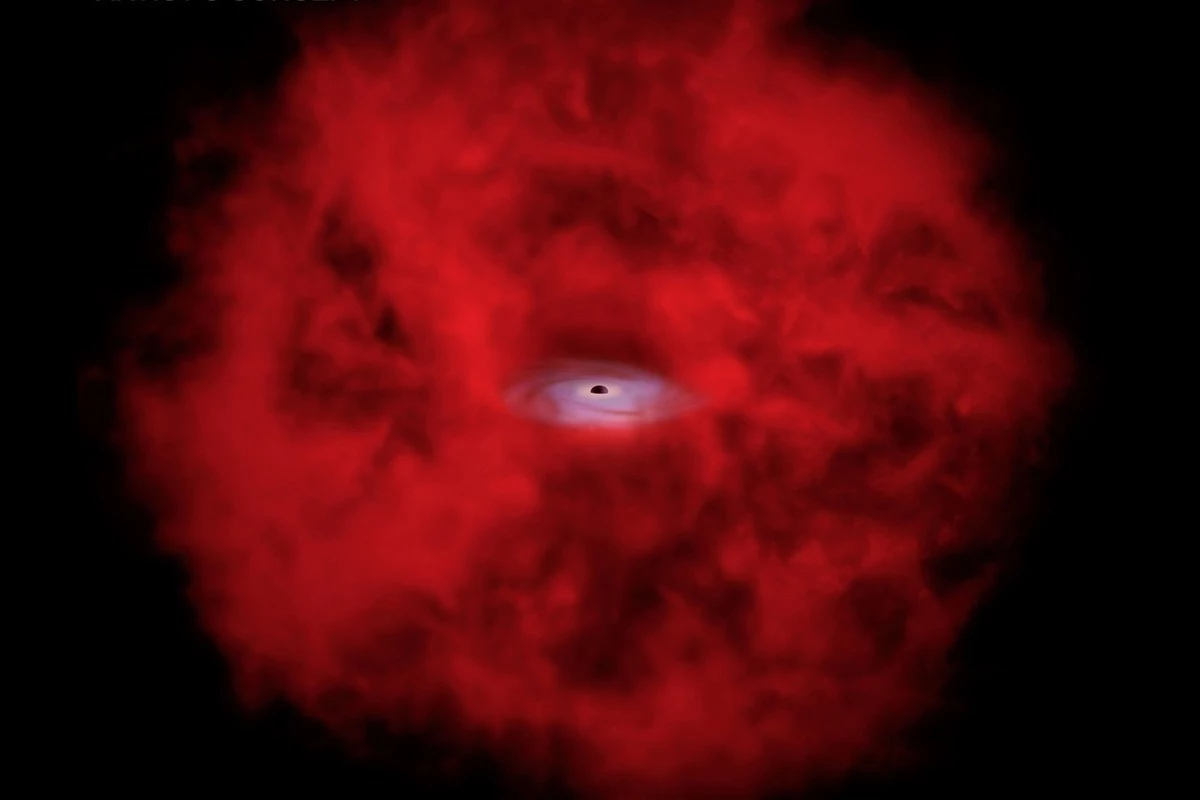
Astronomers have added a consequential new data point to one of early-universe astronomy’s most intriguing mysteries: the “little red dots”—compact, unusually bright red sources seen within the universe’s first billion years. By combining observations from NASA’s Chandra X-ray Observatory and the James Webb Space Telescope (JWST), researchers report a newly characterized high-energy source dubbed the “X-ray dot,” located roughly 12 billion light-years away.
What makes this object strategically important for astrophysics is not merely its distance, but its X-ray emission pattern, which aligns with behavior typically associated with accreting black holes. That signature strengthens a long-standing hypothesis: at least some little red dots may not be ordinary early galaxies or star-forming regions, but rather rapidly growing supermassive black holes wrapped in thick, obscuring gas—sometimes described in the literature as a “black hole star” phase.
Co-authors from institutions including the Max Planck Institute and Princeton University frame the result as evidence of a transitional stage in black hole evolution, potentially capturing a formative period when black holes grew quickly while still deeply embedded in their natal environments. If that interpretation holds across a broader sample, it would help reconcile a persistent cosmological tension: how supermassive black holes became so massive so early in cosmic history.
Why Chandra + JWST is more than a scientific pairing—it’s an operating model
The deeper story is methodological. This result underscores how modern discovery increasingly depends on multi-wavelength fusion—the deliberate integration of instruments that “see” different physics. JWST’s infrared sensitivity is optimized for detecting faint, redshifted light from the early universe, while Chandra’s X-ray vision probes high-energy processes such as black hole accretion. Alone, each observatory can suggest a narrative; together, they can test competing explanations.
From a business-and-technology lens, the Chandra–JWST synergy is a preview of where frontier science is headed: cross-platform, cross-calibrated discovery pipelines that treat telescopes as nodes in a distributed sensing network. This approach has several implications:
- Instrument complementarity becomes a force multiplier: infrared can reveal the dust-enshrouded structure; X-rays can indicate compact, energetic engines.
- Joint analysis reduces ambiguity: multi-spectrum correlation helps distinguish genuine astrophysical signals from confounding effects like dust reddening or background contamination.
- Future mission design is likely to prioritize interoperability: shared standards for calibration, metadata, and coordinated follow-up can shorten the time from detection to interpretation.
In practical terms, the “X-ray dot” is also a reminder that flagship observatories are not static assets. Their value compounds when researchers can revisit archival data with new targets identified by newer instruments—turning decades of stored telemetry into a renewable discovery resource.
The hidden technology stack: detectors, cryogenics, and AI-driven faint-signal detection
Detecting a faint, heavily obscured X-ray source at extreme distance is not simply a triumph of telescope time—it is a triumph of precision engineering and data science. The ability to isolate weak signals from background noise depends on a layered technology stack:
- Low-noise detectors and advanced sensor architectures that preserve signal integrity at the margins of detectability
- Cryogenic cooling systems that reduce thermal noise and stabilize instrument performance
- On-board and ground-based filtering that manages massive data volumes without discarding rare anomalies
- Machine learning and pattern recognition pipelines that can separate astrophysical signatures from artifacts, cosmic rays, and statistical fluctuations
The role of AI and machine learning is especially notable. As observatories generate ever-larger datasets, manual classification becomes a bottleneck. Automated systems increasingly handle tasks such as anomaly detection, candidate ranking, and cross-matching across catalogs. The “X-ray dot” narrative fits a broader trend: AI is becoming an enabling layer for discovery, not merely an optimization tool.
These capabilities have well-documented spillover potential. Techniques refined in space science frequently migrate into terrestrial applications where the problem is similar—extracting weak signals from complex noise fields. Likely beneficiaries include:
- Medical imaging (enhanced reconstruction and denoising)
- Industrial inspection (non-destructive testing and defect detection)
- Defense and remote sensing (multi-sensor fusion and anomaly identification)
- Semiconductor and metrology workflows (precision detection under constrained signal conditions)
In other words, the scientific headline is also a validation event for a portfolio of technologies that matter well beyond astronomy.
Investment, competitiveness, and the geopolitics of “big science” capability
Flagship observatories are expensive, long-horizon bets—often justified on scientific grounds but sustained through a broader political economy of innovation. Discoveries like the X-ray dot strengthen the argument that public investment in frontier research can produce compounding returns through talent development, supplier ecosystems, and transferable technologies.
Several strategic dynamics stand out:
- Public-private R&D leverage: even when funding is public, execution depends on universities, national labs, aerospace primes, and specialized instrumentation firms. Breakthroughs can translate into follow-on contracts and new commercialization pathways.
- Commercial uptake of validated components: detector designs, cryogenic subsystems, and high-reliability electronics proven in space conditions can become differentiators in competitive markets.
- Science diplomacy and soft power: leadership in high-visibility discoveries shapes global perceptions of technological capability, helping attract international partners and top-tier researchers.
This matters in a macro environment where inflationary pressures and competing fiscal priorities can squeeze research budgets. High-impact results provide decision-makers with a clearer narrative: that advanced observatories are not only tools for answering cosmic questions, but also platforms for industrial innovation and strategic positioning.
The X-ray dot, then, is more than a point of light from the early universe. It is a signal—scientific, technological, and economic—that the next era of discovery will belong to ecosystems that can fuse instruments, compute at scale, and translate frontier capability into durable advantage.

 By
By
 By
By

 By
By
 By
By

 By
By
 By
By







