


A planetary-scale “hydraulic jump” and why Venus just became more valuable to modelers
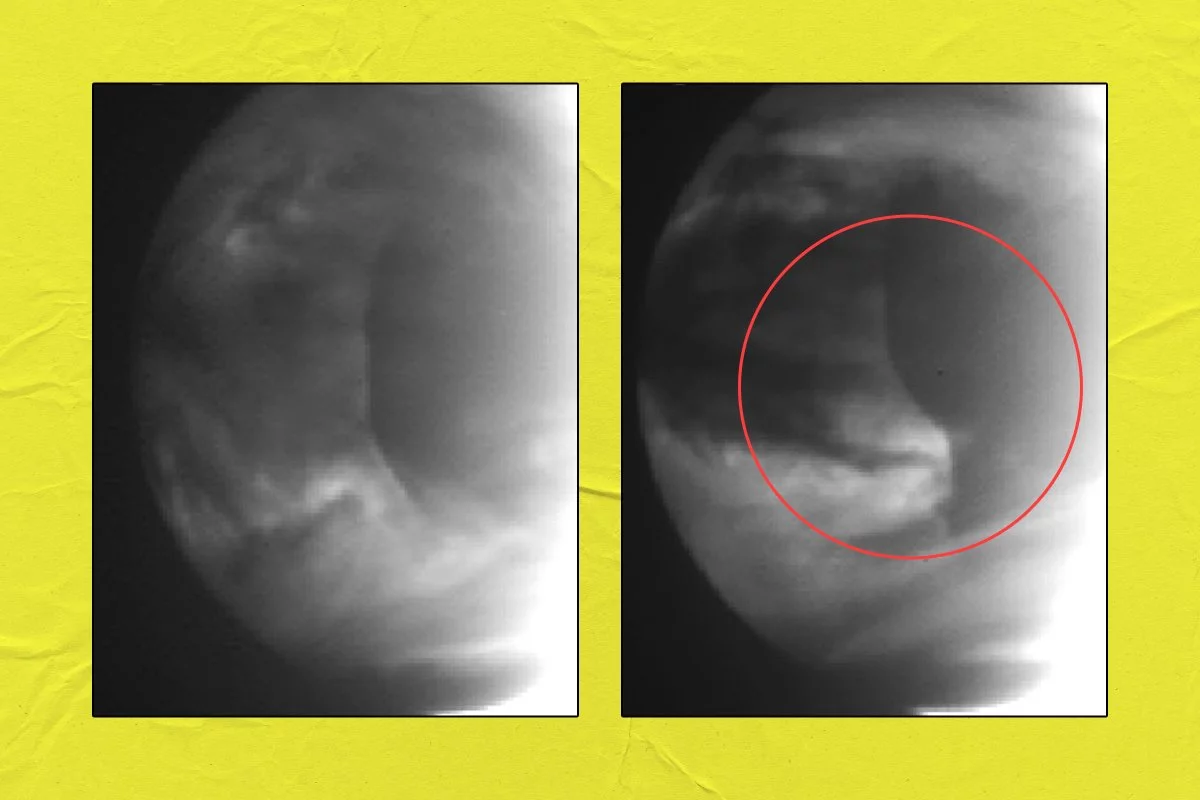
When JAXA’s Akatsuki orbiter returned images in 2016 of an immense, ~3,700-mile-long atmospheric wave spanning Venus’s cloud tops, the feature looked less like ordinary turbulence and more like a coherent, engineered structure—an arc-shaped front that seemed to defy expectations for a planet with no oceans and no familiar weather cycle. New analysis led by the University of Tokyo reframes that spectacle as something fluid dynamicists know well on Earth: a hydraulic jump, scaled up to planetary proportions.
On Earth, hydraulic jumps are the abrupt transitions you see when fast, shallow flow suddenly thickens—common in spillways, rivers, and even kitchen sinks. Translating that intuition to Venus is not a simple metaphor. The research indicates a destabilizing wave in the lower cloud layer can trigger a powerful vertical updraft, lofting sulfuric-acid vapor into higher altitudes and forming a slow-moving, massive cloud front. The key scientific advance is the explicit linkage of large-scale horizontal flow with vertical wave processes at a scale not previously observed in a planetary atmosphere.
For atmospheric science, the implication is direct: Venus is not merely “superrotating”; it is actively converting horizontal momentum into vertical structure through non-linear wave–flow interactions that standard models may underrepresent. For technology and business, the implication is broader: the planet is increasingly a testbed for extreme-regime fluid dynamics, where new retrieval methods, sensors, and AI-enabled reconstruction pipelines can be proven under conditions that stress today’s assumptions.
Superrotation meets vertical physics: a new constraint on Venus climate dynamics
Venus’s atmosphere is famous for superrotation—cloud-level winds that circle the planet roughly 60 times faster than the surface rotates. That speed turns the Venusian cloud deck into a natural laboratory for phenomena that, on Earth, are either too transient, too localized, or too difficult to isolate from confounding variables. The hydraulic-jump interpretation matters because it suggests the atmosphere can organize into stable, large-scale discontinuities—not just waves, but transitions that resemble “breaking” behavior familiar from fluids and internal waves.
Several scientific threads converge here:
- Non-linear wave breaking at scale: A hydraulic jump is a hallmark of a system crossing a threshold—where smooth flow becomes a sharp transition. On Venus, that threshold appears tied to lower-cloud wave instability and subsequent vertical transport.
- Coupling of layers: The finding emphasizes that Venus’s cloud layers are not independent bands; they can be dynamically coupled, with lower-layer disturbances shaping upper-layer morphology.
- A new handle on momentum transport: Superrotation requires mechanisms that move momentum efficiently. If hydraulic-jump-like events are common, they may represent a previously underappreciated pathway for redistributing energy and momentum vertically.
For modelers, this is not just a curiosity. It is a constraint: any Venus general circulation model aiming to reproduce observed cloud behavior must now account for planetary-scale transitions that combine horizontal flow with vertical updrafts and aerosol/condensate evolution. That, in turn, sharpens the value of Venus as an analogue for understanding how atmospheres behave when pushed toward extremes.
Remote sensing, inversion algorithms, and the rising role of AI in sparse-data atmospheres
Akatsuki’s contribution is also a story about instrumentation and analytics. The probe’s multi-band infrared and ultraviolet observations enabled cloud tracking and compositional inference across layers that are otherwise inaccessible. Yet the deeper lesson is methodological: planetary atmospheres are often measured with sparse, indirect signals, and the frontier is increasingly defined by how well teams can invert those signals into coherent 3D narratives.
This discovery reinforces several technology trends with direct spillover potential:
- Advanced atmospheric retrieval pipelines: Multi-spectral imaging paired with modern inversion approaches can extract structure from limited vantage points—an approach relevant to both planetary missions and Earth observation.
- AI-augmented reconstruction: Machine learning is becoming essential for integrating heterogeneous measurements—images, spectra, and derived wind fields—into consistent dynamical interpretations. The Venus case underscores why: the phenomena of interest are large, slow, and multi-layered, demanding models that can reconcile time evolution with incomplete sampling.
- Sensor miniaturization and mission economics: Demonstrated scientific returns from compact payloads strengthen the case for smaller, more frequent missions—including commercial or hybrid public–private architectures—where analytics becomes a differentiator as much as hardware.
Importantly, the direction of travel is bidirectional. Instruments and algorithms refined for Venus—such as aerosol-sensitive spectrometry concepts and advanced cloud-motion tracking—can be adapted for Earth applications including volcanic plume monitoring, stratospheric aerosol tracking, and pollution transport modeling. As climate and air-quality analytics become more operationalized, the value of robust inversion methods—tested against “hard mode” atmospheres like Venus—becomes easier to justify.
Strategic implications: Venus science as climate benchmark, industrial analog, and geopolitical signal
Venus remains Earth’s most sobering neighbor: a CO₂-dominated atmosphere, sulfuric-acid clouds, and an extreme greenhouse state. While Earth is not on a Venus trajectory in any simple sense, Venus provides a high-contrast benchmark for radiative–convective parameterizations and for understanding how atmospheres behave when feedbacks dominate. The hydraulic-jump result adds a new dimension: it highlights how vertical exchange processes can be organized by large-scale flow, shaping cloud structure and potentially influencing radiative balance.
From a business-and-technology vantage point, the cross-disciplinary relevance is unusually concrete:
- Aerospace engineering: Non-linear flow transitions and wave–boundary interactions resonate with challenges in high-speed inlet design and complex compressible flows.
- Oceanography and energy systems: The analogy to internal wave breaking and multi-phase flow dynamics connects to offshore engineering and even thermal management in advanced systems.
- Climate risk analytics: Better understanding of vertical coupling and transport processes can inform how Earth models treat stratosphere–troposphere exchange, with downstream relevance to ozone recovery assessments and debates around solar radiation management.
Geopolitically, the episode also underscores Japan’s growing prominence in deep-space planetary science. Akatsuki’s enduring scientific yield strengthens the argument that sustained, focused missions—paired with world-class analysis—can reshape leadership narratives traditionally dominated by the NASA–ESA axis. It also raises the strategic logic for multi-agency Venus architectures—orbiters, aerial platforms, and potentially landers—where shared standards, shared data rights, and interoperable analytics could define the next decade of Venus exploration.
The larger takeaway is that Venus is no longer just a cautionary tale; it is becoming a precision laboratory for extreme atmospheric physics, and the organizations that can fuse remote sensing, AI reconstruction, and fluid-dynamics insight will be best positioned to convert planetary discovery into terrestrial advantage.


 By
By
 By
By

 By
By
 By
By
 By
By
 By
By







