
A rare modern ship-sinking reframes the undersea domain—and revives an old benchmark
The reported March 4, 2023 engagement during Operation Epic Fury, in which a U.S. Navy submarine sank an Iranian warship, lands with unusual historical weight. If accurate as described, it marks the first hostile vessel destroyed by American undersea forces since August 1945, when USS *Torsk* recorded its last World War II kill. That long gap is not merely trivia; it underscores how submarine power often operates in the shadows—deterrence by presence, intelligence collection, and sea denial—rather than in publicly visible kinetic events.
Yet when a submarine does sink a surface combatant, the episode becomes a concentrated signal of capability: stealth, persistence, and the ability to impose sudden cost at sea. For defense planners, investors, and industrial stakeholders, the incident also sharpens a central reality of contemporary maritime competition: undersea warfare remains one of the most capital-intensive, technologically demanding, and strategically consequential arenas in national security.
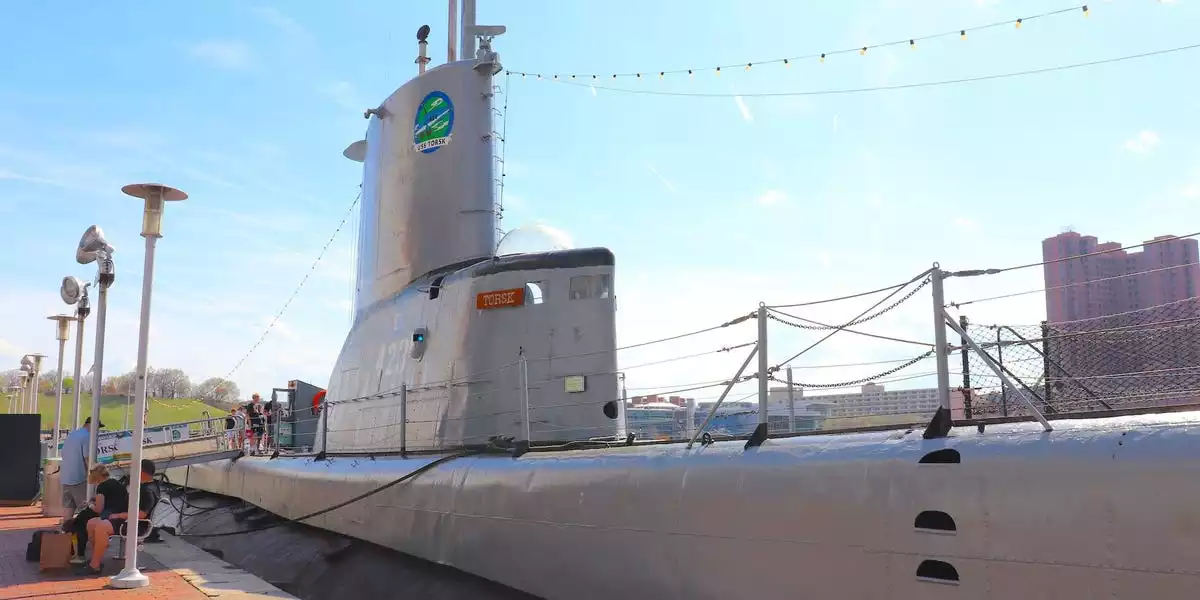
Against that backdrop, the museum ship USS *Torsk* in Baltimore—commissioned in 1944, modernized in the 1950s, decommissioned in 1968—takes on renewed relevance. Historic Ships in Baltimore has updated its interpretive narrative to connect *Torsk*’s systems and patrol history (including Cuban Missile Crisis-era operations) to today’s undersea contest. The result is more than heritage storytelling; it is a tangible bridge between the analog mechanics of mid-20th-century submarines and the digital, networked lethality of modern fleets.
From acoustic torpedoes to networked lethality: what *Torsk* still teaches engineers
Walking through *Torsk* is a form of technological deconstruction. The boat’s artifacts—torpedo rooms, control spaces, crew compartments—illustrate how enduring design principles persist even as sensors, compute, and weapons evolve.
Key through-lines stand out:
- Stealthy engagement as a constant
*Torsk*’s WWII-era passive-homing acoustic torpedoes represented a major leap: the ability to acquire and prosecute targets without the revealing “ping” of active sonar. Modern heavyweight torpedoes now incorporate digital seekers, advanced signal processing, and improved counter-countermeasures, but the strategic logic remains consistent: *detect first, strike without being found*.
- Launch architecture as a story of expanding mission sets
The museum’s “garbage disposal” ejector—an early method supporting rapid salvo tactics—captures the operational pressure to shoot, reload, and maneuver under threat. Today, that lineage extends into vertical launch systems (VLS), encapsulated missiles, and multi-role payload concepts that can include unmanned undersea vehicles (UUVs). The evolution is not simply about more firepower; it is about flexible payload delivery across strike, surveillance, and anti-submarine warfare.
- Modernization as a recurring survival strategy
*Torsk*’s post-war snorkel conversion is a reminder that platform relevance is often preserved through retrofit. Contemporary parallels include open-architecture combat systems, modular upgrades, and AI-driven diagnostics that compress upgrade cycles and reduce downtime. The strategic implication is clear: navies increasingly compete not only on new hulls, but on how quickly they can refresh sensors, software, and mission packages.
In an era where defense technology discourse can become abstract—dominated by acronyms, classified performance claims, and procurement timelines—*Torsk* offers a rare, physical clarity: constraints are real, trade-offs are unavoidable, and engineering decisions shape doctrine.
The human system inside the machine: habitability as a force multiplier
Submarines are not just weapons platforms; they are closed ecosystems where human performance determines operational success. *Torsk*’s preserved living conditions and morale infrastructure—famously including an ice cream machine and a comparatively capable galley—may read as quaint, but they point to a sophisticated truth: crew endurance is combat power.
Modern submarine design increasingly treats habitability as a strategic variable, not a luxury. The contemporary emphasis on:
- ergonomic workspaces and modular berthing,
- noise reduction and signature management,
- and layouts that support multi-month deployments,
reflects the same underlying calculus visible on *Torsk*: if a crew is exhausted, distracted, or degraded, the platform’s technical advantages erode. This is especially salient as undersea missions expand—tracking adversary submarines, protecting sea lines of communication, monitoring seabed infrastructure, and operating in contested littorals where decision cycles are compressed.
For technology leaders, this is also a human-machine interface story. The next competitive edge may come as much from decision-support tools, console design, and cognitive load management as from raw sensor range.
Capital, workforce, and narrative power: why a museum submarine matters to business and strategy
The eighty-year span between *Torsk*’s last wartime sinking and the reported Operation Epic Fury engagement highlights the sustained investment burden of undersea dominance. Submarines demand specialized shipyards, long-lead components, nuclear expertise (where applicable), and a workforce fluent in high-reliability manufacturing. As great power competition intensifies, budget trade-offs sharpen between:
- next-generation platforms (such as ballistic missile submarines and advanced attack boats),
- upgrading legacy fleets,
- and broader anti-access/area-denial capabilities.
This is where *Torsk*’s role as a museum becomes economically and strategically relevant. Heritage vessels can function as talent catalysts—a hands-on recruitment tool for STEM pathways and skilled trades—by making complex systems legible to students, apprentices, and mid-career technicians. The industrial base challenge is not theoretical; it is a pipeline problem spanning welders, electricians, systems engineers, software integrators, and maintainers.
There is also a modern business opportunity embedded in the interpretive update itself: digital-physical fusion. Augmented reality overlays, digital twins, and VR-based maintenance scenarios could turn museum platforms into low-cost test environments for training and human-factors research—an attractive arena for partnerships among museums, defense primes, and simulation software firms. Many submarine-derived innovations—acoustics, autonomy, energy storage, low-power computing—also have clear dual-use pathways into commercial markets such as offshore energy, seabed mapping, and undersea cable monitoring.
Finally, the symbolic linkage between *Torsk*’s WWII legacy and a modern undersea engagement functions as geopolitical signaling. Public awareness of a ship-sinking—especially framed as the first since 1945—reinforces perceptions of U.S. undersea reach and shapes adversary risk calculations. In an age where deterrence is partly psychological and narrative-driven, the continuity story matters: it suggests not only capability, but institutional persistence—a navy and an industrial ecosystem that keep iterating, upgrading, and preparing for the next contested patrol.
The enduring lesson from *Torsk* is not nostalgia; it is that undersea advantage is built over decades, paid for in advance, and proven in moments that arrive without warning.

 By
By
 By
By

 By
By
 By
By

 By
By