

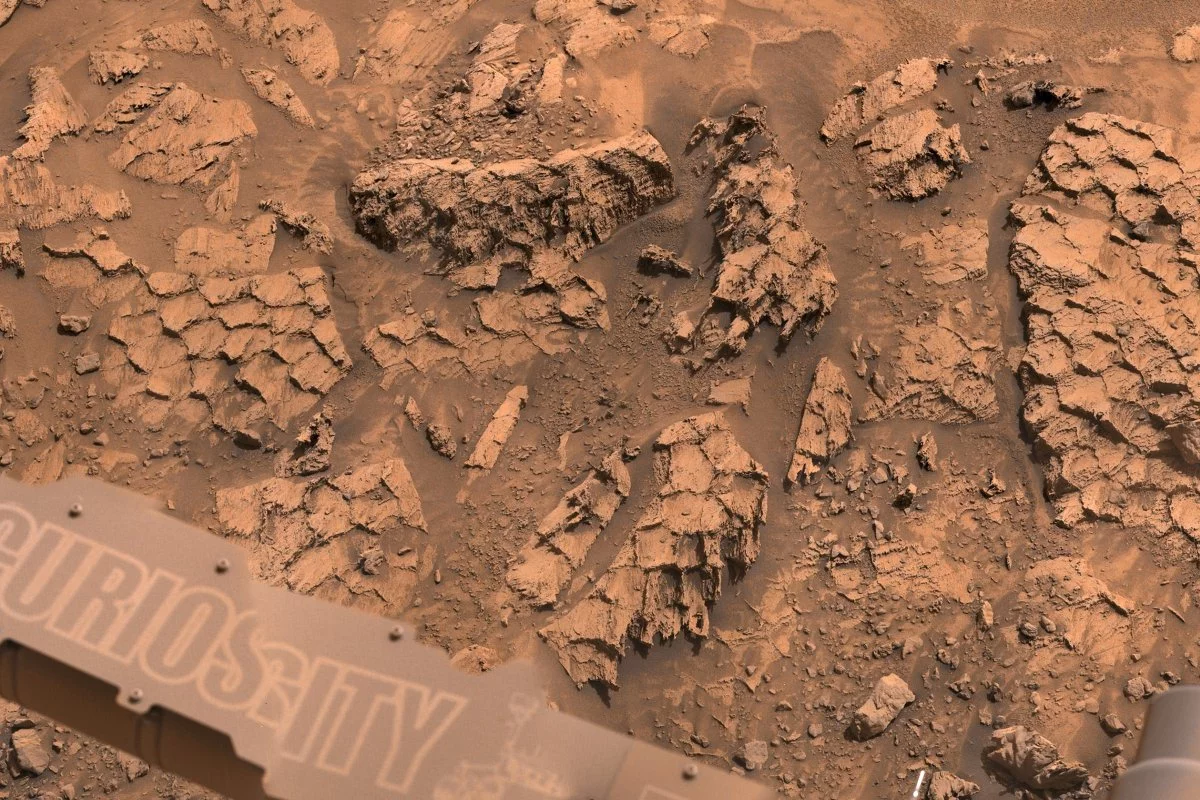

A honeycomb on the Martian trail—and a sharper picture of early Mars
NASA’s Curiosity rover has returned a new class of visual evidence from the route toward Antofagasta crater: an expansive field of polygonal, honeycomb-like rock textures that appear with a regularity and density not previously seen in Curiosity’s Mastcam mosaics. Polygonal patterns themselves are not new to Mars science, but the scale and uniformity of these “scale-like” formations elevate them from a curiosity to a potentially diagnostic signature of ancient environmental cycles.
The leading hypothesis—consistent with long-standing sedimentary geology on Earth—is that these polygons represent ancient mud cracks, formed when wet sediments repeatedly wetted, dried, shrank, and fractured. If that interpretation holds, it strengthens the case that parts of Mars experienced cyclical hydrology roughly 3.8–3.6 billion years ago, aligning with broader climatological reconstructions, including a 2022 Nature analysis pointing to a more dynamic early Martian climate than the planet’s current cold aridity suggests.
This matters not only because it adds texture—literally—to the story of water on Mars, but because it narrows the question from “Was there water?” to “What kind of water cycle operated here, for how long, and under what chemistry?” Those are the parameters that begin to define habitability in operational terms.
From patterns to proof: how Curiosity’s instruments turn images into paleoenvironmental evidence
A striking image is only the opening bid in planetary science. The real work is translating morphology into mechanism, and Curiosity’s value lies in its ability to pair high-resolution imaging with in-situ geochemical interrogation. As the rover approaches and studies the Antofagasta region, the scientific pathway is likely to hinge on triangulating multiple lines of evidence:
- Morphology and context (Mastcam imaging): Are the polygons confined to a specific layer, do they cross-cut bedding, and do they occur alongside other sedimentary indicators such as laminations or nodules?
- Elemental chemistry (APXS): Do the rocks show enrichment patterns consistent with evaporation, alteration, or cementation that would support wet–dry cycling?
- Remote micro-chemistry (ChemCam): Can laser-induced breakdown spectroscopy detect compositional gradients that map onto crack boundaries or infill material?
This “sensor fusion” approach is increasingly central to modern exploration: images identify anomalies, chemistry tests hypotheses, and context determines whether a feature is local or systemic. The broader scientific resonance is amplified by the parallel storyline unfolding at Jezero Crater, where NASA’s Perseverance rover has reported “leopard-spot” textures that some researchers consider potential biosignature candidates. While the two rovers are exploring different terrains and time slices, the combined narrative is converging on a more nuanced early Mars—one where water activity may have been episodic, spatially varied, and chemically diverse, rather than a single global “wet era.”
Rover autonomy, edge analytics, and RTG durability: the technology story behind the science
Curiosity’s discovery is also a reminder that Mars exploration is a proving ground for autonomous robotics and resilient computing. The rover’s ability to identify, prioritize, and document unusual geology reflects steady progress in onboard decision support—capabilities that translate directly into terrestrial industries where conditions are harsh, communications are intermittent, and human oversight is expensive.
Key technology dimensions with clear Earth-side analogs include:
- Autonomous navigation and machine vision: The same hazard avoidance and targeting logic that helps Curiosity traverse unpredictable terrain is relevant to mining robotics, pipeline inspection, and precision agriculture, where systems must interpret complex surfaces and act safely without continuous human control.
- Sparse-data operations and edge computing: Mars imposes extreme latency and bandwidth constraints. Techniques for compressing, prioritizing, and interpreting data “at the edge” map cleanly onto industrial IoT, smart manufacturing, and remote infrastructure monitoring.
- Long-duration power and ruggedization: Curiosity’s decade-plus lifespan underscores the strategic value of radioisotope thermoelectric generators (RTGs) and radiation-tolerant design. That durability is feeding renewed interest in compact, maintenance-light power systems for deep-sea platforms, remote outposts, and other long-endurance uncrewed systems.
For business and technology leaders, the point is not that a Mars rover is a product template, but that its constraints force innovations in reliability engineering, autonomy, and data triage—the same pillars now shaping competitive advantage in critical terrestrial automation markets.
Markets, policy, and planetary competition: why Martian mud cracks ripple into the real economy
High-visibility milestones like this one tend to expand the gravitational pull of the space economy. Curiosity’s findings arrive at a moment when space-tech supply chains are deepening and diversifying—driving demand for precision optics, radiation-hardened electronics, advanced materials, and miniaturized analytical instruments. That demand is increasingly met by a mix of established aerospace primes and specialized start-ups, widening the industrial base that supports both civil and commercial missions.
At the same time, the economics of planetary data are evolving. As private firms look for analog applications—ranging from resource prospecting to carbon-capture site verification—the perceived value of Mars-derived geodata rises, especially when paired with analysis tools that can be adapted to Earth observation workflows. The result is a nascent but credible pathway toward a data-services economy adjacent to the satellite imagery market, where the differentiator is not just resolution, but interpretive models built under extreme constraints.
The strategic layer is equally pronounced:
- Geopolitical signaling: Scientific breakthroughs function as soft-power assets, reinforcing U.S. leadership as China, ESA, and others accelerate Mars programs.
- Dual-use technology attention: Autonomy, rugged communications, and advanced sensing are inherently cross-domain, drawing interest from defense and security stakeholders.
- Resource governance pressure: As hydrated minerals and volatile-rich strata become better characterized, debates over off-world resource rights intensify—intersecting with frameworks such as the Artemis Accords and emerging national legislation.
Curiosity’s honeycomb terrain is, on its face, a geological puzzle. Yet it also acts as a forcing function—tightening scientific hypotheses about early Mars, validating high-end autonomy under real constraints, and sharpening the policy and commercial questions that will define the next phase of planetary exploration. The polygons may be ancient cracks in drying mud, but the implications are anything but brittle: they point toward a Mars that was once more dynamic, and a space economy that is becoming more consequential by the mission.

 By
By

 By
By

 By
By

 By
By
 By
By







