


Virality as a proving ground for humanoid robots in public life
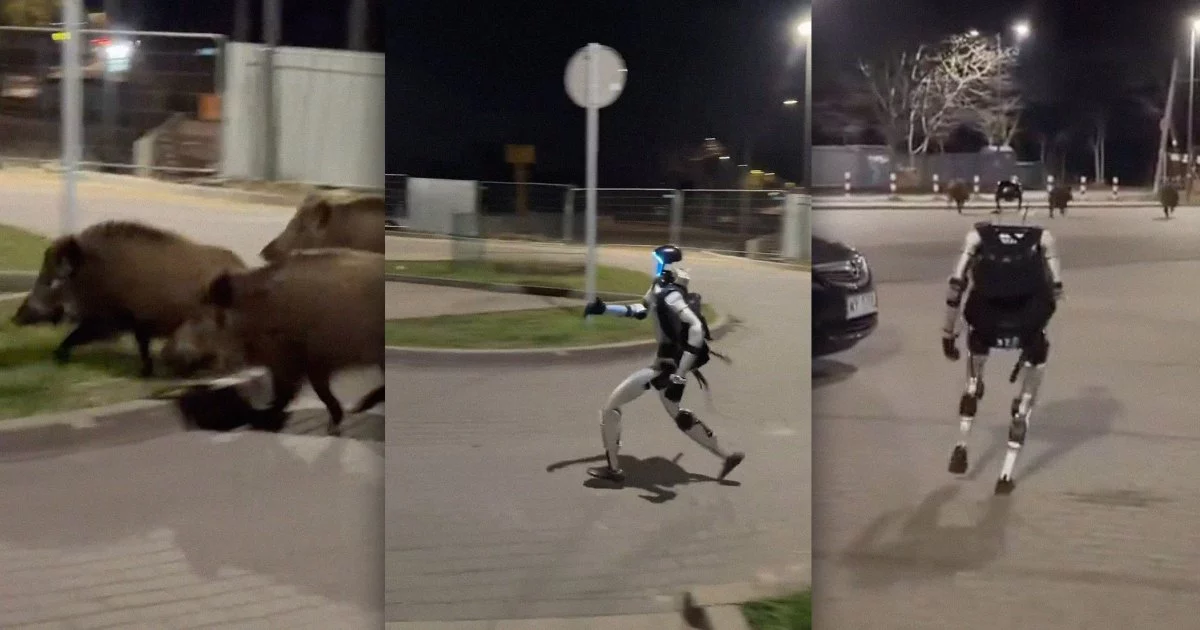
A customized Unitree G1 humanoid robot—nicknamed “Edward Warchocki”—has become an unlikely symbol of how quickly robotics can move from lab curiosity to cultural artifact. The footage that propelled Edward into the spotlight—appearing to “herd” wild boars out of a Warsaw parking lot—reads less like a field test in wildlife management and more like a carefully staged demonstration of presence: bipedal locomotion, stable posture, and a machine that can occupy human spaces without immediately looking out of place.
That distinction matters. The public often interprets such clips as evidence that humanoids are ready for broad deployment. In reality, the viral moment is doing different work: it’s normalizing humanoid robots as social actors—entities that can be photographed, joked about, invited onstage, and circulated as content. Edward’s subsequent appearances—reportedly including the Polish parliament and entertainment venues—underscore that the early “killer app” for many humanoids may be attention, not labor.
Across the Atlantic, another Unitree G1—“Jake the Rizzbot”—illustrates how quickly a robot can be turned into a character with a storyline. The cowboy hat, the coming-out narrative, and the social-media-ready persona are not incidental flourishes; they are the product. In a crowded attention economy, a humanoid robot is no longer just hardware—it is a platform for narrative, and narrative is monetizable.
What today’s Unitree G1 moments reveal about capability—and constraint
The spectacle is real, but so are the technical boundaries. Platforms like the Unitree G1 reflect genuine progress in balance control, gait stability, and modular integration. Yet the gap between a choreographed public appearance and a dependable worker in messy environments remains substantial.
Key constraints shaping near-term deployments include:
- Battery and duty cycle limitations: Many bipedal systems still operate on time horizons measured in hours, not shifts—restricting sustained field use.
- Payload and manipulation trade-offs: Humanoids can move like humans, but carrying, lifting, and manipulating objects reliably is still hard, especially under variable conditions.
- Terrain sensitivity and risk management: Uneven ground, weather, crowds, and unexpected obstacles raise safety and reliability challenges that controlled demos avoid.
- Autonomy remains selective: Much of what looks “intelligent” in viral clips can be achieved with pre-programmed behaviors, constrained perception, and remote-control overrides.
This is not a dismissal of progress; it’s a clearer reading of where value is currently easiest to capture. Entertainment and publicity are unusually forgiving environments: if a robot pauses, wobbles, or needs intervention, it can be reframed as charm rather than failure. Industrial settings are less tolerant. A warehouse, a construction site, or a public-safety scenario demands repeatability, uptime, and predictable failure modes—areas where humanoids are still maturing.
At the same time, these public deployments generate something highly valuable: data. Every appearance is an opportunity to collect telemetry, refine perception models, and stress-test human–robot interaction patterns. In that sense, the “stunt economy” can function as a low-stakes pipeline feeding higher-stakes autonomy.
The emerging business model: robotic personas as marketing engines and IP assets
Edward and Jake point to a strategic shift: humanoid robots are increasingly being positioned as brand mascots, influencers, and content creators—a bridge between physical robotics and digital marketing ecosystems. This is not merely a gimmick; it can be a rational go-to-market strategy for companies facing long R&D cycles and uncertain enterprise adoption timelines.
Several economic dynamics are converging:
- Earned media at scale: A viral robot appearance can deliver global reach at a fraction of traditional advertising costs, boosting brand equity for manufacturers and integrators.
- Funding and valuation signaling: Visibility can translate into investor interest, especially in a sector where public imagination often precedes practical deployment.
- Hybrid revenue streams: Beyond hardware sales, humanoids can generate income through appearance fees, sponsorships, licensing, merchandising, and streamed events.
- Digital twin potential: A robot persona can extend into software—chat experiences, social accounts, and branded content—creating a multi-surface “character” that persists even when the hardware is offline.
This mirrors influencer marketing, but with a twist: the “talent” is owned, programmable, and scalable. That raises new questions about authenticity, disclosure, and manipulation—particularly when a humanoid’s persona is designed to evoke empathy or social identification.
The job-displacement discourse also looks different through this lens. Edward and Jake are not replacing workers; they are competing for attention. Yet the cultural impact is still consequential: these robots shape expectations about what automation is and how quickly it will arrive, influencing consumer sentiment, labor politics, and corporate automation strategies.
Liability, regulation, and the next phase of human–machine interaction
The lawsuit tied to Jake—seeking $1 million in damages after an alleged assault by a public figure—highlights a regulatory frontier that is arriving faster than many policymakers anticipated. The central issue is not whether robots have “rights” in a philosophical sense, but how legal systems will treat incidents involving humanoids as they become more common in public spaces.
Pressure points that regulators and enterprises will need to address include:
- Liability allocation: Who is responsible when a humanoid is damaged—or causes damage—during a public activation: the owner, operator, manufacturer, venue, or software provider?
- Safety standards for public interaction: Clear requirements for force limits, fall behavior, emergency stop protocols, and operator supervision.
- Privacy and data governance: Humanoids equipped with cameras and sensors can collect sensitive bystander data, raising compliance questions in jurisdictions with strict privacy regimes.
- Persona and IP protection: As robotic identities become monetized, disputes over likeness, branding, and unauthorized use will become more frequent.
Meanwhile, macroeconomic drivers—aging workforces, persistent labor shortages, and renewed automation investment—ensure that humanoids will not remain purely theatrical. The likely trajectory is a two-track evolution: spectacle-funded development alongside targeted pilots in logistics, inspection, and light service roles where the ROI case can be proven.
Edward and Jake may look like internet novelties, but they are also early signals of a market where humanoid robotics, entertainment economics, and regulatory policy are becoming inseparable. The companies that thrive will be those that can convert attention into capability—building trust, safety, and real utility without losing the cultural momentum that made the machines visible in the first place.


 By
By
 By
By
 By
By

 By
By
 By
By







