

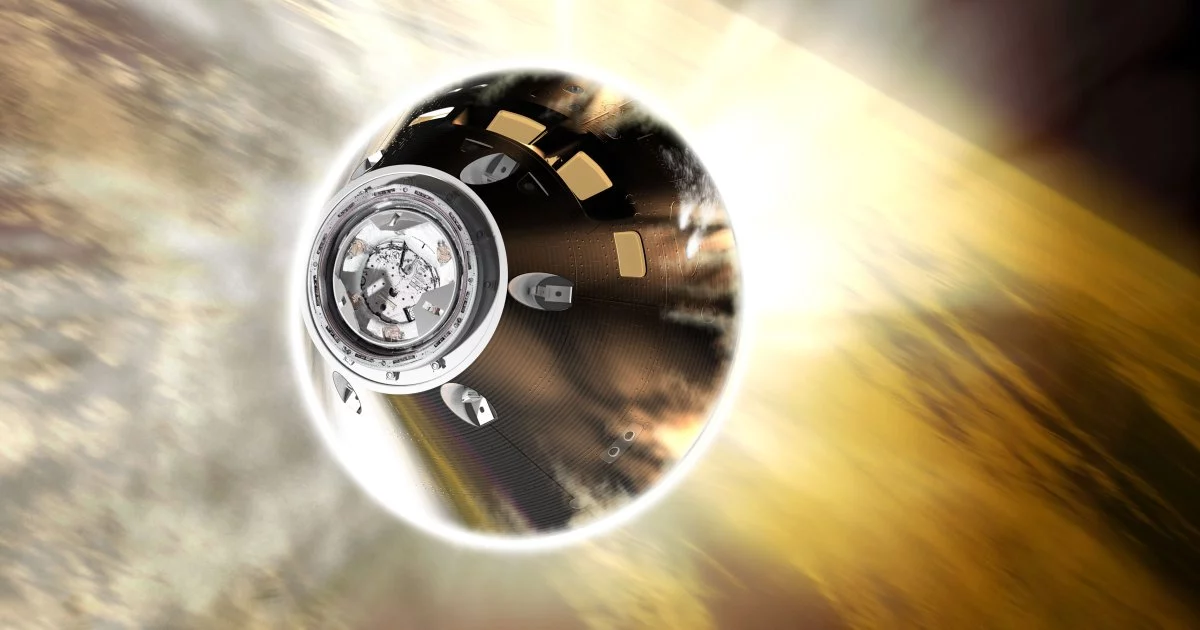

A high-stakes homecoming: Artemis 2’s reentry becomes the program’s defining proof point
NASA’s Artemis 2 has now rounded the Moon’s far side and committed to the most unforgiving phase of any deep-space mission: Earth return and atmospheric reentry. The Orion crew module is expected to separate from its service module and hit the upper atmosphere at more than 23,000 mph, where the physics are brutally simple—energy must be shed, heat must be managed, and margins must hold. Peak heating will drive the heat shield toward ~5,000 °F, a regime where small material uncertainties can become mission-level risks.
This is why the mission’s reentry is being watched not only as a technical milestone, but as a referendum on NASA’s readiness to scale Artemis from demonstration to routine. The agency’s leadership—Administrator Jared Isaacman and Associate Administrator Amit Kshatriya—has emphasized extensive testing, analysis, and risk mitigation. Yet the public debate has been sharpened by a 2024 NASA Office of Inspector General (OIG) report documenting cracks and ablative material loss in more than 100 locations on Orion’s heat shield after Artemis 1, and by warnings from veteran voices including former astronaut Charlie Camarda.
For Artemis, the optics matter almost as much as the engineering. A clean reentry would reinforce confidence in NASA’s decision-making and sustain political and commercial momentum. A visible anomaly—especially one tied to a previously documented concern—could reshape timelines, budgets, and the credibility of the broader lunar architecture.
The heat shield question: materials science, manufacturing discipline, and the “skip reentry” bet
Orion’s heat shield is a mission-critical char-phenolic ablative system—designed to sacrifice material in a controlled way to carry heat away. Ablation is not failure; it is the mechanism. The controversy stems from whether Artemis 1’s post-flight condition reflects expected behavior with acceptable variability, or whether it signals manufacturing inconsistency, quality-control gaps, or undetected micro-fractures that could propagate under peak loads.
NASA’s chosen mitigation is a revised “skip reentry” profile. Rather than a single continuous plunge, Orion briefly “skips” off the upper atmosphere before reentering more deeply, reducing peak thermal load and spreading heating over time. The trade is clear:
- Benefits
– Lower peak heating and potentially improved thermal margins
– Reduced risk of localized overheating that could stress vulnerable regions
- Costs and complexities
– Higher demands on precision guidance, navigation, and control
– Increased trajectory complexity and operational coupling between software, sensors, and aerodynamics
– Potential impacts to propellant and mission planning flexibility
From a systems engineering standpoint, this is not simply a heat-shield story. It is a systems-of-systems test where thermal protection, flight software, navigation, communications, and recovery operations must interoperate under extreme conditions. In high-reliability domains—commercial aviation, nuclear power, medical devices—controversies like this often converge on the same root themes: design-for-inspectability, traceable provenance, and rigorous process control that makes defects less likely and easier to detect early.
A notable opportunity sits at the intersection of aerospace and modern industrial analytics: digital twins and machine-learning-driven anomaly detection. These tools—now common in advanced automotive and high-end manufacturing—could be leveraged more aggressively to model crack initiation and propagation, correlate flight telemetry with post-flight inspection outcomes, and improve pre-flight certification confidence. The Artemis heat-shield dataset is not just a troubleshooting archive; it could become a benchmark for predictive assurance across the space sector.
Business and budget exposure: why a thermal protection issue can move markets and policy
Artemis is projected to cost well over $90 billion through the mid-2030s, and reentry performance has outsized leverage over that financial trajectory. If Artemis 2 validates NASA’s mitigation approach, it strengthens the case for keeping the program’s cadence and funding intact. If it does not, the downstream effects could be immediate:
- Programmatic impact
– Additional testing, redesign cycles, and schedule slips that can cascade into multi-billion-dollar overruns
– Reprioritization pressure as Congress weighs lunar ambitions against other national needs
- Contractor and supply-chain impact
– Heightened scrutiny for major partners such as Lockheed Martin, Northrop Grumman, and Aerojet Rocketdyne
– Reputation and recompete risk in a procurement environment increasingly sensitive to performance and transparency
- Insurance and capital impact
– Insurers and reinsurers recalibrating premiums for crewed missions
– Potential chilling effects on venture capital for lunar-adjacent startups if perceived systemic risk rises
The heat-shield debate also exposes a structural tension in modern aerospace: NASA’s reliance on public-private partnerships accelerates innovation and distributes capability, but it can complicate accountability when anomalies emerge across organizational boundaries. A successful Artemis 2 reentry could become a template for how agencies manage risk within fast-moving contractor ecosystems—potentially even inspiring “regulatory sandbox” approaches that balance speed with safety guardrails. A failure, by contrast, could invite tighter oversight, more conservative certification regimes, and procurement shifts toward modularity and inspectable manufacturing.
Strategic signaling from the lunar corridor: credibility, competition, and the next industrial stack
Artemis is not only a science and exploration program; it is a strategic signal in an era of renewed great power competition. A safe, repeatable U.S. deep-space capability reinforces leadership and strengthens alliances built around shared lunar infrastructure. A high-profile setback would not end Artemis, but it could narrow political tolerance for risk and embolden rival narratives from competing space powers.
Beyond geopolitics, the mission is a bellwether for the emerging lunar economy stack—landers, surface logistics, in-situ resource utilization, and eventually tourism. Those markets depend on one foundational commodity: confidence. Confidence in engineering margins, in supply-chain integrity for high-temperature materials, and in the institutional ability to learn quickly without normalizing deviance.
Artemis 2’s reentry will therefore be read on multiple layers at once: as a technical validation of a redesigned flight profile, as a governance test of NASA’s risk culture, and as a market signal for the durability of the broader deep-space investment thesis. When Orion hits the atmosphere at lunar-return velocity, it won’t just be bringing a crew module home—it will be carrying the credibility of an entire exploration architecture through the plasma.

 By
By


 By
By
 By
By

 By
By
 By
By







