
A record-setting round that reframes OpenAI as infrastructure, not just a lab
OpenAI’s reported $110 billion funding round—backed by Amazon, Nvidia, and SoftBank at a $730 billion pre-money valuation—lands as more than a headline-grabbing capital event. It signals a market-wide reassessment of what “frontier AI” now represents: not an experimental capability showcased in demos, but a durable layer of digital infrastructure expected to underpin everyday workflows across industries.
The speed of the valuation step-up—from roughly $500 billion just months earlier—also reflects a broader investor thesis: that AI is transitioning from discretionary innovation spend to structural enterprise necessity, even amid tighter macro conditions. In that framing, OpenAI is being valued less like a single product company and more like a platform with compounding network effects—where distribution, compute access, and ecosystem partnerships can be as decisive as model quality.
Notably, OpenAI is also reaffirming its partnership with Microsoft while widening its capital and compute relationships. That dual posture—continuity with a key incumbent partner, paired with diversification—suggests a company preparing for a longer game: scaling globally, navigating regulation, and keeping optionality for an eventual IPO pathway without being forced into it prematurely.
Compute, inference, and the industrialization of model deployment
The composition of the round is as revealing as its size. This is not simply “money for research.” It is capital explicitly tied to production-grade AI, where the binding constraint is increasingly inference throughput—the ability to serve real-time responses reliably, securely, and cost-effectively at massive scale.
Several technical and operational implications stand out:
- Inference becomes the new battleground: Nvidia’s participation, paired with next-generation inference compute agreements, points to a strategic focus on serving live workloads—customer support, financial analysis, clinical documentation, e-commerce personalization—where latency and reliability are non-negotiable.
- Hardware–software co-evolution accelerates: Nvidia’s role extends beyond supplying GPUs. When a frontier model provider becomes a design partner, silicon roadmaps can be tuned to real-world workload profiles, creating a feedback loop that speeds both model iteration and chip optimization.
- From general models to tailored ecosystems: Amazon’s commitment—reportedly $50 billion, including a $35 billion milestone-based tranche—is tied to joint development of bespoke models. This aligns with a clear industry direction: enterprises increasingly want domain-specific architectures with embedded compliance controls, proprietary data integration, and application-level tuning rather than one-size-fits-all models.
This is the industrialization phase of AI: the shift from “can it work?” to “can it run everywhere, all the time, at predictable cost?” The winners will be those who can deliver not only intelligence, but service-level guarantees, governance tooling, and integration patterns that fit regulated and mission-critical environments.
Why the deal structure matters: incentives, leverage, and concentration risk
The round’s structure underscores a more disciplined era of AI financing—one where strategic investors seek measurable outcomes, not just exposure.
Key economic and strategic dynamics include:
- SoftBank’s $30 billion outright commitment reads as a high-conviction bet on AI as a long-duration growth engine. After a period marked by portfolio volatility, the move signals renewed appetite for scale positions in category-defining platforms.
- Amazon’s milestone-based tranche introduces performance accountability. Conditional capital can align incentives around deliverables—compute credits, product integrations, revenue milestones, or deployment targets—while shifting some risk back onto the company being funded.
- Multi-hyperscaler hedging strengthens OpenAI’s negotiating position: By bringing Amazon and Nvidia into the cap table while maintaining Microsoft ties, OpenAI reduces single-partner dependency and improves resilience against supply constraints, pricing pressure, or strategic misalignment. This “multi-hyperscaler” posture may become a template for any frontier AI leader seeking to avoid vendor lock-in.
At the same time, the round intensifies a central concern for the broader market: concentration. When the most capable model developers are funded and supplied by a small set of hyperscalers and chip leaders, barriers to entry rise sharply. Startups and mid-tier challengers face a steeper climb across:
- access to frontier-grade compute
- top-tier research and systems talent
- distribution channels into enterprise procurement
- regulatory and security compliance overhead
The likely outcome is not a flat, open playing field, but a landscape shaped by alliances, consolidation, and platform ecosystems—with a handful of firms setting de facto standards for performance, safety practices, and pricing models.
The next phase: regulation, energy realities, and the IPO question
As OpenAI and its backers push frontier AI deeper into daily business operations, the external constraints become as important as the internal roadmap.
Regulatory scrutiny is poised to intensify across multiple fronts:
- EU AI Act compliance and cross-border governance requirements
- emerging US guidelines and sector-specific rules (healthcare, finance, employment)
- national security reviews tied to dual-use capabilities and advanced compute supply chains
- data localization and auditability expectations for enterprise deployments
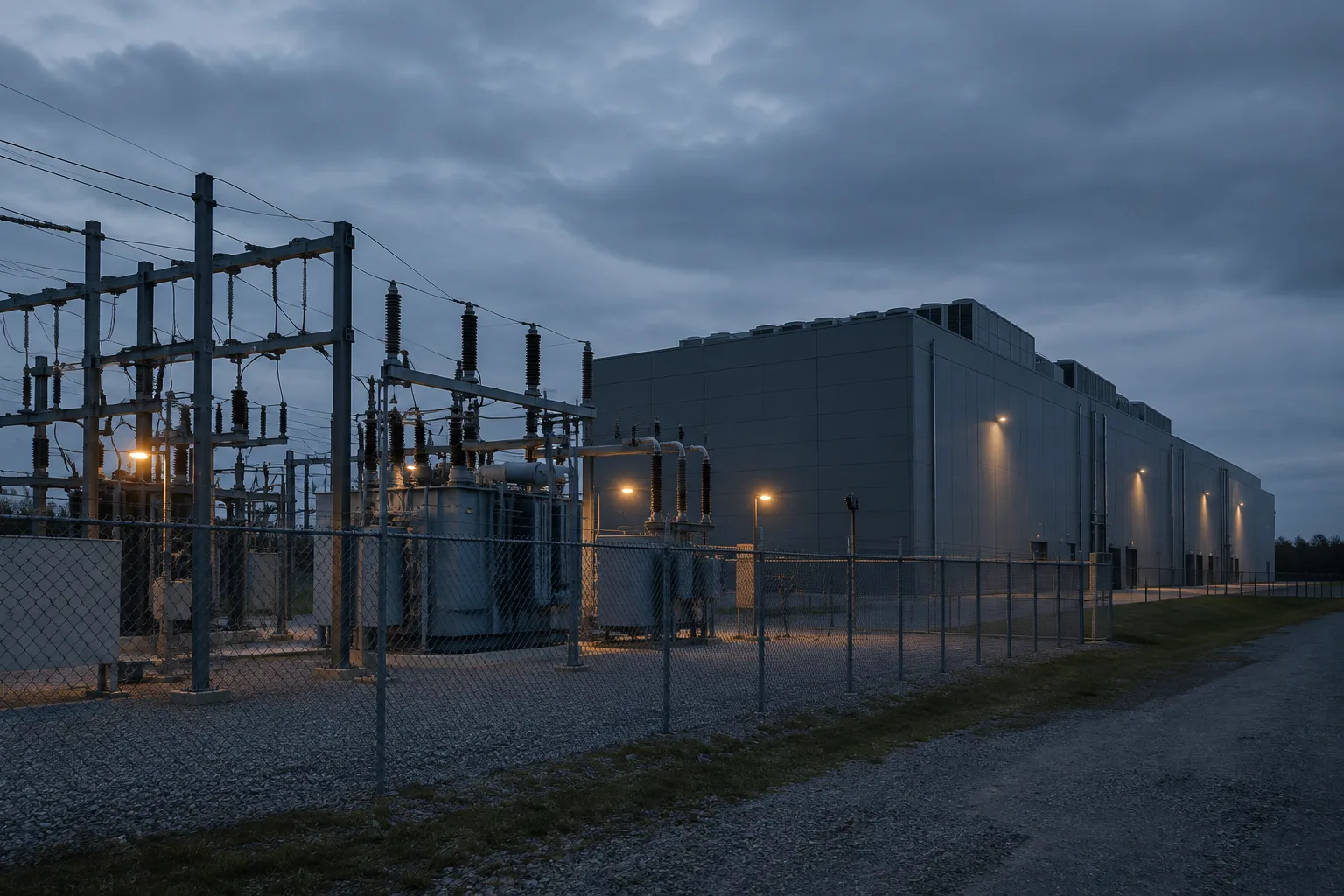
Meanwhile, the infrastructure implications are unavoidable. Scaling inference at global demand levels drives an AI data center build-out cycle, with knock-on effects in power procurement, grid capacity, liquid cooling adoption, and green energy sourcing. Competitive advantage will increasingly hinge on who can secure reliable energy and deploy efficient inference stacks—not just who has the best benchmark scores.
Finally, OpenAI’s openness to an eventual IPO keeps capital markets on notice. A credible sequence of product launches, enterprise penetration, and revenue milestones could set up a landmark public offering that resets valuation benchmarks for AI companies—and pressures peers to demonstrate not only innovation, but repeatable unit economics.
This round crystallizes a defining shift in the AI economy: frontier capability is being financed and engineered as a long-term utility layer, where compute access, hyperscaler partnerships, and deployment discipline will determine who shapes the next decade of business software and digital services.

 By
By


 By
By
 By
By
 By
By
 By
By
 By
By