
A strategic pivot for U.S. manufacturing: from mega-plants to software-defined microfactories
Edward Mehr, founder of Machina Labs, is making a pointed argument that lands squarely in today’s reshoring and industrial-policy debate: the United States should stop trying to mirror China’s centralized, scale-dominant factory model and instead build an advantage around distributed, flexible manufacturing. The distinction is more than rhetorical. It reframes competitiveness away from labor arbitrage and sheer throughput, and toward adaptability, resilience, and rapid reconfiguration—attributes increasingly prized in defense, aerospace, and advanced automotive supply chains.
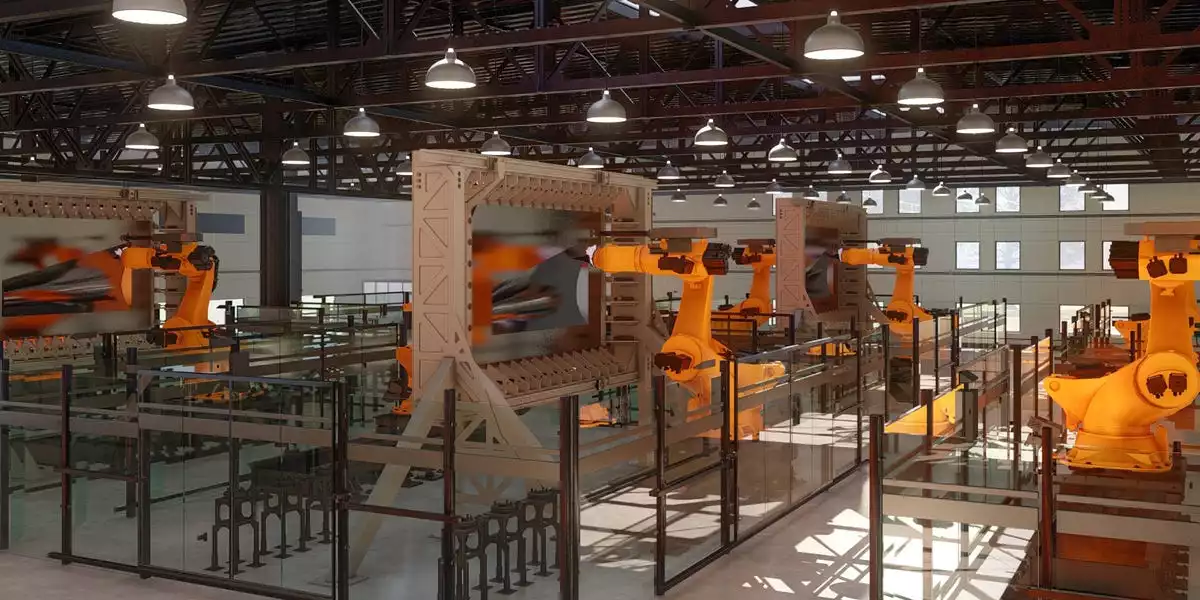
In practical terms, the “distributed microfactory” thesis suggests a network of smaller, digitally orchestrated production nodes—closer to demand, less exposed to single-point failures, and capable of switching between products without the long downtime that defines traditional retooling. This is where Machina Labs positions itself: not as another automation vendor selling fixed-purpose robot cells, but as a platform for portable, task-flexible robotics designed to produce complex metal structures with minimal changeover friction.
The strategic subtext is clear for executives and policymakers: if China’s advantage is scale and centralization, the U.S. counterweight may be modularity plus software, built into manufacturing from day one rather than bolted on as incremental “Industry 4.0” upgrades.
Why robotics adoption still stalls—and what a “ChatGPT moment” could change
Despite years of hype, robotics penetration across broad swaths of U.S. manufacturing remains uneven. Mehr’s prediction of a robotics breakthrough “on the scale of ChatGPT” within five years is notable not because it is guaranteed, but because it highlights the missing ingredient in industrial automation: ease of deployment at acceptable risk.
Today’s adoption barriers are less about whether robots can move precisely—and more about whether they can be deployed without:
- Lengthy integration cycles that require specialized engineering teams
- High capital expenditure (CAPEX) tied to custom facilities and bespoke tooling
- Uncertain near-term ROI, especially for high-mix, low-volume production
- Operational fragility, where small product changes trigger expensive revalidation
Even major players experimenting aggressively—Tesla and Amazon among them—illustrate the paradox: the firms most capable of absorbing early-stage complexity are not necessarily representative of the broader industrial base. For mid-tier suppliers, the requirement for immediate, auditable ROI can freeze decision-making, particularly in a higher-rate environment where capital is scrutinized and payback windows compress.
A “killer app” for robotics, if it arrives, is likely to be a convergence of capabilities rather than a single invention:
- Advanced perception robust enough for real-world variability
- Low-code/no-code robot training, reducing reliance on scarce integrators
- AI-driven path planning and adaptive control, improving first-time-right execution
- Digital twins and integrated analytics, enabling faster validation and continuous improvement
If that inflection point materializes, early pilots won’t just deliver incremental productivity—they will shape standards, data pipelines, and operating models that become difficult for late adopters to replicate.
Machina Labs’ scaling bet: portable robots, retool-free changeovers, and defense-grade demand signals
Machina Labs’ recent $124 million Series C—led by Lockheed Martin Ventures and Toyota Ventures—is best read as a strategic signal as much as a financing event. The capital will fund a 200,000-square-foot facility housing 50 robots, scaling annual output from hundreds to thousands of metal structures, with production largely supported by long-term offtake agreements from Lockheed Martin.
That structure matters. In industrial robotics, demand certainty is often the difference between a promising pilot and a scalable business. Offtake-backed expansion reduces the classic “valley of death” risk where automation platforms struggle to bridge from prototype capability to repeatable, bankable production.
Machina’s core value proposition—portability plus rapid task switching—targets two pain points that routinely derail automation programs:
- Fixed-cost rigidity: traditional automation assumes stable volumes and stable designs
- Retooling downtime: changeovers can erase the productivity gains robots promise
By emphasizing “plug-and-produce” deployment and retool-free transitions, Machina aligns with the broader shift toward agile, software-defined manufacturing, where production capacity behaves more like a configurable service than a monolithic asset.
For the U.S. defense-industrial base, the implications extend beyond efficiency. Distributed manufacturing capacity can support sovereign production, reduce exposure to geopolitical chokepoints, and improve continuity under disruption—an increasingly central theme in national security procurement and aerospace supply assurance.
Labor, resilience, and the new political economy of automation
Automation anxiety remains a persistent undercurrent in U.S. manufacturing policy, but Machina Labs is advancing a different narrative: a stable workforce of roughly 150 employees operating in higher-skill, robot-collaborative roles, with internal surveys indicating elevated engagement. While such claims should be interpreted cautiously and validated over time, the direction is consistent with historical transitions such as CNC adoption—where work often shifts from manual repetition to setup, supervision, quality control, and process optimization.
For business leaders, the labor question is not whether robots replace jobs in the abstract, but whether companies can build credible pathways for:
- Upskilling into robotics operation, maintenance, and programming
- Hybrid roles that blend production knowledge with data and software interfaces
- Retention and engagement, particularly in tight regional labor markets
At the macro level, distributed microfactories also intersect with sustainability and cost structure. Localized production can reduce logistics emissions and inventory buffers, while real-time process control can improve material utilization—benefits that increasingly matter in ESG reporting, customer audits, and carbon-sensitive procurement.
What emerges from Machina Labs’ trajectory is a pragmatic blueprint for the next phase of American industrial competitiveness: not a nostalgic return to the mega-plant era, and not automation as a one-time capital project, but manufacturing as a reconfigurable, software-driven capability—portable enough to move, flexible enough to adapt, and strategically anchored where resilience matters most.

 By
By

 By
By

 By
By

 By
By
 By
By