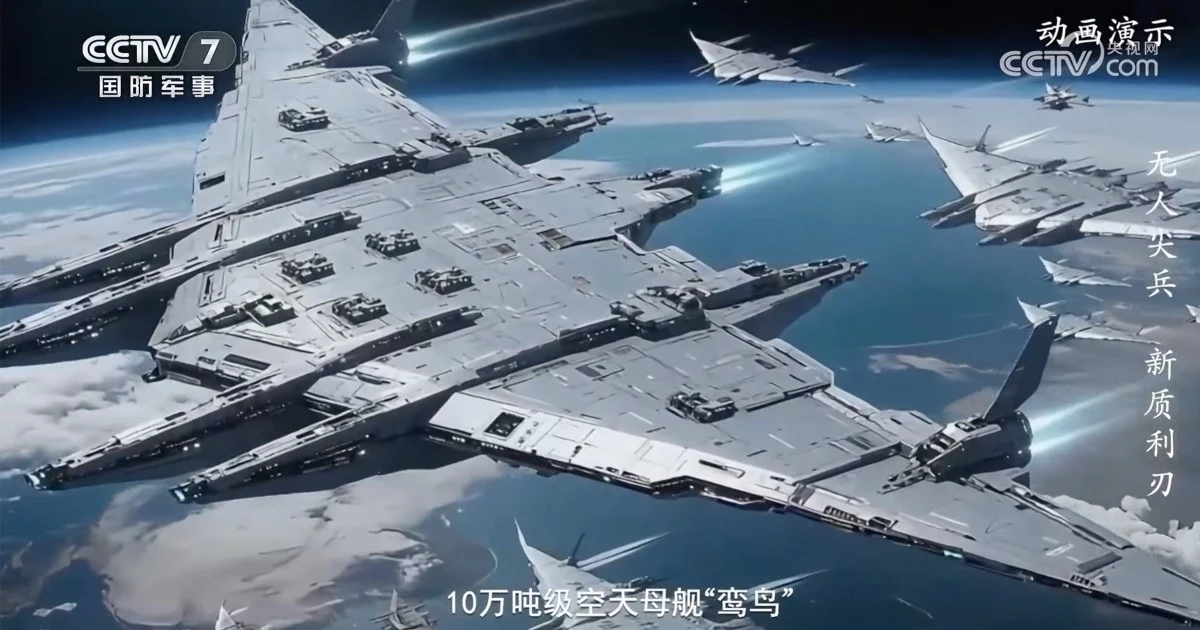

The South Heaven Gate Project: China’s Vision for Orbital Power Projection
In the rarefied air of global defense innovation, few concepts have stirred as much intrigue—and apprehension—as China’s “South Heaven Gate Project.” At its core lies the Luan Niao, a proposed 800-foot, 120,000-ton orbital mothership designed to deploy 88 autonomous Xuan Nu fighter drones and hyper-ballistic missiles from the edge of space. Though still in the conceptual phase, the project is more than a flight of technological fancy; it is a signal flare for the world’s aerospace and defense communities, illuminating the convergence of state ambition, industrial capacity, and the relentless march of dual-use innovation.
Technological Leapfrogging: Propulsion, Autonomy, and Materials
The Luan Niao’s sheer scale demands a revolution in orbital logistics. Propelling a vessel of such mass requires a hybridization of technologies—reusable heavy-lift rockets, in-orbit refueling, and the plausible integration of advanced nuclear or solar-electric propulsion systems. The implications are profound: sub-orbital deployment of combat drones could compress the time-to-target from hours to mere minutes, outpacing the reaction times of existing missile-defense networks and fundamentally altering the calculus of deterrence.
But propulsion is only the beginning. The envisioned fleet of 88 Xuan Nu drones necessitates distributed, edge-based artificial intelligence—each drone capable of real-time threat assessment, cooperative targeting, and electronic warfare. This points to significant advances in mesh networking, edge AI silicon, and cognitive autonomy. The required leap in material science is equally audacious: ultralight composites and high-temperature alloys, once the exclusive domain of stealth fighters, will likely diffuse into commercial aviation and space launch vehicles, echoing past technology spillovers.
Perhaps most consequential is the “unified aerospace-defense” mandate—a deliberate fusion of civil and military research, data, and supply chains. China’s track record in 5G, electric vehicles, and high-speed rail demonstrates its capacity to orchestrate such integration at scale, with the South Heaven Gate Project as its most ambitious iteration yet.
Economic Realignment and Industrial Leverage
Behind the technological spectacle lies a shrewd economic calculus. China’s R&D expenditure now surpasses the European Union in absolute terms, reaching 2.54% of GDP. Mega-projects like Luan Niao serve as domestic stimulus, redirecting surplus industrial capacity away from a faltering property sector toward higher-margin aerospace clusters. The demand for rare-earth magnets, satellite-grade semiconductors, and high-density batteries not only strengthens Beijing’s upstream supply-chain leverage but also insulates its ambitions from Western export controls.
The commercial spillover potential is vast. Technologies honed for high-altitude power generation, autonomous flight, and advanced thermal management could catalyze new markets in low-Earth orbit broadband, hypersonic cargo delivery, and even stratospheric tourism. The financialization of space—through specialized insurance, satellite-servicing funds, and RMB-denominated space bonds—signals China’s intent to broaden its influence in global capital markets, leveraging the Luan Niao as both a technological and financial anchor.
Strategic Geometry: Deterrence, Governance, and Competitive Signaling
The strategic ramifications are as far-reaching as the project’s orbital ambitions. An operational Luan Niao would circumvent the vulnerabilities of terrestrial air bases and extend China’s strike radius far beyond traditional carrier groups, compressing decision cycles in flashpoints such as the Taiwan Strait and South China Sea. This new geometry of deterrence challenges U.S. anti-access/area-denial doctrines and compels a reassessment of allied defense postures.
Yet, the initiative also tests the boundaries of international norms. Straddling the Outer Space Treaty and nascent space-traffic-management regimes, the South Heaven Gate Project will accelerate calls for updated arms-control frameworks—though consensus remains elusive amid fractured multilateralism. Even as a prototype, Luan Niao’s mere articulation compels recalibration: U.S. and European defense planners are already scrutinizing their portfolios, from DARPA’s X-plane to Europe’s IRIS², for countervailing measures.
The New Competitive Sandbox
The South Heaven Gate Project is not merely a speculative vision—it is a lodestar for a new era of space-enabled power projection, industrial realignment, and technological spillover. For technology firms, the message is clear: anticipate surging demand for radiation-hardened chips, advanced composites, and AI avionics, and diversify supply chains to mitigate geopolitical chokepoints. Aerospace primes must pivot toward rapid-launch ISR, in-orbit refueling, and counter-swarm defenses, while investors would do well to monitor Chinese Tier-2 and Tier-3 suppliers for dual-use intellectual property with commercial crossover potential.
For policymakers and strategists, the challenge is to set norms and regulatory frameworks that both safeguard security and enable innovation. As outer-space basing concepts migrate from PowerPoint to procurement, the risk of strategic surprise grows. Those who treat the South Heaven Gate Project as a marginal curiosity do so at their peril. The real opportunity lies in mapping the converging technology curves, supply-chain realignments, and cross-sector linkages that will define the next two decades of global competition—on Earth and far above it.


 By
By
 By
By

 By
By
 By
By