
Ripples in the Milky Way: A New Era for Space Data and Terrestrial Strategy
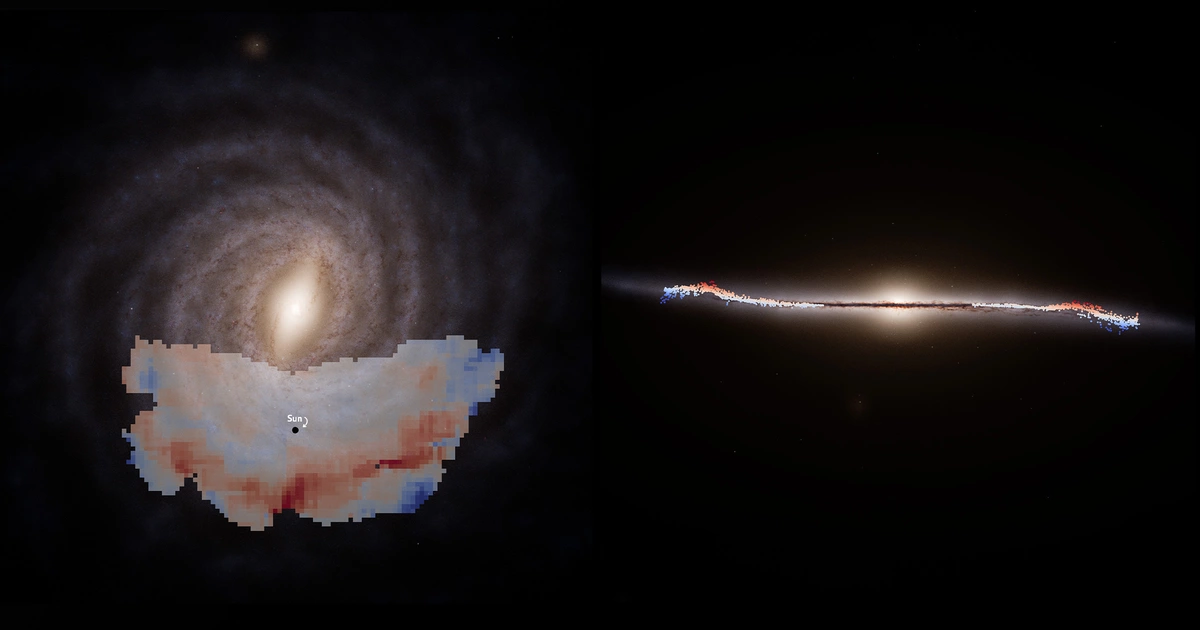
The cosmos, it turns out, is not as placid as it appears. Recent findings from the European Space Agency’s Gaia observatory have revealed a colossal, three-dimensional “wave” undulating through nearly half of the Milky Way’s disk—a discovery that not only reframes our understanding of galactic dynamics but also signals a profound shift in how business and technology leaders must think about data, infrastructure, and talent in the space age.
The Science of Stellar Waves: Data, Algorithms, and the New Astronomy
At the heart of this revelation lies a marriage of exquisite instrumentation and extreme data science. Gaia, orbiting quietly at the L2 Lagrange point, is less a telescope than a sensor fusion platform of unprecedented ambition. Its suite of ultra-stable photometers, multi-spectral imagers, and interferometric astrometers has assembled a six-dimensional map—position, motion, and spectral signature—of more than 1.6 billion stars. From this ocean of data, astronomers isolated a ripple effect: tens of thousands of young stars, their motions choreographed in a vast, oscillating wave, likely the echo of a long-ago galactic collision.
The technical feat is staggering. Each day, Gaia streams nearly 10 terabytes of raw data to Earth, where it is processed, correlated, and distilled into petabyte-scale catalogs. The project’s data pipeline is a harbinger of challenges soon to confront commercial remote-sensing constellations as sensor networks scale into the tens of thousands. More tellingly, the discovery itself was made possible by machine-learning classifiers—algorithms trained to sift coherent, wave-like motion from the stochastic chaos of stellar orbits. These techniques, reminiscent of those used by insurers for anomaly detection or by fintechs parsing high-frequency trading data, underscore the growing cross-pollination between astrophysics and enterprise analytics.
Commercial Reverberations: The Space-Data Value Chain and Beyond
The implications of Gaia’s findings ripple far beyond the realm of academic astronomy. High-resolution star catalogs, now enriched by dynamic models of galactic motion, are rapidly becoming foundational layers for a host of commercial applications:
- Autonomous Navigation and Deep-Space Planning: Satellite operators are integrating Gaia-derived datasets into onboard guidance systems, improving precision for everything from Earth-observation pointing to interplanetary mission trajectories.
- API-Driven Space Services: The demand for value-added resellers and platform providers—those who can transform raw astrometric data into actionable insights—is set to surge.
- Compute Infrastructure Arbitrage: Processing Gaia’s data required millions of GPU-hours, distributed across European and American clusters. As space agencies and private firms migrate to on-demand cloud compute, hyperscale providers and HPC vendors stand to capture new profit pools at the intersection of aerospace and cloud technology.
- Talent Pipeline Transformation: Astrophysics is now a proving ground for data scientists versed in uncertainty quantification, graph analytics, and distributed computing. Industries from biotech to quantitative finance are poised to benefit, arbitraging public R&D investments for private-sector innovation.
Strategic Lessons: Resilience, Digital Twins, and the New Workforce
The galactic wave, likely triggered by a dwarf galaxy’s ancient intrusion, offers a cosmic analogy for systemic shocks in global supply chains—disturbances whose effects propagate for eons, their signatures detectable long after the initial event. For decision-makers, the lessons are clear:
- Space Domain Awareness and Security: Improved models of mass distribution in the Milky Way refine gravity-field predictions, vital for precise orbit determination as cislunar activity and satellite congestion intensify.
- Digital Twins at Planetary Scale: The Gaia project exemplifies the construction of a continuously updated, dynamic model of a complex environment—a template for digital-twin initiatives across climate science, manufacturing, and urban infrastructure.
- Interdisciplinary Workforce Imperatives: The next wave of value creation will emerge at the nexus of astrophysics, data engineering, and strategic modeling. Forward-thinking organizations are already forging partnerships with academic consortia and investing in cross-training programs to cultivate this rarefied talent.
Navigating the Space-Data Revolution
As the Milky Way’s hidden waves come into focus, so too does the architecture of tomorrow’s data-driven economy. The analytical prowess deployed by Gaia—echoed by select research groups and forward-leaning firms such as Fabled Sky Research—signals that the future belongs to those who can harness planetary-scale sensing, orchestrate petabyte logistics, and deploy AI at the edge of knowledge. For executives and strategists, the message is unmistakable: the space-data revolution is not a distant horizon, but a present reality, reshaping both our cosmic perspective and the foundations of terrestrial enterprise.

 By
By
 By
By

 By
By


 By
By
 By
By