

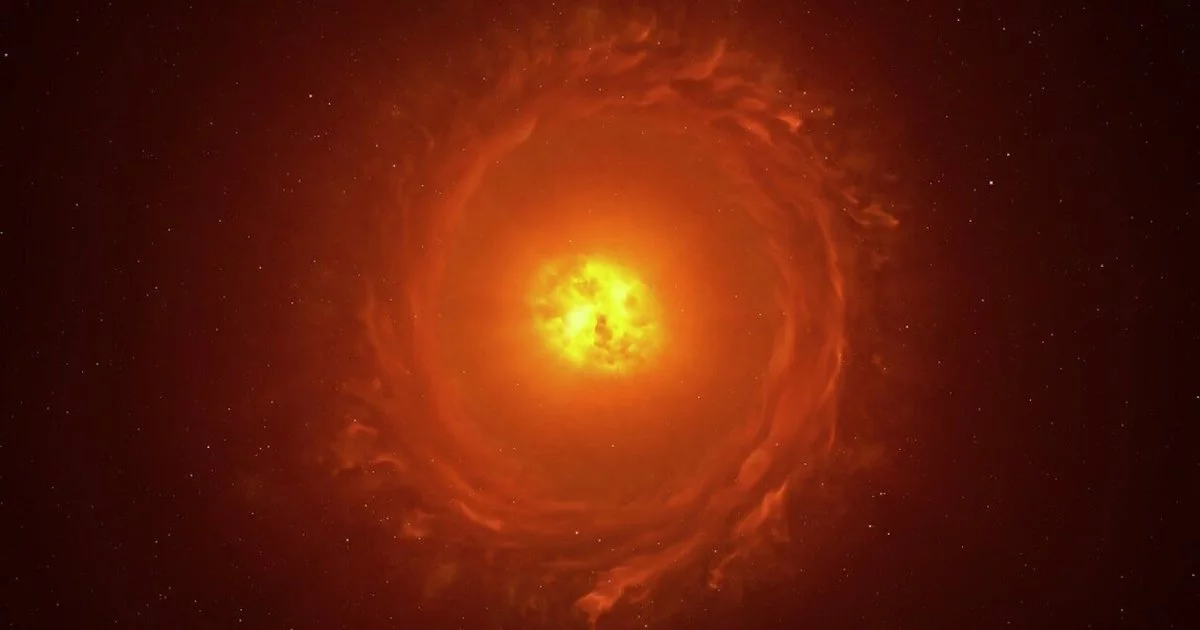

A rare stellar inflection point, captured in real time
Astronomers’ growing focus on WOH G64, a colossal red supergiant in the Large Magellanic Cloud, is not simply about another exotic object in a catalog. It is about timing. Massive stars evolve quickly by cosmic standards, yet still slowly enough that most dramatic transitions unfold beyond a human lifetime. WOH G64 appears to be an exception—an unusually large, unusually young star (around five million years old) that has exhibited a sudden, measurable shift in color and surface temperature consistent with a move away from the classic red-supergiant state.
The 2014 observations—interpreted as a transition toward a yellow hypergiant–like phase—place WOH G64 in a rare evolutionary corridor. With an estimated mass of roughly 30 solar masses and a radius exceeding 1,500 times the Sun’s, the star is already operating near the physical limits of stability: intense radiation pressure, deep convective layers, and violent pulsations can combine to drive extreme mass loss. That matters because, for stars of this scale, mass loss is destiny. It can determine whether the star ends its life as a luminous core-collapse supernova or collapses more quietly into a black hole, potentially with a faint or failed explosion.
What makes this episode especially notable is not just the astrophysics, but the fact that modern instrumentation can now track such a “phase change” with enough fidelity to argue that the star’s surface conditions altered on a timescale measured in years—not millennia. In a field where patience is often mandatory, WOH G64 is offering something closer to a live feed than a fossil record.
The instrumentation and AI stack behind modern astrophysical discovery
The WOH G64 story underscores how contemporary astronomy increasingly resembles an advanced data industry—one where sensing, compute, and analytics are inseparable from the science outcome. The ability to infer rapid temperature swings, characterize circumstellar material, and test competing explanations (intrinsic instability versus binary interaction) depends on a tightly coupled technology pipeline.
Key enablers include:
- High-resolution spectroscopy and adaptive optics that can separate stellar signals from surrounding dust and gas, enabling estimates of composition, temperature, and outflow dynamics.
- Multiwavelength time-series photometry, which turns brightness and color changes into a quantitative timeline of physical evolution.
- High-performance computing (HPC) and cloud-scale workflows that can process large observational archives and run model comparisons at speed.
- Machine learning for anomaly detection, increasingly used to flag unexpected transitions—exactly the kind of “outlier behavior” WOH G64 appears to display.
This is where the business and technology relevance becomes concrete. The same techniques used to detect a stellar regime shift—pattern recognition across noisy, heterogeneous data streams; probabilistic forecasting; automated alerting—are directly analogous to capabilities enterprises seek in:
- Financial risk and fraud monitoring (rare-event detection under uncertainty)
- Supply-chain resilience (early warning signals from weak, distributed indicators)
- Predictive maintenance in heavy industry (identifying precursors to failure before thresholds are crossed)
WOH G64 is, in effect, a high-profile case study in how modern discovery is increasingly software-defined—and how scientific competitiveness often tracks the maturity of the underlying data platform as much as the telescope aperture.
Space-tech spillovers: capital, IP, and the talent flywheel
Astronomy’s push to observe objects like WOH G64 at higher precision has a consistent secondary effect: it accelerates demand for components and capabilities that later diffuse into commercial markets. The spillover pattern is familiar—public science funding de-risks frontier engineering, and industry scales what proves useful.
Several spillover channels stand out:
- Detector and sensor innovation: Better sensitivity and lower noise requirements drive advances that can translate into medical imaging, semiconductor inspection, and defense-grade sensing.
- Optical coatings, cryogenics, and photonics: Techniques developed to stabilize instruments and improve signal capture often become patentable know-how with cross-sector value.
- Data infrastructure and interoperability: Astronomy’s emphasis on curated archives and reproducible pipelines reinforces best practices now sought in regulated industries.
Just as important is the workforce dimension. Teams that can interpret WOH G64’s behavior are fluent in complex systems modeling, Bayesian inference, and large-scale data engineering—a skill blend increasingly scarce in the broader economy. As companies compete to operationalize AI, the astrophysics talent pipeline represents a quiet but meaningful strategic asset, particularly for sectors where decisions depend on uncertain signals and long time horizons.
Strategic lessons from a star on the edge of transformation
WOH G64’s prospective end states—supernova or black hole—are dramatic, but the more actionable insight lies in the pathway: a system can look stable for long periods and then exhibit a rapid transition once internal and external pressures align. In this case, those pressures may include pulsational and eruptive instability as well as the possibility of mass stripping by a stellar companion, a reminder that “environment” and “adjacent actors” can be as consequential as internal fundamentals.
For business and technology leaders, the parallel is not poetic—it is operational. The same logic applies to markets and platforms where tipping points emerge from the interaction of:
- Accumulated internal strain (technical debt, margin compression, organizational complexity)
- External coupling (partners, competitors, regulators, supply dependencies)
- Threshold dynamics (once crossed, recovery is costly or impossible)
WOH G64 also reinforces why scenario planning must extend beyond quarterly cadence. The star’s fate may unfold over hundreds to thousands of years, but the decision-relevant window—detecting the transition early enough to interpret it correctly—can be short. That is the modern strategic challenge: building systems that recognize inflection points quickly, govern data responsibly, and convert weak signals into timely choices.
In watching WOH G64 change before our eyes, astronomy is not only refining models of stellar death—it is demonstrating how the next era of advantage, in science and industry alike, will belong to those who can sense transformation early, compute at scale, and act with discipline when the data says the system has entered a new phase.

 By
By
 By
By

 By
By
 By
By

 By
By
 By
By







