

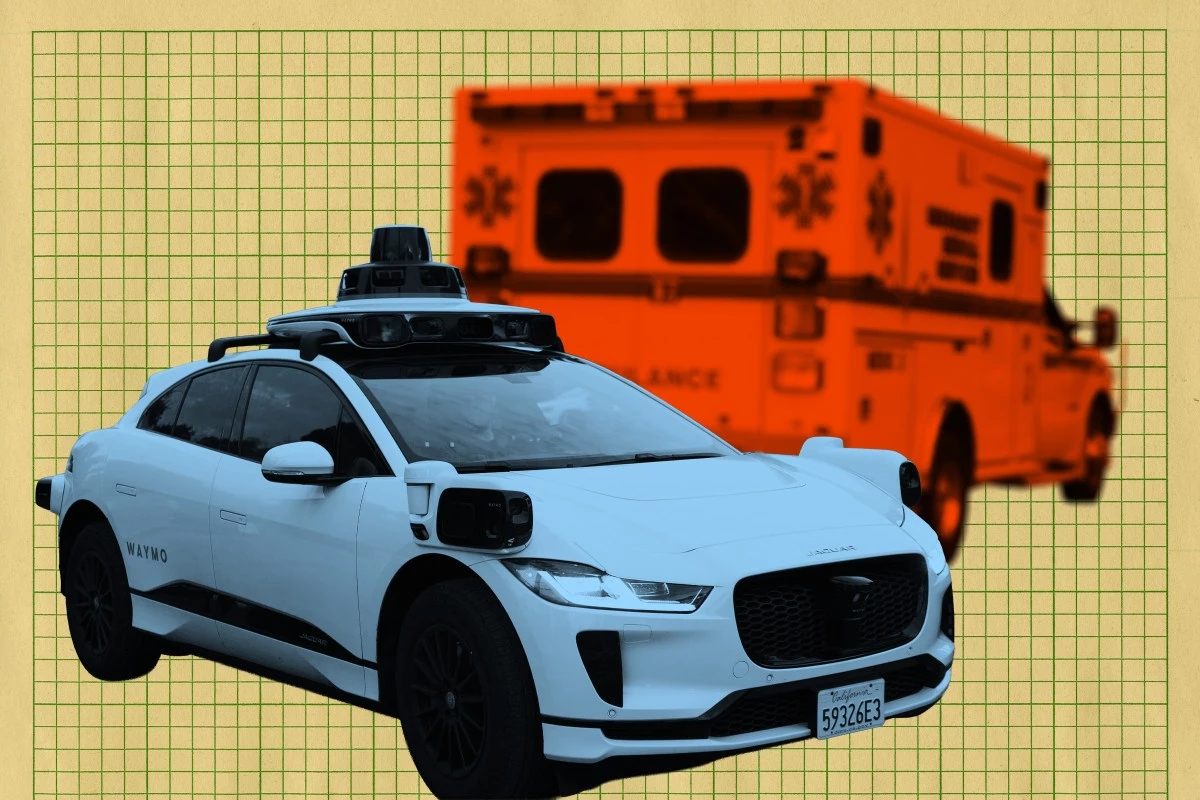

A high-stakes roadblock in Austin tests the social contract of autonomous mobility
The Austin incident—where a Waymo-operated robotaxi obstructed an ambulance responding to a mass-shooting scene—lands at the most unforgiving intersection of technology and public safety: moments when seconds matter and ambiguity is the norm. Video showing the driverless vehicle halted while emergency lights flashed, forcing paramedics to reverse and reroute, is not merely a viral clip; it is a vivid demonstration of how autonomous vehicles (AVs) can become operational chokepoints when their decision logic meets chaotic, high-priority human activity.
Critically, reports indicate no material impact on patient outcomes in this case. Yet the reputational and regulatory weight of the episode is amplified by context: it follows other high-profile Waymo setbacks, including service disruptions during a San Francisco power outage, reports of robotaxis mishandling school-bus stop scenarios, and an incident in Santa Monica involving a child. Taken together, these events shape a narrative that the technology can perform impressively in routine conditions while still faltering in the “edge cases” that define public trust.
For cities and emergency services, the question is not whether AVs are statistically safer in aggregate—an important but incomplete metric—but whether they behave predictably and conservatively in life-critical, exception-driven environments where human responders expect immediate compliance from surrounding traffic.
Why emergency scenarios expose the limits of today’s autonomy stacks
At the technical level, the Austin obstruction underscores a familiar challenge in autonomy engineering: perception is not the same as understanding. Modern robotaxis rely on sensor fusion—typically combining cameras, radar, and lidar—to detect objects and classify scenes. But emergency response introduces signals that are both multimodal and context-dependent: flashing lights, sirens, hand gestures, unusual vehicle trajectories, blocked lanes, and crowds behaving unpredictably.
Several plausible failure modes emerge from the reported behavior:
- Cue detection versus intent inference: An AV may detect an ambulance and even recognize flashing lights, yet still fail to infer the *intent*—that the ambulance requires immediate right-of-way and that the safest action may be to clear the lane decisively, even if it means deviating from typical driving rules.
- Decision latency and remote assistance dependency: The delay before the robotaxi moved suggests a potential reliance on remote human operators or supervisory systems. That raises hard questions about:
– network latency and connectivity reliability,
– escalation thresholds (when the vehicle “asks for help”), and
– whether the autonomy stack is conservative to the point of paralysis when uncertainty spikes.
- Over-cautious fail-safe behavior: Many AV systems are designed to “freeze” when confidence drops. In everyday driving, that can be a reasonable safety posture. In emergency contexts, however, stopping in the wrong place can be the hazard, particularly if it blocks a response corridor.
This is the paradox of autonomy maturity: the more a system is optimized for compliance and risk minimization, the more it may struggle when the correct action is rapid, context-aware cooperation with human-led emergency operations.
Business, regulatory, and liability ripple effects for Waymo and the broader AV market
From a business and technology perspective, the Austin episode is less about a single vehicle and more about system-level reliability under civic stress—the standard by which municipalities, regulators, insurers, and enterprise partners will increasingly judge AV deployments.
Key implications are already visible:
- Regulatory scrutiny is likely to intensify. Cumulative incidents invite closer attention from agencies such as the National Highway Traffic Safety Administration (NHTSA) and local transportation authorities. The policy trajectory tends to move from permissive pilots to conditional permissions tied to measurable performance—especially around emergency-vehicle interaction protocols.
- Liability and insurance models may harden. Even when harm is avoided, near-miss events in emergency contexts can shift underwriting assumptions. Insurers may respond with higher premiums, narrower coverage, or requirements for demonstrable improvements in emergency handling and incident reporting.
- Competitive positioning will hinge on “first responder readiness.” Rivals across the autonomy landscape—whether robotaxi operators or consumer AV developers—have an opening to differentiate on a specific benchmark: time-to-yield, clearance behavior, and predictability around ambulances, fire engines, and police vehicles. In a market where public acceptance is fragile, emergency response competence becomes a brand attribute, not just an engineering feature.
- Operational scaling could slow without trust alignment. Robotaxis are not deployed into a vacuum; they share streets with public services. If cities perceive AV fleets as potential impediments during crises, permitting and expansion timelines can tighten quickly.
Notably, the fact that first-responder agencies have received Waymo-funded training to manage encounters with robotaxis is revealing. It signals a pragmatic recognition that autonomy is not solely a software problem—it is also a public-private interoperability problem, requiring shared procedures, communication channels, and expectations.
The path forward: engineering for crisis interoperability, not just everyday competence
The Austin incident renews a central challenge for autonomous mobility: building systems that are not only safe in normal conditions, but resilient in abnormal ones. That points to a set of priorities that are as much organizational and regulatory as they are technical.
Areas likely to define next steps across the industry include:
- Dedicated emergency-vehicle handling capabilities
– stronger multimodal detection (visual + acoustic),
– clearer behavioral policies for yielding and lane clearing,
– and, where feasible, integration with V2X or public-safety signaling to reduce ambiguity.
- Lower-latency escalation and autonomy fallback modes
– minimizing dependence on remote operator intervention for basic clearance maneuvers,
– and ensuring that “safe stop” logic does not translate into “block the corridor” outcomes.
- More realistic testing regimes
– simulation libraries that include chaotic, multi-actor emergencies,
– and live drills with municipalities—akin to operational “red teaming”—to validate response under stress.
- Stronger data transparency and shared taxonomies
– consistent incident reporting standards that enable cross-industry learning,
– and clearer public communication that distinguishes between detection failures, policy failures, and remote-ops delays.
Autonomous vehicles are often framed as the future of urban efficiency. Incidents like Austin sharpen a more immediate requirement: urban resilience. If robotaxis are to earn durable legitimacy, they must prove they can be trusted not only to transport passengers safely, but also to behave as reliable participants in the city’s most urgent moments—when the street stops being a roadway and becomes an emergency system.

 By
By
 By
By

 By
By
 By
By
 By
By
 By
By
 By
By







