

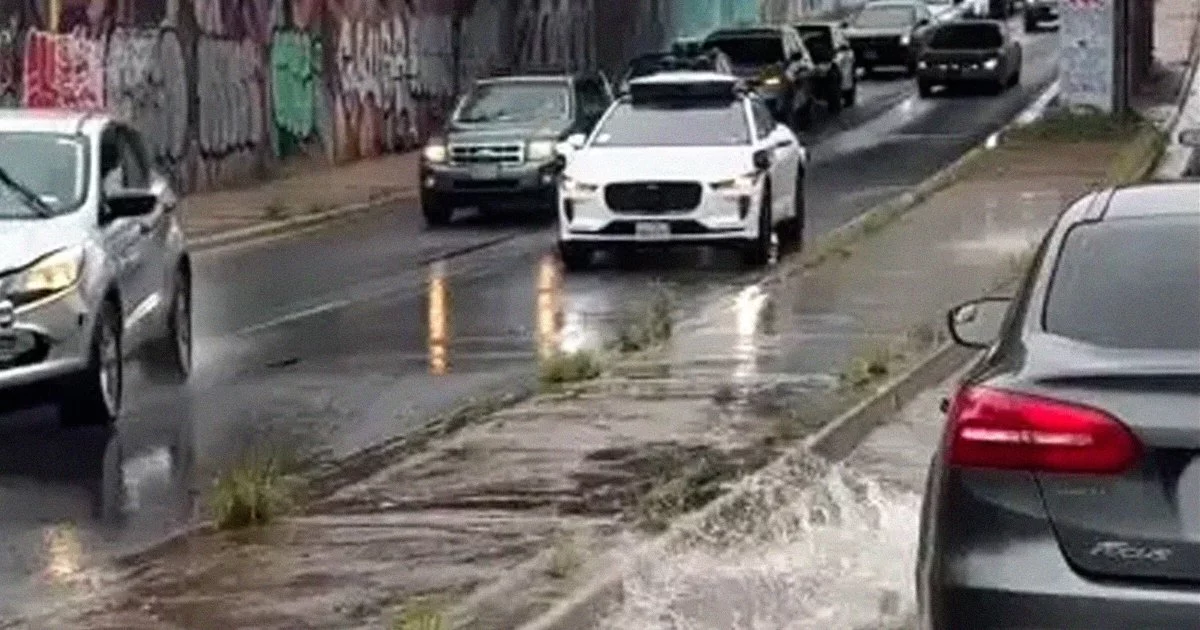

Austin’s rainstorm as a real-world stress test for autonomous mobility
Waymo’s autonomous vehicles have accumulated millions of miles in dense urban environments, a scale that has helped normalize robotaxis as a credible transportation product rather than a lab experiment. Yet a recent incident in Austin—where a Waymo vehicle stalled on North Lamar Boulevard during heavy rain after encountering a modest puddle—highlights a persistent truth about autonomy: the hardest problems are rarely the everyday ones.
The operational impact was immediate and visible. A single immobilized vehicle on a major corridor can trigger congestion, frustrate human drivers, and amplify scrutiny far beyond the severity of the underlying hazard. More revealing, however, was the appearance of inconsistent behavior across vehicles: footage suggesting two Waymo units initially entered floodwater before stopping abruptly points to variability in how the system interprets and responds to water-related risk.
For public acceptance, these moments matter disproportionately. Autonomous driving is judged not only by crash statistics, but by whether it behaves predictably, legibly, and consistently under conditions that humans encounter routinely—especially in cities where weather volatility is becoming the norm rather than the exception.
What the puddle reveals about perception, sensor fusion, and decision thresholds
At the technical level, standing water is a deceptively complex perception problem. Water surfaces can behave like mirrors, distort depth cues, and mask road geometry. In heavy rain, the challenge compounds: droplets, spray, and reflections can degrade sensor confidence and create ambiguous signals.
Key technical fault lines exposed by the Austin incident include:
- Sensor fusion limits in wet environments
– Lidar and radar returns can be skewed by reflective water surfaces, producing uncertain obstacle boundaries or misreading depth.
– Camera-based cues can be compromised by glare, low contrast, and rain streaking—especially at night or under street lighting.
– When modalities disagree, the fusion stack may default to caution, which can manifest as “stop and wait” behavior.
- Algorithmic risk assessment that favors immobilization
– Many AV stacks are designed around a conservative principle: when uncertain, fail safe. In practice, “fail safe” often means refuse to proceed.
– A puddle that a human driver would treat as low-risk can become, for an AV, an unbounded uncertainty: hidden potholes, unknown depth, hydroplaning risk, or submerged debris.
- Inconsistency as a product risk, not just a technical bug
– If one vehicle refuses a shallow puddle while another enters deeper water before halting, the issue is not merely calibration—it becomes a question of policy coherence.
– Inconsistency undermines trust because it suggests the system’s behavior is not reliably inferable from the environment, which is central to both consumer confidence and regulatory comfort.
The deeper challenge is data scarcity. Machine-learning components trained predominantly on clear-weather driving can become brittle when confronted with rare, high-stakes conditions like flash flooding. Without sufficient high-fidelity examples—paired with ground truth about water depth and road condition—models may oscillate between overconfidence and excessive caution.
The business consequences: utilization, liability, and brand equity under edge-case pressure
Robotaxi economics depend on high utilization and predictable service. A vehicle that stops unexpectedly on a main road doesn’t just create a traffic nuisance—it can degrade the fundamentals of the business model.
Several market implications follow:
- Operational efficiency and unit economics
– Unplanned stoppages reduce fleet availability, lowering rides per vehicle per day and pressuring per-mile margins.
– If weather triggers frequent service interruptions, operators may need larger fleets to meet demand, raising capital intensity.
- Liability and insurance dynamics
– Immobilization can create secondary risk: rear-end collisions, unsafe lane changes by surrounding drivers, or emergency response complications.
– Even absent physical harm, incidents can generate claims tied to delays or disruptions, potentially increasing commercial insurance premiums and tightening underwriting terms.
- Public confidence and regulatory momentum
– Highly shareable clips of “a robotaxi stuck in a puddle” can outweigh more meaningful safety statistics in the public mind.
– Regulators may respond by demanding more stringent adverse-weather reporting, expanded incident logs, or standardized performance benchmarks for water hazards.
For Waymo specifically, the reputational stakes are amplified by its positioning as a technical leader. In autonomy, leadership is measured not only by how well a system performs on average, but by how gracefully it handles the long tail of edge cases—because those are the scenarios that shape public narrative and policy.
Where the industry goes next: resilience engineering, smart-city data, and climate-adaptive autonomy
The Austin incident is best understood as a preview of a broader industry requirement: climate-adaptive autonomy. Urban flash floods and severe rain events are becoming more frequent in many regions, turning “rare edge cases” into recurring operational realities. That shifts the competitive frontier toward resilience—systems that can degrade gracefully, reroute intelligently, and communicate intent clearly.
Practical pathways emerging from this moment include:
- Sensor and model upgrades tailored to water risk
– Expanded sensor modalities—such as high-resolution radar and potentially thermal—can improve robustness when cameras and lidar struggle.
– Continuous learning pipelines that rapidly label and retrain on real-world storm events can reduce brittleness, provided they are paired with strong validation controls.
- Simulation and validation at scale
– Flood-aware digital twins and synthetic scenario generation remain underused relative to their potential.
– The goal is not to “teach the car every puddle,” but to stress-test decision policies across combinations of road camber, drainage patterns, visibility loss, and uncertain depth.
- Partnership models that extend beyond the vehicle
– Municipal data feeds, weather intelligence, and vehicle-to-infrastructure (V2I) alerts could provide localized hazard awareness that onboard sensors alone cannot reliably infer.
– Roadside IoT flood gauges or embedded roadway sensors may become strategically valuable in high-risk corridors, especially where robotaxi services concentrate.
Autonomous mobility is often framed as a software problem, but incidents like this underline a more systemic reality: the winning platforms will blend on-vehicle intelligence, real-time urban data, and operational discipline. The puddle in Austin is small; the implications for all-weather autonomy—and the credibility of robotaxi services at city scale—are not.

 By
By
 By
By

 By
By
 By
By
 By
By
 By
By
 By
By







