


A recalibrated in-store fulfillment playbook amid surging Walmart e-commerce growth
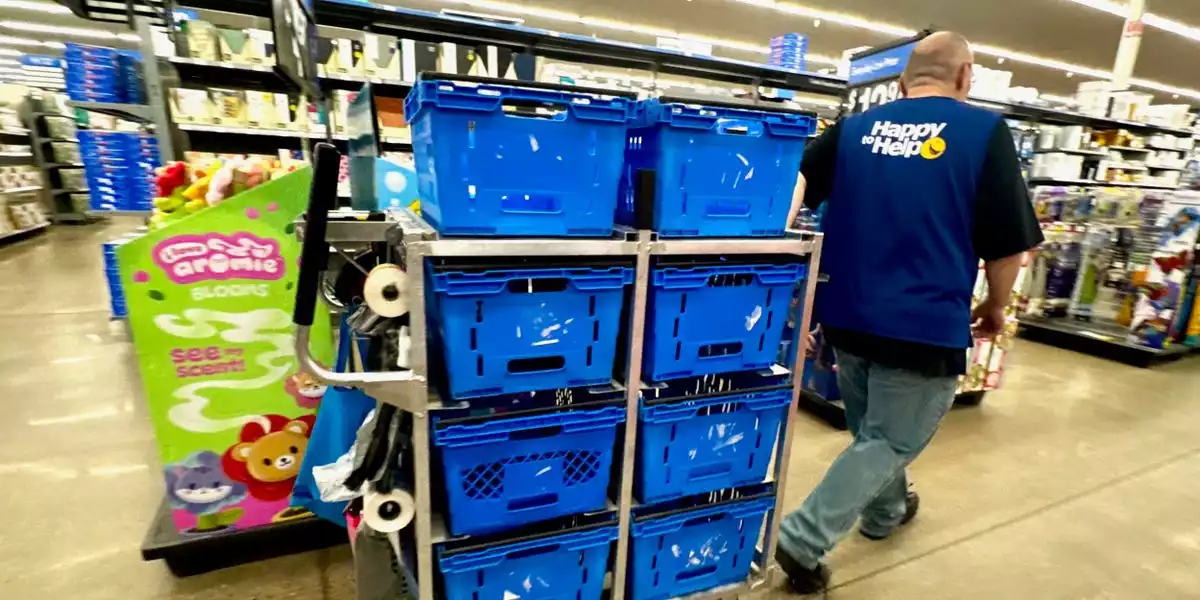
Walmart’s latest adjustment to its in-store online order fulfillment protocols—cutting the maximum number of blue bins per cart from eight to six and refining guidance on when associates should push versus pull carts based on aisle visibility—lands at a telling moment for modern retail operations. The company is scaling an omnichannel model across roughly 4,600 stores, while reporting 27% e-commerce sales growth in its most recent quarter. That combination—rapid volume expansion inside legacy store footprints—turns seemingly small process changes into strategically meaningful levers.
At face value, reducing bin capacity implies fewer items per picking trip and a potential hit to throughput. Yet the move also reflects a broader operational reality: store-based fulfillment is not just a logistics function; it is a human-centered production system operating in public spaces. Unlike a warehouse, the store aisle must serve shoppers and workers simultaneously, with tighter constraints on visibility, maneuverability, and safety. Walmart’s revisions suggest an effort to standardize safer behaviors at scale while preserving the speed that makes store fulfillment economically attractive.
Key operational implications embedded in the change include:
- Lower cart load density to reduce strain, improve control, and limit collision risk
- Contextual handling rules (push vs. pull) that acknowledge aisle sightlines and customer traffic
- A shift toward repeatable, auditable procedures that can be trained consistently across thousands of locations
Safety, liability, and the economics of “one less bin”
The reduction from eight bins to six is more than a productivity tweak; it is a statement about risk tolerance in a high-volume environment. Walmart has faced cart-related injury litigation in the past, and large judgments tend to reshape internal cost-benefit calculations. In that context, the new limits can be read as a form of risk management engineering—reducing the probability of incidents that carry outsized financial and reputational consequences.
From a business perspective, safety initiatives often compete with speed. But in labor-intensive fulfillment, safety can also function as a strategic input to performance:
- Lower injury rates reduce lost-time incidents and scheduling volatility
- Reduced turnover pressure can improve labor continuity, which is crucial for pick accuracy and pace
- Fewer claims and legal exposures can stabilize costs that are otherwise difficult to forecast
- Stronger safety posture supports ESG narratives and stakeholder expectations around frontline work
The cart protocol changes also reflect a subtle but important truth: in-store pickers operate in a mixed environment where customers, displays, and narrow aisles create dynamic hazards. Guidance that adapts to aisle visibility is effectively a human-factors design decision—recognizing that the safest handling method depends on what an associate can see and anticipate in real time.
Digital shelf labels and LED “pick guidance” as a throughput counterweight
To offset any reduction in per-trip capacity, Walmart is rolling out digital shelf labels with LED indicators designed to help pickers locate items faster. This is a pragmatic technology choice: it targets one of the most persistent time sinks in store fulfillment—search and confirmation time—without requiring a full redesign of store layouts or a leap to warehouse-grade automation.
In operational terms, LED-enabled shelf labels function like a lightweight version of “pick-to-light” systems used in distribution centers. Their value compounds at scale because they can:
- Reduce item-finding time, especially in dense categories with similar packaging
- Lower substitution and mis-pick rates, improving customer satisfaction and reducing rework
- Improve onboarding speed for new associates by making the environment more navigable
- Enable more consistent performance across stores with different layouts and merchandising conditions
This is also a notable example of Walmart choosing incremental innovation over disruptive capital investment. Rather than immediately leaning on robotics, micro-fulfillment retrofits, or dark-store conversions, the company is enhancing the productivity of its existing store network—an approach aligned with disciplined ROI thinking. For a retailer operating at Walmart’s scale, even small per-order efficiency gains can translate into meaningful margin protection, particularly as online order volumes rise.
Social listening, workforce signaling, and what competitors will take from this
One of the most consequential aspects of this episode is not the cart itself, but the feedback loop. The changes follow employee feedback aired on social media, underscoring how operational policy is increasingly shaped by real-time, public sentiment. For large employers, “social listening” is evolving into an informal but powerful input to process design—compressing the time between frontline friction and corporate response.
That responsiveness carries labor-market implications. Retail fulfillment is a high-churn domain, and Walmart’s ability to signal that associate concerns can drive tangible change may support:
- Retention and morale, reducing the hidden costs of constant rehiring
- A more experienced picking workforce, which tends to improve speed, accuracy, and customer outcomes
- Stronger alignment between HR, safety, and supply chain teams—often siloed in large organizations
For competitors, the lesson is twofold. First, store-based fulfillment leadership increasingly depends on human-centered operational design, not just algorithmic routing or inventory systems. Second, Walmart’s approach hints at a likely near-term trajectory for omnichannel retail: a layered model where manual picking is augmented by low-friction digital tools, while heavier automation is deployed selectively where store size, volume, and economics justify it.
Walmart’s revised cart limits and LED shelf-label rollout ultimately read as a mature scaling decision: protect the workforce, reduce tail-risk exposure, and reclaim speed through targeted technology—an operational posture designed to keep e-commerce growth compounding without turning the store aisle into a liability.

 By
By

 By
By

 By
By
 By
By

 By
By







