
Vib-OS and the promise of “vibe coding” meets the reality of operating-system engineering
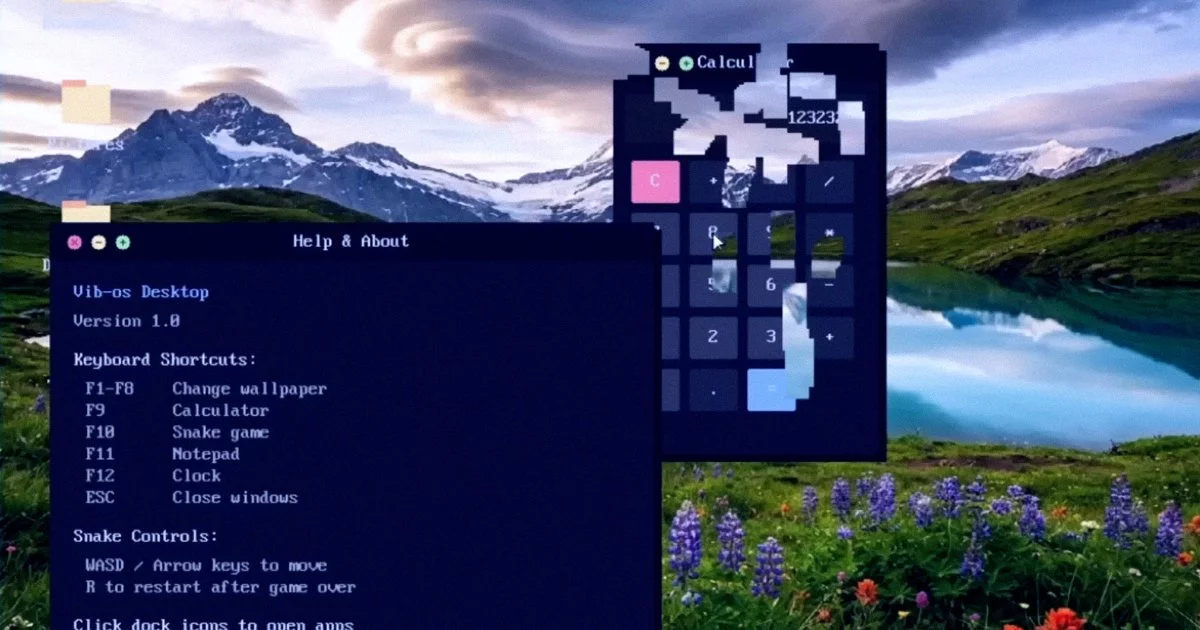
Andrej Karpathy’s popularization of “vibe coding”—translating software intent into natural-language prompts that an AI model turns into code—has quickly become a cultural shorthand for a new development posture: *describe the outcome, let the model fill in the implementation*. Vib-OS, an AI-generated operating system published on GitHub with support for ARM64 and x86, is the most theatrical expression of that idea to date. It advertises a custom kernel, a macOS-inspired GUI, a virtual filesystem, and even the ability to launch Doom, the canonical “can it run?” benchmark.
A recent teardown by YouTuber Tirimid punctured that narrative in a way that is instructive rather than merely entertaining. The critique wasn’t about aesthetics or missing polish; it was about functional absence behind convincing surfaces:
- UI elements that appear interactive but do not respond
- No internet connectivity, undermining any claim to modern OS utility
- A text editor that doesn’t save
- A “Browser” that is effectively a stub
- No Python integration, limiting extensibility and developer workflows
- A nonworking Doom launcher, despite the headline-grabbing claim
The audience reaction—amusement mixed with disappointment—captures the moment. Vib-OS is simultaneously a compelling demonstration of how quickly AI can generate *the shape* of a system, and a cautionary exhibit of how easily that shape can be mistaken for substance.
When generative code collides with deterministic expectations: hallucinations, verification, and the “looks done” trap
The most revealing aspect of Vib-OS is not that it fails; it’s *how* it fails. Traditional software engineering is built around deterministic behavior, reproducibility, and layered verification. AI-assisted development, especially in its “vibe coding” form, can invert that order—producing plausible artifacts first and leaving correctness as an afterthought.
At the core is a familiar generative-model failure mode: hallucination. In code, hallucination often manifests not as random noise but as confidently structured incompleteness—functions that compile but don’t work, interfaces that exist but don’t connect, documentation that describes features that were never implemented. The Doom claim, as presented, becomes emblematic: a credible-sounding capability that collapses under execution.
This points to a widening verification gap. Mature engineering organizations rely on:
- Unit and integration tests that encode expected behavior
- CI/CD pipelines that prevent regressions
- Static analysis and linting to catch unsafe patterns
- Code review norms that interrogate assumptions and edge cases
Vibe coding can accelerate scaffolding, but without those guardrails it also accelerates the production of highly legible prototypes that are not operational systems. The risk is not merely wasted effort; it’s organizational miscalibration—teams and stakeholders mistaking a visually complete demo for a deployable foundation.
Why kernels, GUIs, and runtimes expose the limits of today’s AI coding tools
Operating systems are a stress test for AI-generated software because they sit at the intersection of hardware constraints, concurrency, security boundaries, and long-lived maintenance. Vib-OS highlights three domains where generative models can imitate form while struggling with function.
1) Kernel-level complexity
A kernel is not just a collection of files; it is a disciplined set of invariants around scheduling, memory management, interrupts, drivers, and isolation. AI can generate boilerplate and plausible abstractions, but low-level correctness depends on deep, context-specific knowledge and extensive validation. Without ground-truth feedback loops—tests on real hardware, fuzzing, performance profiling—AI output can remain “syntactically impressive” while being operationally brittle.
2) GUI fidelity without event plumbing
A macOS-inspired interface is a perfect target for generative models: it’s visually recognizable and pattern-rich. But a GUI is only as real as its event handling, state management, and integration with underlying services. Unresponsive controls are not a minor bug; they are a sign that the system is cosmetic-first, with missing connective tissue between presentation and capability.
3) Toolchain integration and ecosystem gravity
The absence of Python integration is telling because language runtimes are ecosystems, not modules. They require packaging, versioning, security patching, standard libraries, and stable APIs. AI can draft interfaces, but it struggles to automatically generate the operational completeness that makes a platform extensible. In business terms, this is the difference between a demo and a developer product.
Layered over all of this is the uncomfortable security reality: AI-written code can introduce vulnerabilities through non-idiomatic patterns, unsafe defaults, or misunderstood cryptographic and networking primitives. Without human-led review and automated security testing, “AI speed” can translate directly into AI-accelerated technical debt.
Business implications: prototype velocity, credibility risk, and the emerging role of AI code governance
Vib-OS lands in a market environment defined by aggressive investment in AI tooling and a parallel push for efficiency—sometimes alongside workforce reductions. That tension makes artifacts like Vib-OS more than curiosities; they become signals in the broader debate about ROI timelines and automation readiness.
For executives and product leaders, the strategic takeaway is nuanced:
- First-mover advantage is real in prototyping and ideation. Vibe coding can compress early exploration cycles and help teams test UI concepts, workflows, and feature narratives quickly.
- Credibility risk is equally real when prototypes are presented as functional systems. Overpromising—internally or externally—can erode trust in AI initiatives and in the teams sponsoring them.
- Vendor ecosystems will be judged on reliability, not novelty. Platforms from Microsoft, OpenAI, and others benefit when AI coding assistants integrate into established IDEs and workflows—but public failures that look like “AI vaporware” can harden skepticism.
The practical path forward is not to reject AI-generated development, but to professionalize it. Organizations experimenting with vibe coding should treat AI output as untrusted code until proven otherwise, and build an AI-specific software delivery discipline around:
- Mandatory tests and CI gates for AI-generated modules
- Human ownership for architecture, security, and production readiness
- Clear scope boundaries, reserving AI-first builds for low-risk prototypes
- Governance on IP, compliance, and data handling, extending existing policies into AI-assisted workflows
Vib-OS may not be a usable operating system today, but it is a useful artifact: a vivid reminder that modern AI can generate convincing software *surfaces* at remarkable speed—and that the competitive advantage will belong to the teams who can convert that speed into verified, secure, maintainable systems rather than compelling illusions.

 By
By
 By
By
 By
By


 By
By
 By
By
 By
By