

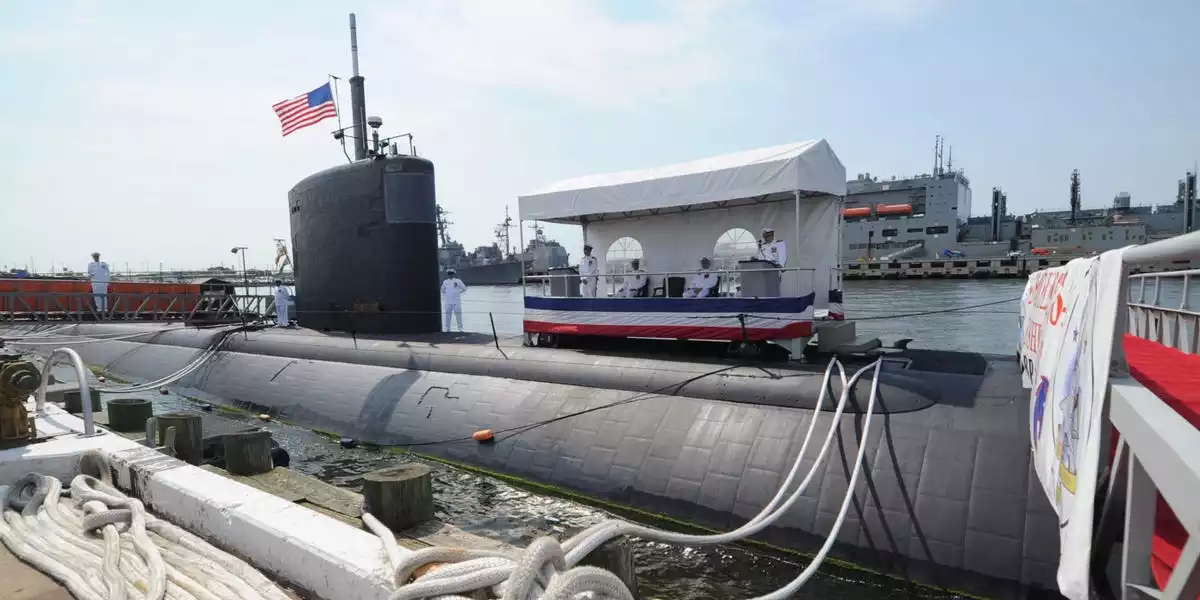

The USS Boise’s Long Hiatus: A Lens on America’s Maritime Industrial Paradox
When the USS Boise—a Los Angeles-class attack submarine—slipped from operational readiness in 2015, few could have predicted its absence would stretch into a decade and a half. As of this year, the Boise remains dry-docked, with a $1.2 billion overhaul contract inked only months ago and a projected return to service no earlier than 2029. This saga is not merely the tale of a single vessel sidelined by circumstance; it is a parable of the U.S. naval-industrial ecosystem’s mounting contradictions, where strategic ambition collides with industrial inertia.
Anatomy of a Modernization Bottleneck
The Boise’s ordeal exposes the brittle underpinnings of American maritime power. The Navy’s four public shipyards—once the envy of the world—now find themselves hamstrung by capacity constraints. Only half can accommodate Los Angeles-class submarines at scale, while commercial yards are saturated with new Virginia-class builds. This lack of surge elasticity is not just an operational inconvenience; it is a structural vulnerability, one that China has exploited by launching over 150 surface ships and submarines since Boise’s last patrol.
The labor force, too, is caught in a slow-motion crisis. Nuclear-qualified welders and electricians are not commodities—they are the product of years-long apprenticeships. A minor attrition spike today reverberates for years, much as the semiconductor industry suffers from wafer-fabrication engineer shortages. The Navy’s maintenance playbook, still reliant on backward-looking logs rather than predictive analytics or digital twins, compounds the risk. The Boise entered overhaul before condition-based maintenance became standard, and the absence of real-time data has left planners flying blind, with cascading delays the inevitable result.
The Economic and Strategic Cost of Delay
The financial shadow cast by the Boise is long and deep. The Congressional Budget Office estimates the effective “deadweight” burden at approximately $3.5 billion—a sum that includes not only procurement costs but also the opportunity cost of an idled crew and the need to reassign missions. Inflation has only sharpened the pain: shipyard labor rates have surged over 25% since 2019, echoing the cost-overrun dynamics of the 1970s but at 21st-century scale. Meanwhile, parts obsolescence for a 1980s hull has concentrated vendor power, mirroring the predicament seen in commercial aerospace as aging platforms linger and suppliers consolidate.
Strategically, the implications are stark. The credibility of U.S. naval commitments—particularly to allies eyeing the AUKUS submarine pact—has been quietly eroded by the sight of a flagship submarine languishing for 15 years. The People’s Liberation Army Navy, by contrast, is on a trajectory to match the U.S. World War II shipbuilding tempo by 2030. In any Taiwan contingency, the availability of attack submarines is the Navy’s highest-leverage variable. The Boise’s latency is not just a logistical headache; it is a real-time metric of the undersea dominance the U.S. is ceding.
Reimagining the Defense-Industrial Compact
The Boise’s extended absence is not merely a tale of technical hiccups or bureaucratic inertia—it is a warning flare for defense leadership, industry, and policymakers alike. The Navy’s force-structure calculus must shift from hull counts to “available days”—a notional 49-boat fleet with only 70% readiness delivers just 34 deployable submarines, falling short of war-planning thresholds. Embedding digital twins and advanced sensor suites in new submarine classes could collapse troubleshooting cycles by up to 40%, a leap already routine in commercial aviation.
For industry, the stakes—and opportunities—are profound. The Navy’s willingness to allocate Boise-scale capital expenditures signals that small and mid-sized enterprises offering nuclear-grade components can secure decade-long revenue streams, provided they meet exacting standards. Technologies like advanced welding robotics, augmented-reality work instructions, and AI-driven dock scheduling not only promise to revitalize shipyards but also carry dual-use potential across energy, aerospace, and offshore construction.
Policymakers, meanwhile, must recognize that talent pipelines for nuclear trades are as critical to deterrence as the platforms themselves. Budget lines should reflect this reality, and multi-year procurement authorities may need to be revisited to shield long-cycle programs from inflationary shocks. As backlogs swell, expect a wave of consolidation among Tier-2 maritime suppliers—savvy investors with patient capital may find counter-cyclical opportunities reminiscent of the last decade’s defense avionics boom.
The USS Boise’s journey is a diagnostic flashpoint, illuminating the misalignment between America’s maritime aspirations and its industrial scaffolding. Closing this gap will demand not just new technologies but a cultural reset—one that prizes repeatability, accountability, and agility. Those who heed the lessons of the Boise—whether in shipyards, boardrooms, or legislative chambers—will shape the contours of American power in an era defined by industrial competition and technological flux.

 By
By
 By
By
 By
By

 By
By
 By
By

 By
By







