

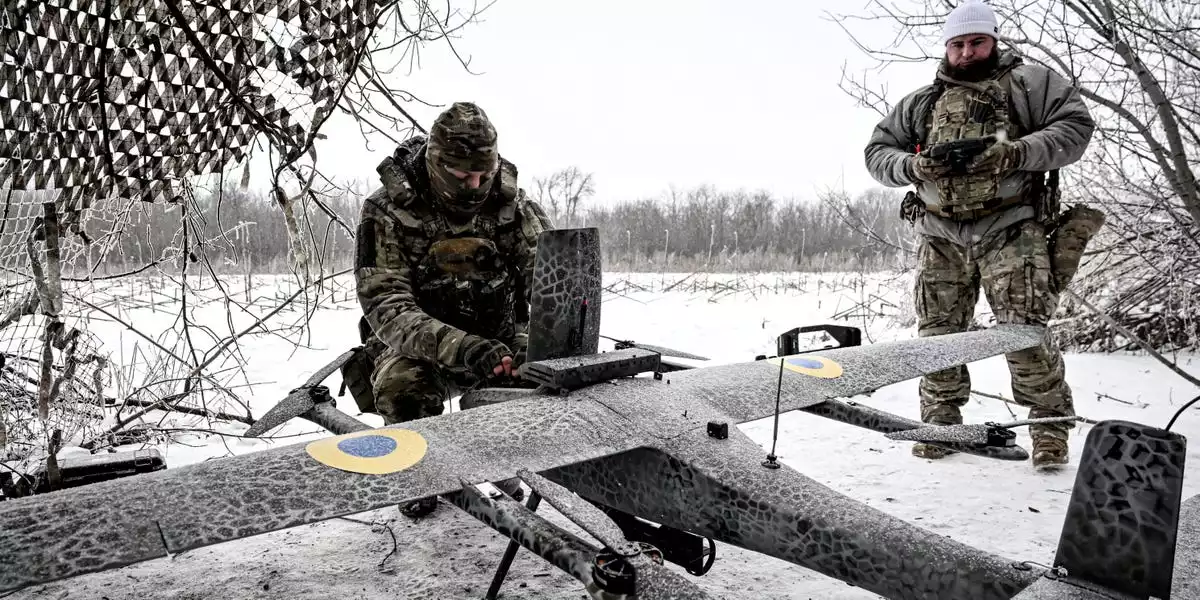

Cold-Weather Warfare: Improvisation at the Frontlines of Drone Technology
As Ukraine’s winter descends with its familiar, biting ferocity, the country’s combat units are quietly rewriting the playbook for battlefield innovation. In the shadow of Russia’s relentless campaign against energy infrastructure—a campaign that has plunged cities into darkness and strained the nation’s industrial backbone—Ukrainian forces have turned to an unlikely source for technological salvation: heated shoe insoles. This humble, $30–$40 consumer product, repurposed as a thermal shield for drone batteries, is not only preserving the operational edge of unmanned aerial vehicles (UAVs) but also illuminating a broader transformation in the economics and strategy of modern conflict.
The Science of Survival: Thermal Management and the Edge Device Revolution
Lithium-based batteries, the lifeblood of military and commercial drones alike, are notoriously susceptible to subzero temperatures. Below –10 °C, these cells can lose up to 30% of their capacity, with voltage sag threatening to trigger mid-flight failsafe protocols—an unacceptable risk in the high-stakes theater of frontline reconnaissance and strike missions. Traditional military solutions—integrated heaters, phase-change materials—are expensive, heavy, and slow to procure. The Ukrainian answer, by contrast, is elegant in its simplicity: a 50-gram heated insole, readily available from civilian supply chains, deployed in a matter of hours.
This field improvisation is not merely a stopgap. It is a case study in the “consumer-grade militarization” of technology, where off-the-shelf solutions outpace bespoke military hardware in both speed and adaptability. By shifting thermal management to the edge device—the drone itself—Ukrainian units are echoing trends in enterprise IT, where localized compute and power redundancy are becoming the norm in edge AI deployments. The implications ripple far beyond the battlefield: lessons learned here may soon inform battery innovations for Arctic logistics, offshore wind maintenance, and polar scientific expeditions.
Economic Asymmetry and Supply Chain Dynamics in Wartime Innovation
The cost calculus behind Ukraine’s battery fix is as striking as its ingenuity. For the price of a disposable insole, soldiers are safeguarding battery packs valued at hundreds of dollars and drones worth tens of thousands—a micro-capex intervention with macro-level impact. This asymmetry is a lesson in resourcefulness that CFOs and risk managers in harsh environments would do well to heed: sometimes, it is the low-tech augmentation that neutralizes the high-tech vulnerability.
The supply chain for heated wearables, largely concentrated in East Asian OEMs, remains unencumbered by export controls, but this may not last. As defense ministries and private security firms take note, opportunistic procurement could tighten availability for recreational consumers by next winter. Meanwhile, Russia’s campaign against Ukraine’s grid is already shaving an estimated 5–7% from monthly industrial output, forcing companies to divert capital toward backup generation and accelerating the adoption of energy resilience technologies—diesel-hybrid systems, battery storage, and microgrids. This emerging demand pool is likely to attract multinational investment, reshaping the region’s energy landscape for years to come.
Strategic Feedback Loops and the Dual-Use Frontier
Ukraine’s battlefield, under constant threat and adaptation, has become a crucible for rapid innovation. The live-fire environment collapses the feedback loop from months to days, granting Ukrainian forces—and their NATO observers—a systemic agility that is as valuable as any hardware. The shift from platform-centric to component-centric thinking is already being catalogued for doctrinal integration, with the West’s supply of energy equipment to Kyiv proving as strategically decisive as the provision of armaments.
The implications for industry are profound. The heated insole hack foreshadows a surge in “defense-inflected” consumer electronics: wearable thermal solutions, modular UAV heating kits, and battery telemetry software tuned for extreme environments. Drone manufacturers in logistics, agriculture, and infrastructure inspection should anticipate demand for integrated cold-weather packages and adaptive power management—premium features that will differentiate tomorrow’s market leaders.
The data harvested from thousands of winter drone sorties is, in itself, a strategic asset. Telemetry on battery degradation under duress offers a treasure trove for firms seeking to develop predictive maintenance algorithms—proprietary insights that could define the next generation of commercial fleet management.
For those with the foresight to act—battery suppliers, infrastructure investors, platform vendors, and policy architects—the Ukrainian experience offers a blueprint for resilience and competitive advantage. The $40 battery fix is more than a wartime anecdote; it is a signal flare for an era in which edge-level ingenuity, supply-chain elasticity, and dual-use innovation will determine who thrives in a world defined by climatic volatility and geopolitical flux.


 By
By
 By
By
 By
By
 By
By
 By
By

 By
By







