


A New Frontline: How Ukraine’s UGV Surge Is Rewriting the Rules of Modern Warfare
The rolling steppe of Eastern Ukraine, once the stage for conventional armored thrusts and massed infantry, now hums with the quiet whir of electric motors and the flicker of algorithmic intent. In this crucible, unmanned ground vehicles (UGVs) have moved from novelty to necessity, their proliferation signaling a tectonic shift in the nature of conflict. Ukraine’s embrace of these machines—nearly 200 indigenous models, from humble evacuation carts to AI-enabled “mini-tanks”—has not only multiplied its battlefield options, but also rewritten the psychological calculus of war.
Modular Innovation and the Mesh of Resilience
The Ukrainian approach to UGV development is as much a story of software culture as it is of hardware. Most platforms are built atop commercial off-the-shelf (COTS) components, enabling a sprint cadence familiar to Silicon Valley but rare in military procurement. In weeks, not years, new variants roll out, each iteration a response to frontline lessons. This rapid modularity is not just a technical feat; it is a survival strategy, allowing Ukraine to outpace Russian adaptation and electronic countermeasures.
Key technological breakthroughs include:
- EW-Hardened Communications: Layered frequency-hopping radios and low-power, line-of-sight repeaters form a mesh network, stress-tested under relentless Russian jamming. These field-forged networks anticipate the resilience of future 6G architectures.
- Human-Machine Teaming: Semi-autonomous navigation and target acquisition are reducing operator cognitive load by up to 40 percent, hinting at a near-future where a single soldier can direct swarms of machines.
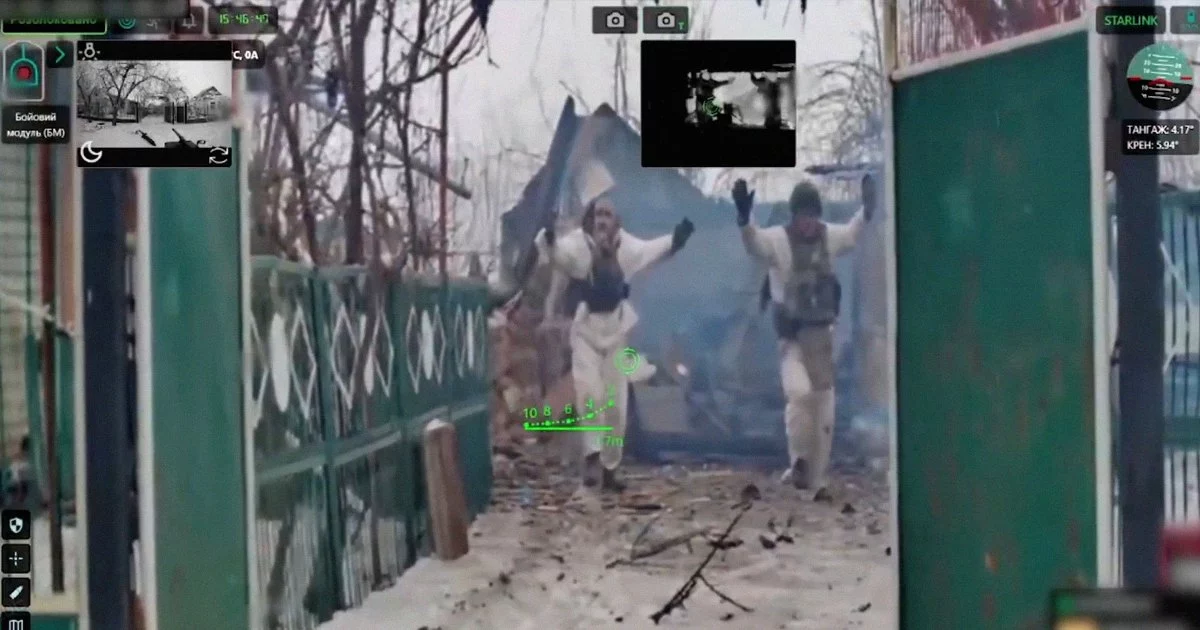
- Psychological Impact: The viral footage of Russian troops surrendering to a DevDroid “Droid TW” UGV is more than a curiosity—it is a glimpse into a new kind of warfare, where the presence of autonomous systems accelerates enemy capitulation and erodes the human calculus of risk.
Distributed Manufacturing and Economic Leverage
Ukraine’s UGV ecosystem is not a monolithic defense-industrial complex, but a constellation of over forty micro-foundries and IT-driven workshops. This distributed model, reminiscent of Taiwan’s semiconductor supply chain, has transformed the country’s software outsourcing prowess into a dual-use manufacturing engine. It is a template with resonance far beyond the battlefield.
Consider these economic dynamics:
- Radical Cost Efficiency: Basic tracked UGVs cost less than $15,000—an order of magnitude below the price of a single Javelin missile—while reusing up to 70 percent civilian components. This cost curve makes robotics accessible not just for militaries, but for border security, disaster response, and industrial safety.
- Western Co-Production: German firms such as ARX Robotics are leveraging Ukrainian combat validation as a de-risking mechanism, accelerating NATO procurement and export cycles. The “combat-proven” premium, once the preserve of Israeli defense exports, is now a Ukrainian asset.
- Data as Strategic Capital: Every mission generates high-resolution telemetry, creating a wartime dataset that will feed future autonomy stacks in mining, energy, and agriculture. Early access to this data is poised to become a key bargaining chip in international defense partnerships.
Geopolitical and Doctrinal Reverberations
The implications of Ukraine’s UGV revolution ripple outward, reshaping not only the immediate conflict but the very doctrines that underpin global security. The battlefield has become a laboratory in which offset strategies—using swarms of low-cost robots to bleed a numerically superior adversary—are tested in real time. This is a playbook with clear relevance for the Baltics, the Indo-Pacific, and any nation facing a larger neighbor.
Notable strategic shifts include:
- Doctrine Spillover: NATO manuals are quietly being revised to integrate UGVs and their countermeasures, while Russia’s lag in ground robotics may drive asymmetric escalation in cyber or space.
- Arms-Control Gaps: Existing treaties, such as the Convention on Certain Conventional Weapons, are silent on tele-operated systems, mirroring the early, unregulated spread of UAVs. The risk of unilateral export restrictions and tech-stack decoupling looms.
- Insurance and Risk Pricing: As machines increasingly absorb frontline danger, war-risk insurance premiums could structurally decline, freeing capital for other uses—a subtle but profound macroeconomic effect.
The Blueprint for Tomorrow’s Civil-Military Landscape
For defense ministries, the lesson is stark: budget allocations must shift from legacy armor to scalable, resilient robotics, with at least 15 percent earmarked for unmanned systems R&D. Technology vendors should prioritize open architectures and AI-ready edge compute, anticipating dual-use spillovers. Investors will find that robotics startups with combat-proven data command premiums rivaling late-stage biotech firms, while policymakers face the urgent task of setting norms around autonomy, data rights, and export controls.
Ukraine’s operationalization of UGVs, supported by a dynamic cohort of domestic and select Western partners, is not merely a response to immediate peril. It is a harbinger—a living prototype—of how ground combat power will be democratized, iterated, and wielded in the decades to come. The world is watching, and the blueprint is being drawn in real time.

 By
By
 By
By

 By
By
 By
By
 By
By
 By
By
 By
By







