

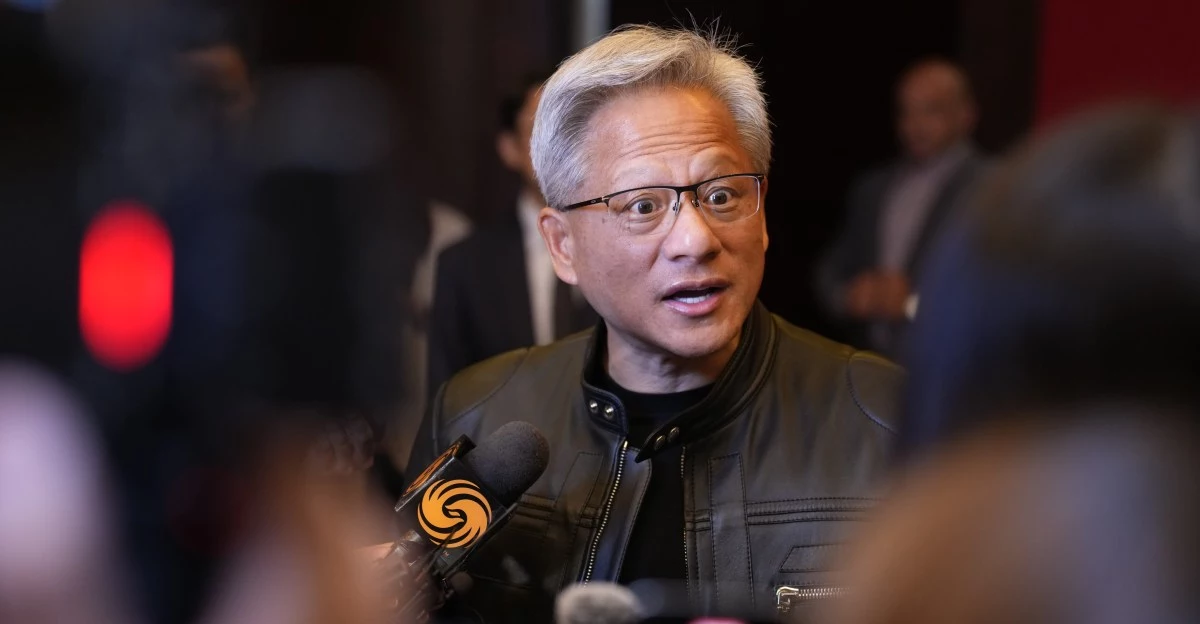

Trump’s Nvidia Pivot: A Case Study in Power, Policy, and the Future of AI
Donald Trump’s abrupt volte-face on Nvidia—shifting from musings about breaking up the AI chip titan to championing its centrality in America’s technological arsenal—offers a rare, crystalline window into the collision of market dominance, geopolitics, and the evolving logic of industrial policy. This episode, catalyzed by Trump’s belated grasp of Nvidia’s overwhelming grip on the AI-accelerator market and a direct parley with CEO Jensen Huang, is less about personalities than about the tectonic forces shaping the future of computation, competition, and national security.
The Anatomy of Dominance: Nvidia’s Moat and Its Fragilities
Nvidia’s supremacy is not merely a matter of market share—though its 80-90% hold on data-center AI accelerators is formidable. The company’s true fortress lies in its software ecosystem, most notably the CUDA platform, which has become the lingua franca for AI developers worldwide. This software lock-in, more than any foundry process or nanometer race, is what keeps even well-capitalized rivals like AMD, Intel, and a16z-backed upstarts at bay.
Yet, this dominance is not without systemic risk. Nvidia’s reliance on TSMC’s advanced packaging lines in Taiwan introduces a single point of failure into the global AI supply chain. Any geopolitical tremor in the Taiwan Strait would reverberate instantly through the world’s hyperscalers, threatening to derail AI adoption timelines and upend enterprise roadmaps. The barriers to entry—cutting-edge HBM memory, proprietary network interconnects, and, above all, developer mindshare—render the prospect of meaningful competition a decade-long endeavor, absent a disruptive leap in chip architecture or algorithmic efficiency.
- De facto standard-setting power via CUDA
- Supply-chain concentration on TSMC
- High barriers to entry for rivals
Policy as Industrial Strategy: Export Controls and Antitrust in the Rearview
The Trump administration’s decision to allow Nvidia’s “fourth-best” H20 GPUs to be exported to China—while keeping the most advanced chips stateside—reveals a sophisticated playbook. This tiered approach ensures that Chinese AI labs remain tethered to U.S. toolchains, forestalling indigenous innovation while sustaining Nvidia’s revenue engine. It’s a modern echo of the “oil-for-naval-supremacy” bargains of the past, with silicon replacing crude as the strategic lever.
Antitrust, meanwhile, has been relegated to the wings. Trump’s public reversal signals a regulatory climate that privileges technological dominance over structural deconcentration, at least when national-security narratives are ascendant. Nvidia’s $4 trillion market cap is more than a financial milestone; it is a shield, conferring lobbying power, supplier pre-emption, and ecosystem lock-in. For now, the cost—political and economic—of aggressive enforcement appears prohibitive.
- Tiered export controls as strategic leverage
- Muted antitrust agenda under national-security imperatives
- Market cap as a policy shield
Economic Reverberations and Strategic Imperatives for Industry Leaders
The consequences of this regulatory and market environment ripple far beyond Nvidia’s balance sheet. Hyperscalers are on track to invest over $200 billion in AI infrastructure between 2024 and 2025, locked into a single-vendor cost curve that supports Nvidia’s margins but compels cloud giants to accelerate in-house ASIC and alternative silicon development. Venture capital, sensing the gravity well, is shifting from model-building to silicon—though Nvidia’s architectural lead and buying power threaten to create a graveyard of “zombie” chip start-ups, echoing the failed LTE modem entrants of the 4G era.
For enterprise executives, the strategic mandate is clear:
- Diversify sourcing: Hedge against single-supplier risk with alternatives like AMD’s MI300, Intel’s Gaudi 3, or custom accelerators on open standards.
- Secure long-term allocations: Treat GPU supply like energy futures, negotiating multi-year capacity reservations.
- Invest in software portability: Encourage development on abstraction layers such as OpenAI’s Triton or OneAPI to reduce CUDA dependence.
- Plan for geopolitical shocks: Model scenarios involving a 12- to 18-month interruption in advanced node availability, and invest in mitigation strategies—edge inference, algorithmic efficiency, or on-prem FPGA fallback.
The Road Ahead: Navigating an Era Where Policy Shapes the Playing Field
Looking forward, the regulatory vector is clear: a second Trump term would likely double down on tight export controls for top-tier GPUs while remaining permissive on downgraded SKUs, with antitrust scrutiny kept at bay. Yet, a shift in administration—or a bold move from Brussels—could still introduce targeted remedies, from bundling rules to interoperability mandates. Technologically, advances in chiplet architectures and optical interconnects may compress the catch-up timeline for challengers, provided supply chains for high-bandwidth memory remain intact.
The Trump–Nvidia episode is more than a footnote in the annals of tech policy; it is a harbinger of a new paradigm, where U.S. leadership in strategic technologies is predicated on the selective nurturing of quasi-monopolies, so long as they serve the national interest. For decision-makers, the imperative is to exploit Nvidia’s performance edge while investing in architectural and geopolitical hedges—recognizing that in this era, policy can reset the competitive landscape overnight.

 By
By


 By
By
 By
By
 By
By

 By
By







