

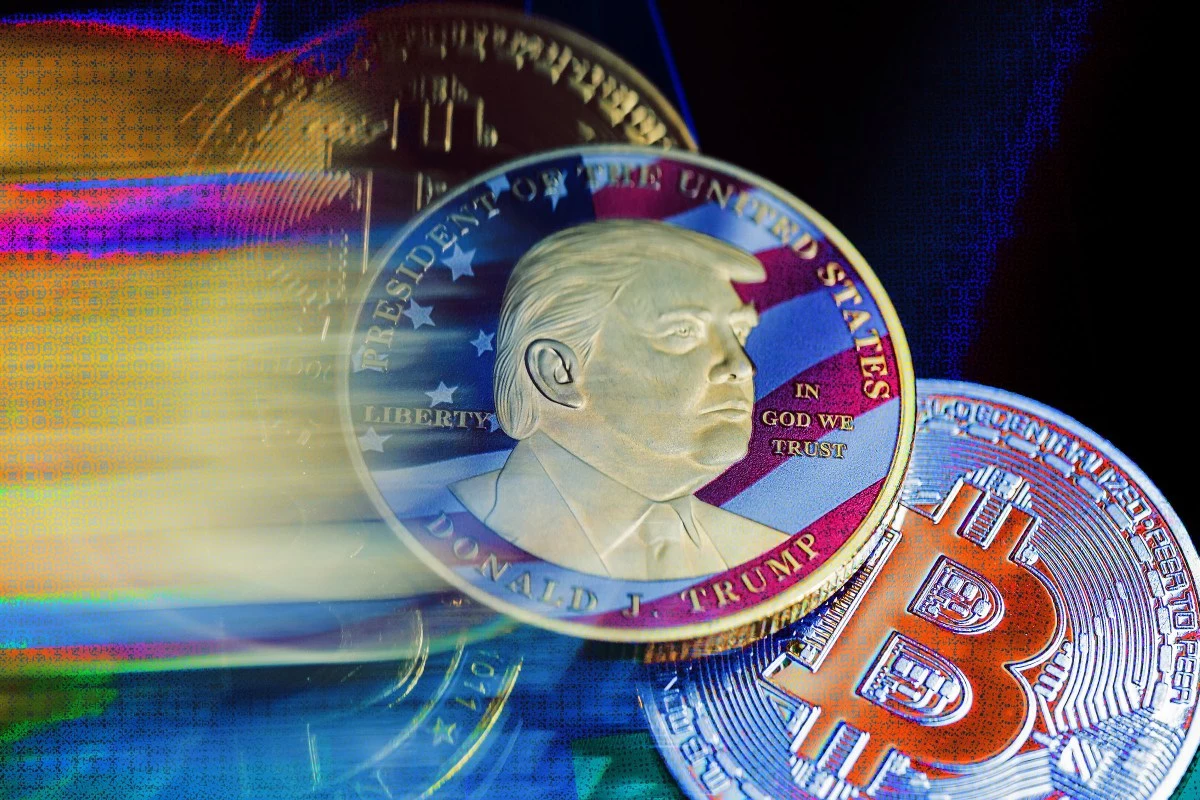

A politically branded meme coin meets the hard edge of market gravity
The dramatic rise and collapse of the $TRUMP token, a Solana-based meme coin launched in late 2023, has become a case study in how quickly narrative-driven assets can unwind when sentiment turns. From a peak above $75 to roughly $2.87—a drawdown of about 96%—the token’s trajectory mirrors the defining traits of the meme-coin economy: reflexive price action, social-media momentum, and valuations anchored more to attention than to cash flows or utility.
What makes this episode especially consequential is the political branding. Unlike dog-themed or purely satirical tokens, a coin tied—directly or indirectly—to a major political figure introduces a second axis of volatility: public approval and political cycle dynamics. As broader enthusiasm around Trump’s brand reportedly cooled, speculative demand for the token cooled with it, reinforcing a feedback loop where price becomes a proxy for popularity rather than fundamentals.
At the same time, the collapse unfolded against a broader crypto risk-off backdrop. With Bitcoin down roughly 38% over six months, liquidity and risk appetite have tightened across digital assets. In that environment, meme coins—often the first to surge in exuberant markets—are also among the first to be sold when investors retreat to perceived quality or cash.
—
Solana, DeFi rails, and how speed can amplify speculative extraction
Technologically, the $TRUMP token underscores how modern Layer 1 networks can be used not only for innovation, but also for rapid speculative manufacturing. Solana’s high-throughput, low-fee architecture lowers the friction to mint, list, and trade tokens at scale—an advantage for legitimate consumer applications, but also an accelerant for short-lived hype cycles.
The mechanics of decentralized finance further sharpen the incentives. On-chain liquidity commonly relies on automated market makers (AMMs), where pricing is determined algorithmically and trading can scale quickly once liquidity is seeded. In many meme-coin launches, smart contracts also include programmable fee structures that route a portion of transaction fees to deployers or designated wallets. Reports tied to the $TRUMP ecosystem cite over $100 million in trading fees in two weeks and roughly $427 million across $TRUMP and a follow-on $MELANIA token, illustrating how fee design can monetize volatility itself.
This is where the episode becomes less about “crypto being volatile” and more about incentive alignment. When governance is thin and disclosure is limited, the system can reward those closest to issuance and liquidity provisioning—especially if they can exit early. The market’s suspicion of an insider-led sell-off resembling a “rug pull” reflects a familiar pattern:
- Early positioning (privileged timing, access to initial liquidity, or insider allocation)
- Rapid price appreciation driven by attention and social propagation
- Liquidity and fee extraction as trading volume spikes
- Downstream losses concentrated among late-arriving retail participants
The technology is not inherently the culprit; rather, it is the combination of composability, speed, and minimal guardrails that can turn token launches into high-velocity wealth transfers.
—
The economics of meme coins: adverse selection, reflexivity, and brand correlation
From a market-structure perspective, the $TRUMP token’s arc highlights classic adverse selection. When a token’s value is primarily narrative-based, those with the earliest access or best information can sell into the very demand they help catalyze. One report cited $109 million in profit within hours for early backers—an outcome that, whether fully verified or not, aligns with how thinly governed launches can concentrate upside among insiders and intermediaries.
Meme coins also thrive on network effects: the more people talk about them, the more liquid they become; the more liquid they become, the more tradable—and therefore discussable—they are. This reflexivity can push prices far beyond any reasonable benchmark, but it works in reverse with equal force. Once the narrative breaks—through political headlines, insider selling, or broader market stress—liquidity can evaporate and volatility becomes punitive.
The $TRUMP case adds a distinctive variable: brand correlation risk. If a token’s perceived value is tethered to a public figure’s reputation, polling, or legal and electoral developments, then token holders are implicitly taking exposure to a complex bundle of non-market events. That linkage can be alluring during momentum phases, but it is structurally fragile:
- Political sentiment can shift abruptly and asymmetrically
- News cycles can reprice “brand assets” faster than markets can digest
- The token becomes a speculative derivative of attention, not utility
For institutional allocators, this is precisely the kind of exposure that is difficult to hedge, difficult to value, and easy to underestimate.
—
Regulatory and governance pressure points: when tokens intersect with public office
The most durable implications may be regulatory. A token associated with a current or prospective head of state raises questions that extend beyond typical meme-coin enforcement debates. Even absent explicit endorsement, the market can interpret branding as affiliation, and affiliation can create conflict-of-interest concerns—particularly if insiders or connected entities benefit from fees, allocations, or liquidity events.
Key issues regulators and policymakers are likely to scrutinize include:
- Disclosure and distribution transparency: Who holds supply, what are the lockups, and how are fees routed?
- Anti-fraud and market manipulation: Do promotional dynamics and insider exits meet thresholds for deceptive conduct?
- Campaign-finance implications: Could token purchases function as in-kind political contributions, and if so, what disclosure or limits apply?
- Securities classification risk: If expectations of profit are driven by managerial efforts or coordinated promotion, enforcement theories may sharpen
For builders and protocol designers, the episode strengthens the argument for embedded safeguards—not as paternalism, but as market integrity infrastructure. Timelocks, vesting schedules, anti-whale constraints, graduated fees, and standardized on-chain provenance can reduce the probability that token markets become dominated by extraction strategies.
For investors—especially executives and institutions—the lesson is less about avoiding crypto and more about differentiating between assets with durable utility and governance versus instruments engineered primarily for attention. The $TRUMP token’s boom-and-bust cycle illustrates how programmable finance can turn political narrative into tradable volatility—and how quickly that volatility can migrate from a chart to reputational, ethical, and regulatory terrain where the costs are harder to quantify and far harder to reverse.

 By
By

 By
By
 By
By
 By
By

 By
By








