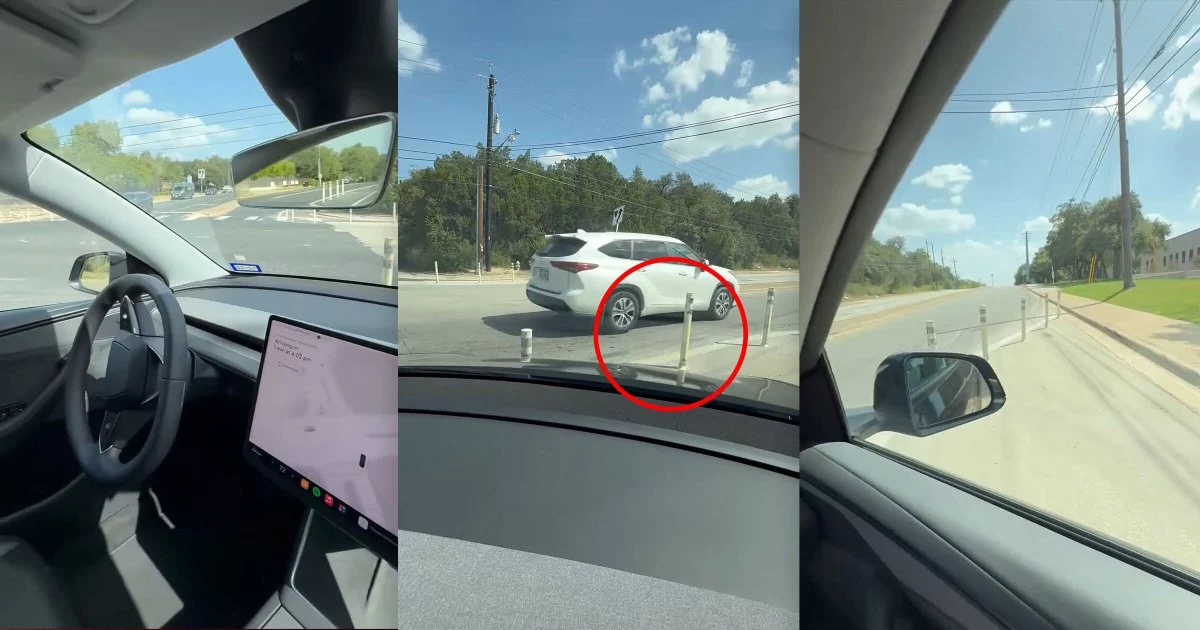

A low-speed collision that spotlights high-stakes autonomy gaps
Video of a Tesla Robotaxi striking and then pushing through plastic lane-control bollards after an incorrect turn is the kind of incident that rarely causes physical harm yet carries outsized strategic weight. No injuries were reported, but the sequence—misread closure, contact with barriers, hesitation, then forward breach rather than a controlled retreat—offers a compact case study in how autonomous driving systems behave when the world stops matching their expectations.
The immediate questions raised are not merely about “why it hit the bollards,” but about whether the system can reliably execute three safety-critical competencies in dense urban environments:
- Detect and classify roadway restrictions (closed lanes, temporary barriers, work zones) with high confidence
- Select conservative fallback maneuvers when the planned route becomes invalid
- Escalate to teleoperation or human assistance quickly and decisively when uncertainty spikes
This matters because the incident lands in the shadow of Tesla’s recent messaging that its Robotaxi operation has logged “0 notable incidents” over 380,000 miles. Even if that claim is technically defensible under a narrow definition, the public—and regulators—tend to interpret such statements as a proxy for robust, repeatable safety performance across edge cases. A single widely shared clip can reframe the narrative from “statistical progress” to “systemic brittleness,” especially when earlier reports have alleged erratic behavior and wrong-way driving.
What the bollard breach suggests about perception, planning, and teleoperation
At a technical level, the episode reads like a chain reaction across the autonomy stack: perception uncertainty → route invalidation → indecisive policy → suboptimal recovery.
Plastic bollards and temporary lane closures are deceptively hard. They can be visually inconsistent, poorly lit, partially occluded, or positioned in ways that conflict with map priors. If the system’s sensor fusion assigns a low “immovable obstacle” confidence—mistaking bollards for traversable debris or flexible objects—the planner may treat the space as passable. The risk is not only misclassification, but miscalibrated certainty: the software may act as if it knows more than it does.
The hesitation captured on video is as revealing as the impact. In safety engineering terms, hesitation can indicate the system recognized a conflict but lacked a validated escape policy. A robust Level 4-style behavior set typically includes conservative defaults such as:
- Stop and hold position while maintaining safe spacing
- Reverse or re-route only when the path is verified safe
- Request remote assistance when the environment is outside the operational design domain (ODD) or confidence thresholds
Proceeding forward through barriers suggests the “no-go zone” logic may not be sufficiently guarded—either because the bollards were not treated as a hard boundary, or because the planner prioritized forward progress over a more conservative retreat.
Perhaps the most consequential ambiguity is whether a teleoperator was notified, whether they had authority to intervene, and how quickly. If remote assistance exists but is slow to trigger—or constrained by restrictive override protocols—then the system can appear “autonomous” while still lacking the safety net that many commercial AV fleets rely on for rare, high-uncertainty moments. In modern autonomous fleet operations, teleoperation is less about “driving the car” and more about unblocking: confirming closures, authorizing a reroute, or instructing a safe stop.
The business impact: trust elasticity, unit economics, and competitive framing
Robotaxi economics are unusually sensitive to public confidence. A single incident can reduce ridership, which then reduces miles, which then worsens the amortization of fixed costs—software development, fleet maintenance, mapping, safety operations—over fewer revenue-generating trips.
Reports of declining ride volumes, if accurate, would signal that Robotaxi demand is elastic to perceived safety and predictability. For autonomous mobility, “safe” is necessary but not sufficient; riders also want smoothness, clarity, and the absence of awkward moments (hesitation, confusion, odd maneuvers). Those moments may not register as “notable incidents” internally, but they can be decisive in consumer choice.
Tesla’s approach is often contrasted with competitors that emphasize constrained domains and heavy operational scaffolding. This incident gives rivals a narrative opening:
- Waymo-style fleets can point to mature teleoperation and conservative ODD management as a pathway to predictable behavior, albeit with higher operating costs.
- Legacy OEM L2+/L3 systems (e.g., highway-focused offerings) can reinforce the message that validated performance in limited corridors may be preferable to broader autonomy with visible edge-case failures.
In markets where regulators and municipalities are cautious, optics matter. A low-speed bollard strike can become a proxy debate about whether Tesla’s autonomy strategy is scalable without a more formal safety case.
Metrics, regulation, and the emerging requirement for radical transparency
The phrase “0 notable incidents” is doing heavy lifting—and that is precisely why it invites scrutiny. In safety-critical industries, credibility hinges on definitions, disclosure, and auditability. If “notable” excludes near-misses, uncomfortable interventions, or minor contacts, the headline number may be technically correct while still misaligned with stakeholder expectations.
Regulators are likely to focus on three pressure points:
- Standardized incident taxonomy (what counts, how it’s reported, and on what timeline)
- Disengagement and intervention reporting (including remote assistance events)
- Liability clarity across software, fleet operator, and any human-in-the-loop function
The broader lesson is that autonomy is entering a phase where development velocity must coexist with safety-case discipline. Agile iteration can produce rapid improvements, but Level 4 deployment increasingly demands formal validation, scenario coverage arguments, and transparent post-incident root-cause analysis.
If Tesla treats this episode as a narrow anomaly, it risks repeating the cycle of viral clips and reactive explanations. If it treats it as a signal—about edge-case coverage, conservative fallback behavior, and teleoperation thresholds—it has an opportunity to strengthen both the product and the public contract that autonomous mobility ultimately depends on.

 By
By
 By
By
 By
By

 By
By

 By
By