


Earnings reality check: deliveries up, cash generation down
Tesla’s second-quarter results delivered a familiar juxtaposition: operational momentum in vehicle deliveries alongside financial signals that the next growth chapter is proving more capital-intensive and less predictable than markets had priced in. The company posted net profit of $1.1 billion, down from $1.2 billion a year earlier and roughly $250 million below expectations. More striking for investors focused on durability rather than headlines, Tesla recorded its first negative free cash flow in more than two years—a metric that tends to matter most when a company is simultaneously funding ambitious R&D programs and defending margins in a competitive EV market.
The market’s response was swift: shares fell 15% in a single day, followed by an additional 3% decline, reflecting not just disappointment with the quarter but a broader repricing of execution risk. In practical terms, negative free cash flow implies that Tesla’s current mix of spending—on autonomy, compute, fleet operations, and ongoing product and manufacturing needs—is not yet being offset by cash generated from the core business at the level investors anticipated.
Key financial takeaways shaping sentiment include:
- Profitability drift: modest year-over-year net income decline, but meaningful versus expectations.
- Cash flow inflection: negative free cash flow suggests higher capital consumption and/or weaker operating cash conversion.
- Narrative sensitivity: when valuation is partially anchored to future autonomy economics, near-term autonomy execution becomes a first-order driver of market confidence.
Robotaxi execution gap: the difference between a demo and a service business
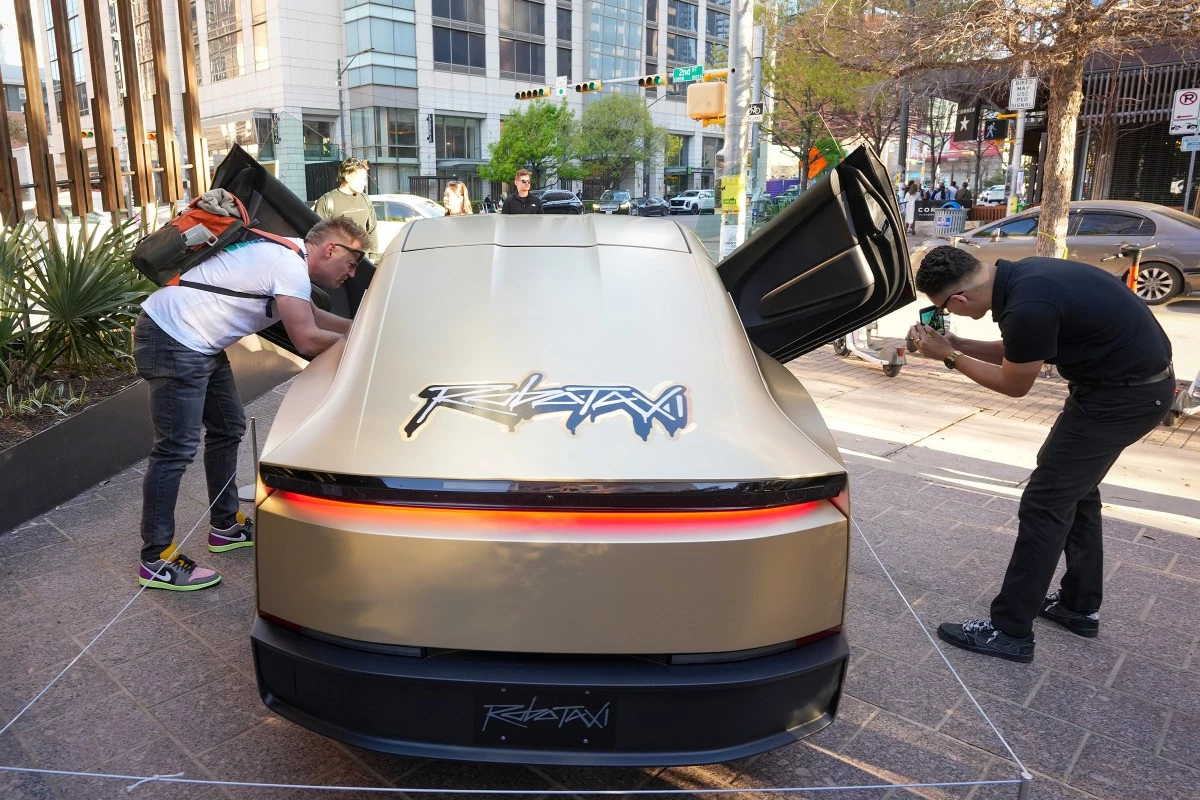
At the center of the quarter’s disappointment sits Tesla’s Robotaxi program—less as a concept than as an operational reality. CEO Elon Musk had forecast more than 1,000 autonomous vehicles on Austin roads within months of launch. The reported state of play is materially smaller: fewer than 100 vehicles, and only about one-third operating without human safety monitors. For a service that must prove reliability at scale, the delta between forecast and deployment is not cosmetic; it directly affects unit economics, regulatory posture, and the pace of product learning.
Even more telling is the usage trajectory. Miles driven by paying Robotaxi customers fell quarter-over-quarter from 1.1 million to 700,000, a decline of more than one-third. That contraction matters because autonomous mobility is, at its core, a compounding system: more miles produce more edge-case exposure, which improves models, which improves safety and comfort, which increases demand and utilization—creating a flywheel. A decline in paid miles interrupts that compounding effect.
Tesla’s presentation of cumulative miles—a common reporting choice in autonomy—can make progress appear monotonic even when current-period performance is deteriorating. Cumulative metrics are not inherently misleading, but they are incomplete without period-over-period context, especially when investors are trying to assess whether a Robotaxi network is accelerating or stalling.
Tesla has also pointed to a spotless safety record over 380,000 miles, but the credibility of any safety claim depends on definitions and disclosure. The term “notable incidents” is described as vague, and anecdotal reports of erratic driving persist. For regulators and enterprise partners, the bar is not simply “no major events,” but transparent incident taxonomy, clear disengagement reporting, and evidence that the system behaves predictably under stress.
Autonomy’s hard problems: data velocity, sensor trade-offs, and regulatory friction
The Robotaxi shortfall underscores a core truth of autonomous driving: commercialization is not a linear extension of feature capability. The remaining challenges tend to cluster in the least forgiving domains—rare events, ambiguous human behavior, complex urban geometry, and adverse conditions—where perception and planning must be paired with robust fail-safes.
Three technical and ecosystem dynamics stand out:
- Data scale and “fleet learning” constraints: Tesla’s autonomy strategy leans heavily on learning from real-world driving. If paid Robotaxi miles are falling and fully driverless miles are limited, dataset velocity slows, potentially delaying improvements in edge-case handling and system confidence.
- Sensor strategy and cost discipline: Tesla’s emphasis on cameras and radar—avoiding LiDAR to preserve cost advantages—remains a defining bet. Yet reports of erratic behavior raise the question of whether a predominantly vision-based approach can consistently handle the full spectrum of real-world complexity without either (a) more constrained operating domains or (b) additional sensing redundancy that could raise per-vehicle costs.
- Regulatory patchwork and permitting reality: Even if the technology advances, scaling Robotaxi operations requires permissions, reporting compliance, and public trust. The U.S. landscape remains fragmented across states and municipalities, while federal agencies tend to move cautiously when safety accountability is diffuse.
Tesla’s announced expansion into Tampa and Orlando adds another layer of scrutiny because fleet sizes and operating parameters remain undisclosed. In autonomy, geography is not merely a market expansion lever; it is a technical multiplier. Each new city introduces different road markings, driving cultures, weather patterns, and construction behaviors—variables that can stress a system that is still stabilizing in its initial deployment.
Strategic stakes: valuation narratives, opportunity costs, and what investors will now demand
Tesla’s long-term autonomy narrative has been a powerful valuation engine, with Musk’s past framing of Robotaxi economics implying extraordinary upside. But the Q2 results highlight the risk of a widening gap between future-market storytelling and present-tense operational metrics. When execution slips, investors typically shift from faith-based valuation to evidence-based valuation—demanding clearer proof of scalability, safety, and profitability.
This quarter also sharpens the question of opportunity cost. Capital and leadership attention devoted to Robotaxi development could have been deployed toward businesses with nearer-term revenue visibility—such as energy storage, grid services, or other product lines—potentially smoothing cash flow while autonomy matures. That does not invalidate the Robotaxi bet; it raises the governance question of portfolio balance under tighter market tolerance for long-duration uncertainty.
Going forward, the metrics likely to matter most are measurable and difficult to spin:
- Active fleet size (by city) and the share operating without safety monitors
- Paid miles per quarter and utilization rates (not just cumulative miles)
- Disengagements and incident reporting with standardized definitions
- Per-mile economics and the path to positive cash contribution
Tesla remains one of the most consequential companies at the intersection of EV manufacturing, AI-driven autonomy, and consumer-scale deployment. Q2 suggests the Robotaxi vision is not failing as an idea—it is colliding with the operational and regulatory rigor required to turn autonomy into a repeatable, cash-generating service, and markets are recalibrating to that reality in real time.

 By
By

 By
By

 By
By
 By
By
 By
By
 By
By







