
A high-stakes failure mode: when autonomy meets the physics of rail crossings
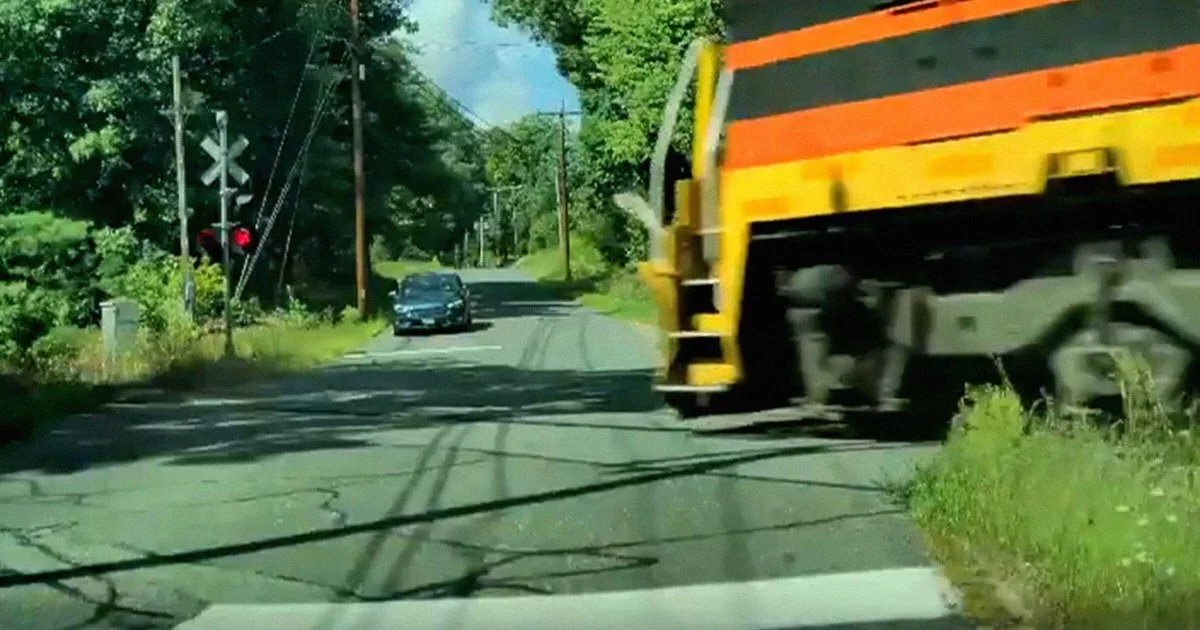
Tesla’s Full Self-Driving (FSD) v14.3.7 is again under an unforgiving spotlight after multiple documented incidents in which vehicles failed to reliably recognize and avoid oncoming trains at active railroad crossings. The most arresting accounts include a near-miss captured by auto journalist Lei Xing, where the vehicle reportedly advanced onto tracks despite flashing warning signals, with only last-second human intervention preventing a potentially fatal outcome. These reports are not isolated anecdotes; they sit alongside earlier cases involving impacts with barrier arms and even collisions with trains, reinforcing a pattern that regulators and safety engineers treat as a critical “edge case” with catastrophic downside.
Railroad crossings are uniquely demanding for automated driving systems because they compress risk into a narrow decision window. The environment combines high-speed cross-traffic, specialized signaling, and non-negotiable right-of-way rules. Unlike many road hazards, a train cannot swerve, cannot brake quickly, and often appears with visual cues that are easy for humans to interpret but difficult for machine perception under glare, occlusion, or complex backgrounds. In that context, the recurring failure mode is not merely a software defect—it raises questions about system design priorities, validation rigor, and the adequacy of current safeguards when autonomy encounters rare but well-known hazards.
For Tesla, the stakes are amplified by the company’s positioning of FSD as a continuously improving, software-defined capability delivered via over-the-air (OTA) updates. Each widely shared incident becomes a referendum not only on a single version number, but on the broader proposition that consumer vehicles can safely learn their way into autonomy at scale.
Why trains expose the limits of perception-led autonomy
At the technical core of these incidents is a familiar challenge in applied AI: perception is not understanding, and classification is not the same as risk-aware decision-making. Railroad crossings demand that a system interpret a scene with strict semantics—signals, gates, track geometry, and the possibility of a fast-moving object that may be partially visible until late in the approach.
Several plausible technical contributors recur across expert discussions of train-related autonomy failures:
- Sensor fusion constraints in a camera-centric stack: Tesla’s approach emphasizes cameras and neural networks, which can be cost-effective and scalable. But camera perception can degrade under glare, low sun angles, weather, visual clutter, or partial occlusion—conditions common at crossings. When the system’s confidence drops, the decision layer may revert to heuristics that are insufficiently conservative for rail environments.
- Edge-case coverage gaps: Crossings vary widely—different light configurations, barrier designs, signage standards, track angles, and train types (freight vs. passenger). If training and validation data underrepresent these variations, the model may generalize poorly, especially when the train is visible only intermittently between poles, vegetation, or roadside structures.
- Decision-making under ambiguity: A robust autonomy stack must treat certain cues as “hard constraints.” Flashing signals and lowered gates are not suggestions; they are binary stop conditions. If the system treats them as probabilistic inputs rather than deterministic triggers, it risks exactly the behavior described in near-miss footage: creeping forward, then accelerating, at the worst possible moment.
- The “rare but known” paradox: Train encounters may be infrequent per mile driven, but they are not unknown. Safety engineering typically treats such scenarios as high-severity, low-frequency events requiring explicit design attention—often through redundancy, rule-based overrides, and conservative fallback behaviors.
This is where the debate over autonomy philosophy becomes concrete. Competitors pursuing multi-sensor approaches (often combining cameras with radar and/or LiDAR) argue that redundancy is not a luxury but a prerequisite for safety-critical perception. Tesla’s counterpoint has historically emphasized software sophistication and fleet learning. The train-crossing problem tests which thesis better withstands the real world’s messiest corners.
OTA velocity versus safety assurance: the validation dilemma
Tesla’s OTA model is a strategic advantage—rapid iteration, fast deployment, and continuous improvement. Yet the same mechanism can become a liability when life-critical behaviors are involved. The central question is not whether software can improve quickly, but whether the release pipeline includes gating mechanisms strong enough to prevent regressions or blind spots from reaching broad distribution.
Key pressure points include:
- Simulation fidelity versus real-world rarity: Simulation can generate millions of miles quickly, but rare events are notoriously hard to model accurately. If a simulator underestimates the frequency or complexity of crossing scenarios, it can produce a misleading sense of readiness.
- Release governance and independent verification: In safety-critical domains, organizations often rely on structured validation, third-party audits, and formal safety cases. Consumer AV features have not consistently followed the same playbook, leaving regulators to infer safety posture from incidents rather than from transparent assurance artifacts.
- Fail-safe design expectations: A conservative system would implement layered protections—if crossing signals are active, the vehicle should default to a hard stop unless a verified safe path exists. The reported behavior suggests that any such safeguards may be insufficiently robust, inconsistently triggered, or overly dependent on perception confidence.
This is precisely why the National Highway Traffic Safety Administration (NHTSA) investigation matters. It signals a regulatory shift toward scrutinizing not just outcomes, but the processes and controls behind autonomous behavior: incident reporting, data access, update governance, and the logic that governs braking and acceleration in high-risk contexts.
Market, regulatory, and competitive fallout: trust is the real product
Beyond the engineering, the economic implications are immediate. Autonomy is ultimately sold on trust, and trust is built on predictability—especially around hazards that the public intuitively understands as deadly. Repeated, high-visibility failures can ripple through:
- Brand equity and consumer confidence: Premium buyers and risk-averse households may reassess the value of FSD subscriptions if the system appears unreliable in obvious danger zones.
- Insurance and liability exposure: If incidents accumulate, insurers may price in higher risk, raising ownership costs and increasing pressure for clearer accountability between driver responsibility and system behavior.
- Competitive positioning: Rivals pursuing geo-fenced Level 4 deployments and multi-sensor redundancy will likely use these episodes to argue that constrained operational design domains are not a limitation, but a safety strategy.
- Regulatory approvals and product roadmap: Investigations can slow feature expansion, constrain OTA practices, or push companies toward more formal certification and disclosure regimes—potentially reshaping how autonomy is commercialized in the U.S. and abroad.
For Tesla, the strategic path forward may hinge on demonstrating measurable, verifiable improvements in crossing behavior—through expanded scenario testing, stronger rule-based overrides, deeper data transparency, and potentially sensor or infrastructure partnerships such as V2X-style crossing communications. The broader industry will be watching closely, because railroad crossings are not merely another edge case; they are a stress test of whether consumer autonomy can earn the right to operate unsupervised in environments where a single misread can be irreversible.

 By
By
 By
By

 By
By
 By
By
 By
By
 By
By
 By
By