

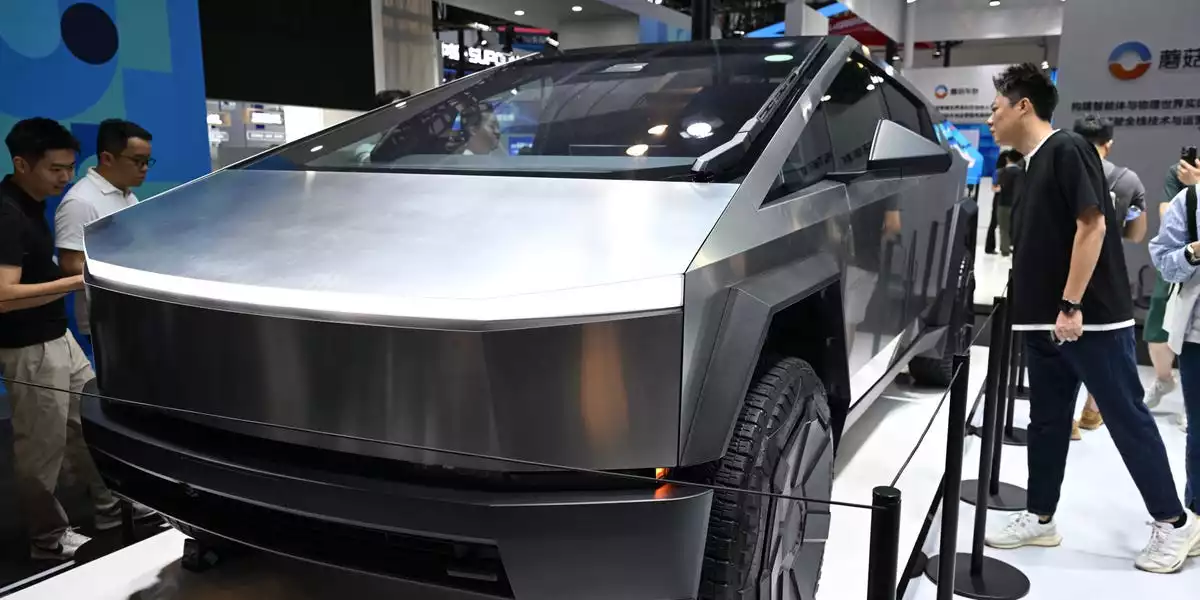

The Cybertruck’s Collision Course with Reality
Tesla’s Cybertruck, once the avatar of Silicon Valley bravado, now finds itself at a crossroads—a monument to ambition and a lesson in the unforgiving calculus of global automotive markets. With U.S. sales tallying just 11,000 units year-to-date, the chasm between Elon Musk’s vaunted 250,000 annual run-rate and today’s reality is stark. The numbers are more than a shortfall; they are a referendum on the limits of spectacle in a business governed by scale, regulation, and economic gravity.
The Cybertruck’s journey from viral prototype to commercial product has been anything but linear. Its stainless-steel exoskeleton and angular form, while visually arresting, have become millstones in the context of global compliance and cost. In Europe, the truck’s width and pedestrian safety profile have rendered it a regulatory outlier, subjecting it to expensive homologation and, in some cases, outright seizure. China’s weight ceilings for pickups all but preclude its entry without substantial redesign. Meanwhile, the sticker price—once promised at $39,900, now hovering between $60,000 and $100,000—has distanced the Cybertruck from the very mass-market buyers it was meant to electrify.
Engineering Dilemmas and Economic Headwinds
The Cybertruck’s technical architecture is a study in trade-offs. The stainless-steel body and giga-casting approach, though innovative, have introduced manufacturing complexities that ripple through the supply chain. Suppliers report yield losses north of 15%, a figure that translates into longer cycle times and structurally higher costs of goods sold. Unlike Tesla’s Model 3 and Y, which benefit from component commonality and volume-driven efficiencies, the Cybertruck stands apart—both literally and figuratively.
Regulatory physics further complicate matters. European Union standards on pedestrian safety and vehicle width classify the Cybertruck as a special-purpose vehicle, raising the bar for compliance and cost. In China, gross vehicle weight restrictions for Class A pickups effectively lock the Cybertruck out of the world’s largest auto market unless Tesla is willing to re-engineer the platform. These are not mere bureaucratic hurdles; they are existential constraints that shape the product’s global viability.
The autonomy narrative, once a cornerstone of the Cybertruck’s value proposition, now appears increasingly contingent on future hardware. Tesla’s own VP of Engineering, Lars Moravy, has publicly acknowledged that a smaller pickup—built on a forthcoming, modular “unboxed” platform—may be better suited to both export markets and autonomous applications. The implication is clear: the Cybertruck is not the endgame, but a waypoint.
Competitive Dynamics and Strategic Recalibration
The competitive landscape is shifting beneath Tesla’s feet. North American pickup buyers remain acutely price-sensitive, and Ford’s aggressive repositioning of the F-150 Lightning has reset value expectations across the segment. Meanwhile, Chinese automakers such as BYD and SAIC are preparing to launch sub-$40,000 electric pickups in emerging markets, threatening to leapfrog Tesla where regulatory barriers are lower but price elasticity is paramount.
For Tesla, the Cybertruck’s brand halo is undeniable, but the opportunity cost is mounting. Every unit produced occupies scarce capacity that could be allocated to the higher-margin Model Y. The company now faces a strategic imperative: converge its product platforms to restore scale economics. The next-generation compact architecture—capable of underpinning a mini-pickup, crossover, and robotaxi—offers a path back to the volume-driven margin flywheel that once defined Tesla’s ascent.
A smaller, globally compliant pickup would not only unlock new regulatory credits in Europe and China but also capitalize on surging midsize truck demand in the U.S. southwest. The market signals are unambiguous: flexibility, compliance, and affordability are the new watchwords.
Implications for Stakeholders and the Road Ahead
- Supply chain partners must prepare for a pivot away from stainless steel, with aluminum-intensive structures likely to dominate Tesla’s next wave of products.
- Fleet operators and commercial buyers should closely monitor Tesla’s compact pickup roadmap, particularly as urban delivery and congestion-zone regulations tighten.
- Competitors have a fleeting opportunity to capture premium-utility market share—provided they can balance payload, urban drivability, and speed to regulatory approval.
- Investors would be prudent to temper Cybertruck revenue forecasts, shifting focus to the cost efficiencies and software margins promised by Tesla’s next-gen platforms.
- Policymakers are reminded of their outsized influence: Tesla’s willingness to redesign underscores the centrality of harmonized safety and dimensional standards in shaping the future of electric mobility.
The Cybertruck’s commercial trajectory is less an anomaly than a case study in the perils of product-market misalignment. Tesla’s pivot toward a smaller, more adaptable pickup is not merely a tactical adjustment, but a strategic realignment—one that seeks to reconcile the company’s innovative instincts with the realities of global scale and compliance. For those attuned to these signals, the next chapter promises not just spectacle, but sustainable growth.

 By
By
 By
By
 By
By

 By
By
 By
By

 By
By







