


The Dawn of a New Productivity Paradigm: Superhuman’s Bid to Orchestrate Knowledge Work
The generative AI landscape is evolving at a breakneck pace, with Grammarly’s transformation into the “Superhuman” productivity platform standing as a bellwether for the sector’s future. What began as a single-purpose writing assistant now aspires to be the connective tissue uniting the disparate tools of modern knowledge work. By weaving together Superhuman Mail, Coda, and the newly launched Superhuman Go under a unified subscription, the company is not merely rebranding—it is staking a claim as the orchestration layer for the enterprise, challenging the dominance of Microsoft Copilot, Google Workspace AI, and a surging cohort of vertical copilots.
From Writing Aid to Contextual Orchestrator
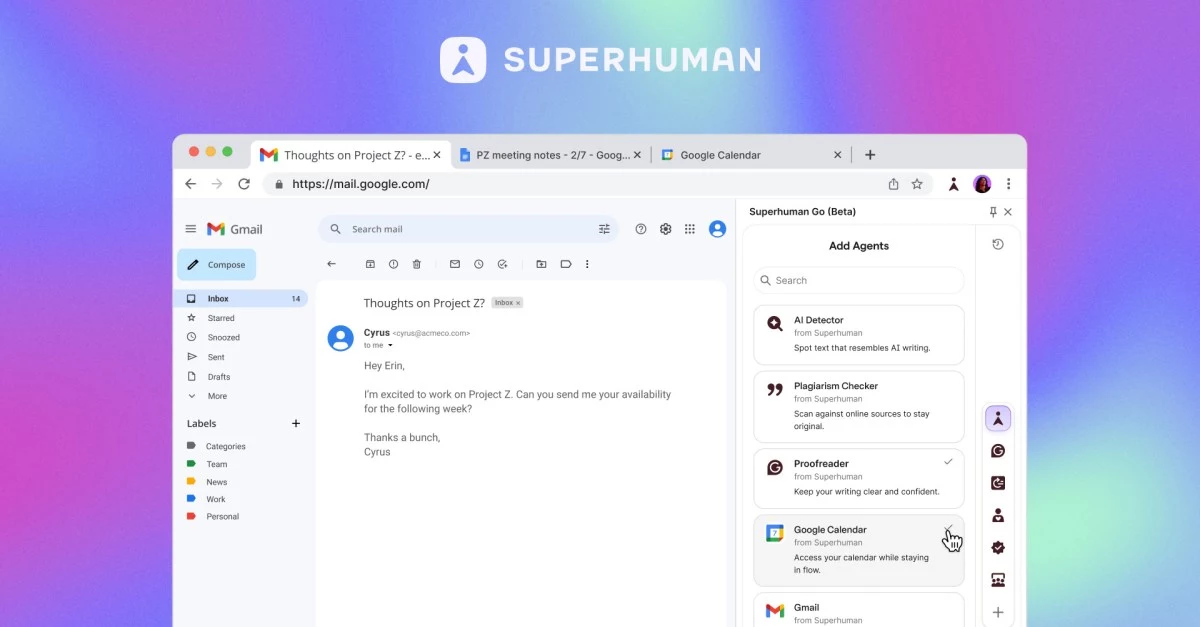
The strategic pivot from Grammarly’s roots in natural-language generation to cross-application orchestration is more than a feature upgrade; it is a reimagining of the very fabric of digital work. Superhuman Go, the centerpiece of this transformation, leverages AI to automate scheduling, search, and task management across a sprawling ecosystem of over 100 SaaS connectors. The introduction of an “Agent Store”—where pre-built workflows for platforms like Google Workspace and Microsoft 365 are surfaced—signals a move toward a platform-as-middleware model. Here, third parties can build bespoke micro-agents, effectively crowdsourcing the domain expertise that powers modern enterprises.
This model echoes the evolution of RPA (think UiPath) and iPaaS (Zapier), but with a crucial difference: the semantic reasoning of large language models. The result is a system that not only automates but understands, promising a future where context is king and productivity is orchestrated, not just assisted.
Economic Stakes and Strategic Gambits
Superhuman’s consolidation strategy is as much an economic maneuver as a technological one. The company’s decision to bundle Superhuman Go at no additional cost until February 2026 is a clear nod to the “freemium-to-lock-in” playbook that Microsoft so effectively deployed with Teams. This aggressive pricing signals a willingness to subsidize heavy cloud inference costs in the short term, betting on future monetization through premium agents, enterprise-grade features, or consumption-based pricing.
Key economic and strategic implications include:
- Total Addressable Market (TAM) Expansion: By moving beyond the $4–5 billion writing-assist segment to target the $135 billion knowledge-worker productivity software market, Superhuman is dramatically enlarging its potential reach—without needing to acquire an entirely new customer base.
- Margin Dynamics: Orchestrating across multiple apps is computationally expensive. The current pricing strategy is a calculated risk, aiming to build scale and stickiness before introducing premium tiers.
- Competitive Pressure: The bundling tactic puts pressure on independent AI point solutions, which may struggle to compete on both cost and integration breadth as Superhuman’s ecosystem grows.
Yet, this ambition is not without risk. As Gmail and Outlook roll out their own native copilots, the threat of API throttling or increased access costs looms large. Superhuman’s promise of cross-app neutrality hinges on its ability to secure durable API partnerships—or, failing that, to invest in reverse-engineering and extension frameworks that maintain its platform’s openness.
Navigating Regulatory Headwinds and Industry Consolidation
The broader industry context is marked by a wave of consolidation, with capital markets showing little patience for loss-making, narrowly focused AI startups. As productivity suites seek cross-sell leverage, roll-ups like Superhuman’s are likely to accelerate. For decision-makers, the calculus is shifting:
- Procurement Strategy: Enterprises must weigh the benefits of bundled, cross-app AI assistants against the risk of vendor lock-in and the potential sunsetting of standalone tools.
- Integration Architecture: CIOs are advised to scrutinize Superhuman’s connector ecosystem, ensuring that data-residency, access control, and auditability meet enterprise standards.
- Regulatory Overhang: The EU AI Act’s provisions on “high-risk systems” could subject multi-context assistants to heightened scrutiny, favoring players with established compliance infrastructure.
Meanwhile, the Agent Store model introduces new vectors for both innovation and risk. As third-party workflows proliferate, questions of data privacy, compliance, and liability will become central—not just for Superhuman, but for the entire category of cross-ecosystem AI orchestrators.
The Road Ahead: Opportunity and Uncertainty
Grammarly’s metamorphosis into Superhuman is emblematic of a broader convergence—where generative AI, workflow automation, and SaaS consolidation are no longer discrete trends but facets of a single, accelerating movement. For technology leaders, the next two years—while Superhuman Go remains free—represent a crucible. Will enterprises double down on vendor-native copilots, or will the promise of a neutral, context-spanning orchestrator prove irresistible?
The outcome will hinge not only on technical execution, but on Superhuman’s ability to navigate economic, regulatory, and competitive crosscurrents. In this landscape, those who can orchestrate context across the cacophony of digital work will not just survive—they will define the future of knowledge work itself.

 By
By
 By
By


 By
By
 By
By

 By
By







