

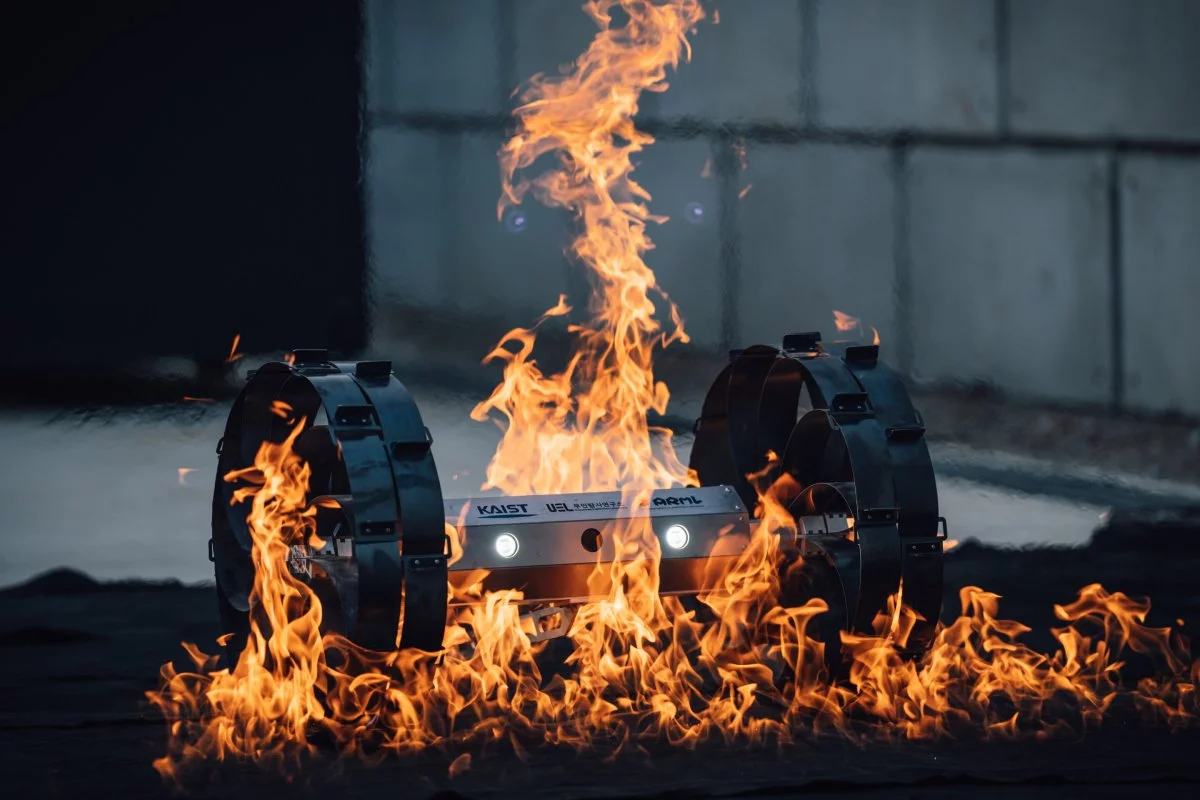

Rethinking Lunar Mobility: South Korea’s Deployable-Wheel Rover and the New Frontier of Subsurface Exploration
The lunar surface, with its powdery regolith, jagged basalt, and treacherous skylights, has long resisted the ambitions of terrestrial engineers. Yet, in a move that redefines the art of planetary mobility, South Korean researchers have introduced a deployable-wheel rover that promises to unlock the Moon’s most enigmatic real estate: its vast, uncharted lava tubes. This innovation is not merely a technical curiosity—it is a strategic inflection point in the evolving cislunar economy.
Engineering Elegance: The Helical Wheel as a Mechanical Chameleon
At the heart of this breakthrough is a deceptively simple yet profoundly effective idea: a helix-configured, carbon-steel wheel capable of telescopic expansion. By morphing from a compact 9 inches (23 cm) to a robust 19.6 inches (50 cm) in diameter, the wheel resolves a persistent dilemma in lunar robotics. Compactness is essential for ingress through narrow volcanic skylights, while a larger footprint is indispensable for traversing loose, unstable regolith.
Key technical advantages include:
- Elastic Helical Geometry: Unlike hinge-based or origami-fold mechanisms, which are prone to failure under abrasive dust and cryogenic cycles, the helical design leverages the resilience of carbon steel. This material maintains elasticity at temperatures plunging to −170°C, sidestepping the brittleness that plagues polymer-based alternatives.
- Mechanical Variable-Gearbox: The wheel’s variable radius functions as a physical gearbox—shrinking for torque and obstacle clearance, expanding for flotation and shock absorption. This adaptability not only enhances performance but also streamlines mission architecture, reducing the need for specialized descent devices and slashing launch mass.
- Digital Autonomy Synergy: The reconfigurable morphology dovetails with AI-driven path-planning, enabling more aggressive, less conservative navigation algorithms. The result: faster traverses, richer data returns, and a step-change in scientific productivity.
Subsurface Value Chains and Industry Disruption
The implications of this mobility revolution extend far beyond exploration. Subsurface lunar shelters, shielded from cosmic radiation, could obviate the need for multi-tonne shielding that current Artemis mission profiles demand. This is not a marginal improvement—it is an order-of-magnitude reduction in logistical complexity and cost.
Emerging lunar cave use cases:
- Cryogenic Propellant Depots: Stable temperatures and natural shielding make caves ideal for long-term storage of volatile fuels.
- Radio-Quiet Telescope Arrays: Subsurface environments are immune to electromagnetic interference, enabling unprecedented deep-space observations.
- ISRU Refineries: The thermal stability of caves supports continuous in-situ resource utilization, from oxygen extraction to additive manufacturing.
On the materials front, the success of deployable carbon-steel structures challenges the orthodoxy that advanced composites are the inevitable future of off-planet mobility. Specialty steel suppliers, long overshadowed by composite manufacturers, now find themselves at the threshold of a new extraterrestrial market. Additive manufacturing, too, stands to benefit, with the prospect of lattice-printing wheels directly from lunar iron—a development that could one day close the loop on spare-parts logistics.
Geopolitical Ripples and Strategic Realignment
South Korea’s foray into lunar robotics marks a decisive pivot from its traditional role as a satellite OEM to a contender in the cislunar technology arena. This move not only broadens the Artemis Accords coalition but also diffuses the concentration of supply chain power previously held by the U.S.–Japan axis. The mother-daughter rover architecture—where a larger “carrier” deploys smaller “seed” rovers for deep-cave mapping—directly challenges the strategies of Japan’s SLIM and China’s Chang’e-7 programs, setting the stage for a new era of technology diversification reminiscent of the CubeSat revolution.
Strategic signals to watch:
- Dual-Use Potential: The elastic wheel’s adaptability is equally valuable for asteroid missions, polar crater exploration, and terrestrial disaster response—domains where civil and defense interests converge.
- Standardization and IP Leverage: Early moves to establish open interface standards for morphing-wheel actuation could catalyze a plug-and-play lunar robotics ecosystem, unlocking licensing revenue and inter-agency collaboration.
Capitalizing on the Morphing-Wheel Inflection Point
For decision-makers, the message is clear: the era of static, single-purpose lunar mobility is ending. Aerospace primes should move swiftly to secure licensing or co-development deals, as integration lead times may dictate inclusion in upcoming Artemis missions. Materials suppliers must validate their carbon-steel alloys for cryogenic fatigue and additive compatibility. Investors would do well to position themselves for both near-term lunar mobility contracts and longer-term terrestrial spinouts, tracking milestones tied to cave-entry demonstrations.
Fabled Sky Research, among others, is closely monitoring these developments, recognizing in South Korea’s deployable-wheel rover not just an engineering feat, but a modular, cost-compressive paradigm shift. As the cislunar economy accelerates, those who align their strategies with this morphing-wheel breakthrough stand poised to capture outsized value in the next decade of lunar and sub-surface enterprise.

 By
By


 By
By
 By
By

 By
By
 By
By







