
Aloha as a countermeasure: when fashion becomes an adversarial attack surface
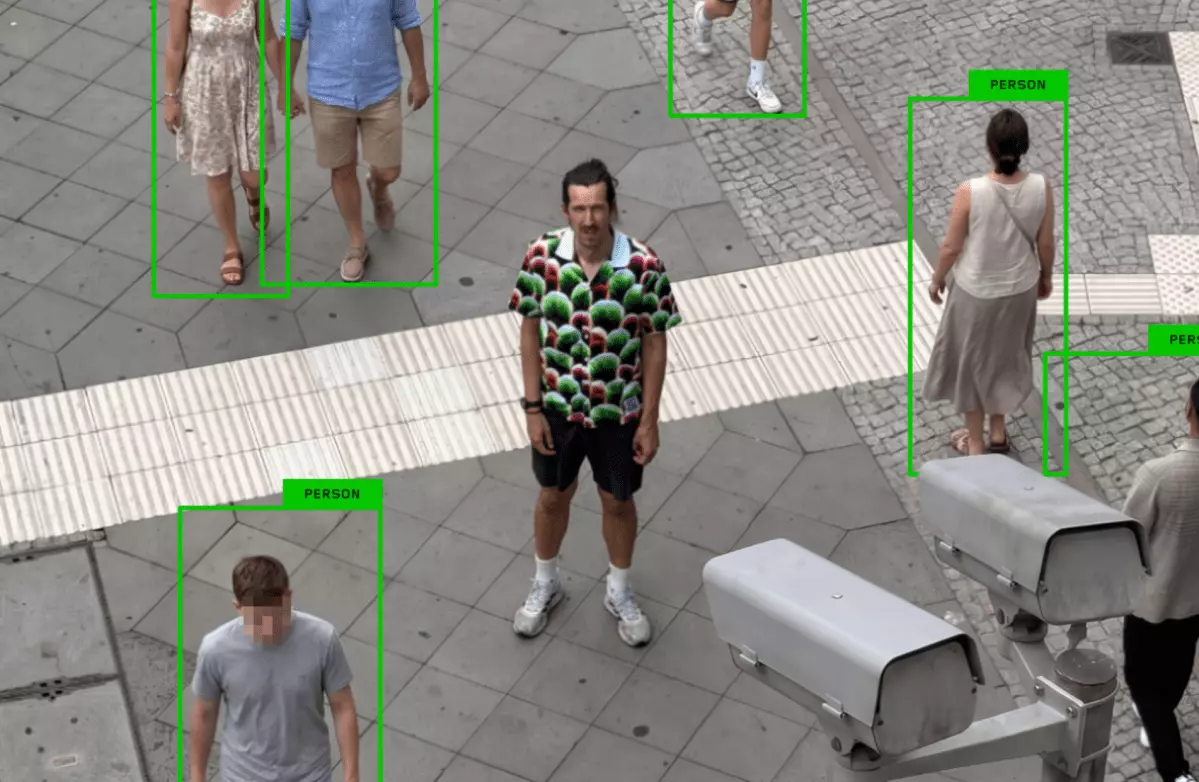
German designer Simon Weckert’s “anti–AI surveillance” aloha shirt reads, at first glance, like playful maximalism—an aggressive collage of pink, orange, and green blobs that feels more like pop art than privacy technology. Yet the garment is engineered with a precise technical intent: to confound computer-vision systems trained to detect human silhouettes, rendering the wearer legible to people but unreliable to automated surveillance.
What makes the project notable is not simply its provocation, but its method. Weckert’s approach draws on adversarial machine learning, where patterns are iteratively tested against detection models and refined until the system’s confidence collapses. In other words, the shirt is not “camouflage” in the traditional sense; it is a model-targeted exploit—a reminder that many AI systems do not “see” like humans do, but instead infer reality from statistical cues learned during training.
The work also fits Weckert’s broader practice of turning infrastructure into a medium. His earlier 2020 installation—using smartphones to simulate a traffic jam—exposed how easily algorithmic systems can be nudged into false conclusions. The shirt extends that critique from mapping and mobility into computer vision surveillance, echoing the speculative anxieties of cyberpunk fiction while grounding them in a tangible consumer object.
—
The technical signal: vulnerabilities in computer vision and the coming robustness premium
At a systems level, the shirt underscores a structural weakness in many contemporary AI vision pipelines: generalization under distribution shift. Models trained on large datasets learn correlations that work well “on average,” but can fail dramatically when confronted with inputs that sit outside their learned patterns—especially when those inputs are deliberately constructed to trigger failure modes.
Key technological implications for AI surveillance and adjacent industries include:
- An adversarial arms race becomes operational reality
Adversarial examples have long been discussed in research, but Weckert’s garment demonstrates a consumer-friendly pathway from lab concept to street-level tactic. As AI vision powers public-space security cameras, retail analytics, access control, and autonomous systems, vendors will be pressured to harden models against evasion—raising engineering complexity and ongoing maintenance costs.
- Limits of purely data-centric statistical learning
The shirt highlights that “more data” is not always sufficient. If detection relies heavily on texture and silhouette priors, adversarial patterns can exploit those assumptions. This pushes the industry toward multimodal fusion and richer sensing stacks—such as combinations of:
– 3D body modeling
– thermal imaging
– depth sensors
– radar/LiDAR augmentation
Each adds resilience, but also introduces cost, integration friction, and new privacy questions.
- Cross-sector spillovers beyond surveillance
The same adversarial dynamics can affect manufacturing quality control, medical imaging diagnostics, and industrial robotics—domains where false negatives and false positives carry material risk. The shirt is a cultural artifact, but its underlying lesson is industrial: any vision model can become a target when incentives to evade or manipulate exist.
The practical takeaway for enterprises is that “accuracy” measured on benchmark datasets is no longer the decisive metric. Increasingly, procurement and deployment will hinge on robustness under attack, including adversarial testing, red-teaming, and continuous monitoring for model degradation in the wild.
—
Business and market consequences: privacy wearables, vendor consolidation, and compliance economics
Weckert’s shirt also points to an emerging commercial category: privacy-enhancing products designed not to encrypt data, but to disrupt data capture at the sensor level. If early adopters once bought VPNs and secure phones, a new cohort may purchase anti-surveillance wearables—especially those with heightened exposure to monitoring, such as journalists, activists, high-net-worth individuals, and corporate executives.
Several economic and strategic effects are likely to follow:
- A nascent market for adversarial textiles and “privacy fashion”
Fashion brands could partner with technologists to commercialize patterns that are tested against common detectors. This reframes privacy as a lifestyle proposition—yet it also raises questions about standardization, efficacy claims, and liability if products fail under certain models or lighting conditions.
- Cost inflation in AI vision services
As defenses improve—through adversarial training, ensemble methods, and multimodal sensing—compute and data requirements rise. That tends to favor large vendors with scale, potentially accelerating consolidation among AI surveillance providers and widening the gap between premium “robust” systems and commodity deployments.
- Regulatory tailwinds and certification pressure
In jurisdictions moving toward comprehensive AI governance—most notably the European Union’s evolving framework—requirements around robustness to adversarial manipulation may become part of certification regimes. If regulators formalize performance thresholds, a new compliance layer emerges:
– third-party auditing and penetration testing for machine vision
– documentation of adversarial training practices
– ongoing post-deployment monitoring obligations
For businesses, this is less a niche art story than a signal about the total cost of ownership for AI vision: robustness, auditability, and governance are becoming core line items, not optional enhancements.
—
The strategic tension: security utility versus social license in smart-city surveillance
The deeper significance of Weckert’s project lies in how it crystallizes the surveillance-versus-privacy tension now embedded in smart-city ambitions and corporate analytics. Real-time detection promises efficiency and safety; it also expands the surface area for misuse, mission creep, and public backlash. The shirt functions as both protest and probe—forcing stakeholders to confront a simple question: if a patterned garment can meaningfully degrade detection, how stable is the promise of ubiquitous machine vision?
Forward-looking organizations are likely to respond along three tracks:
- Investing in adversarial-resistant AI through red-teaming, robust training pipelines, and sensor fusion
- Reassessing risk models for systems that assume consistent detectability in uncontrolled environments
- Engaging governance early—not only to satisfy regulators, but to maintain legitimacy with the public
Weckert’s aloha shirt ultimately reframes surveillance as a design problem with competing incentives: detection improves, evasion adapts, and society negotiates the boundary. The next phase of AI adoption will be shaped as much by this adversarial dynamic—and the politics around it—as by any single breakthrough in model architecture.

 By
By
 By
By
 By
By


 By
By
 By
By
 By
By