
Shark’s ChillPill signals a shift from “home appliance” engineering to personal climate control
Shark’s launch of the ChillPill Personal Fan and Cooling System is more than a seasonal gadget release—it’s a deliberate move into the fast-forming market for personal micro-environments, where consumers increasingly expect comfort to be portable, modular, and instantly available. Priced at $99.99 (discounted from $129.99) and distributed through Amazon and Costco, the product positions Shark—best known for home cleaning appliances—as a credible player in personal cooling technology.
The ChillPill’s proposition is straightforward but strategically potent: a hybrid wearable cooling device that combines a ten-speed battery-powered fan with a dry-touch evaporative mister, designed to reduce the sticky tradeoffs that have historically limited mist-based cooling. In a world where heat waves are becoming more frequent and indoor/outdoor boundaries blur—commutes, outdoor events, hybrid workdays—Shark is effectively betting that cooling will follow the same path as audio and fitness: from shared infrastructure to individualized, always-on utility.
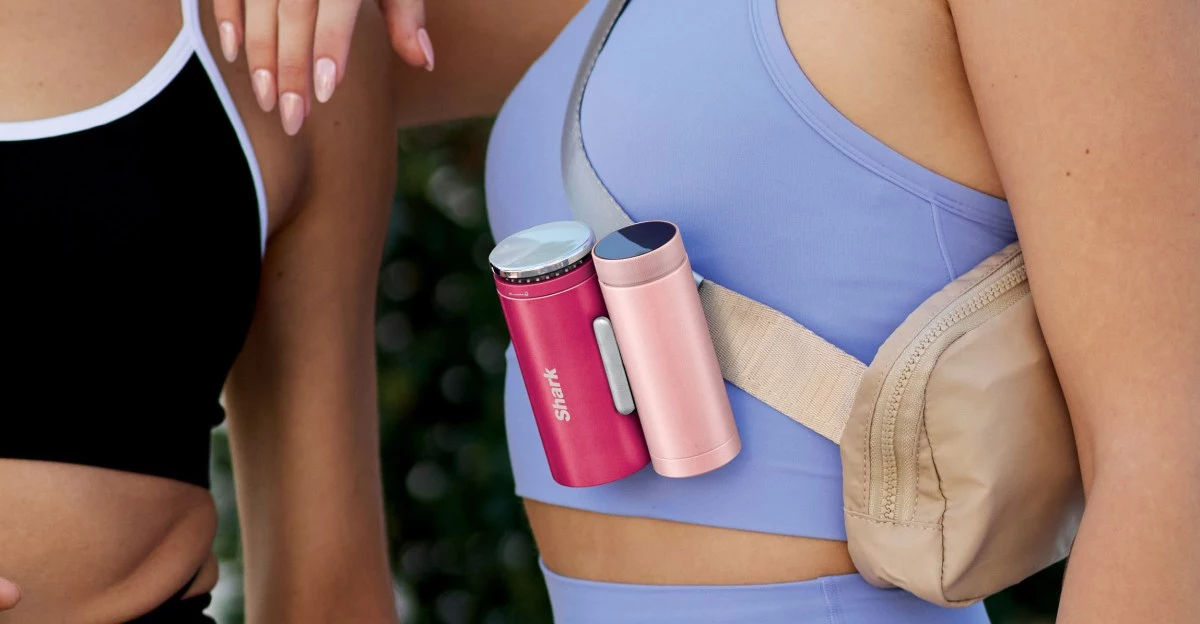
Key product attributes sharpen that bet: up to 11 hours of runtime on low, USB‑C charging, and multiple mounting modes (wearable, clip-on, or free-standing). The result is a device that reads less like a novelty and more like a compact appliance—one intended to be used repeatedly across contexts rather than occasionally in emergencies.
The engineering story: converging airflow, evaporation, and ergonomics into one portable system
From a technology standpoint, the ChillPill reflects a broader consumer-tech trend: miniaturizing multi-modal systems that were once separate products. Fans move air; misters cool via evaporation; combining them in a wearable form factor requires careful attention to comfort, noise, and water behavior.
Several design choices stand out as signals of where personal cooling innovation is heading:
- Convergence of airflow and evaporative cooling: Integrating a variable-speed fan with a mister is not new in principle, but the emphasis on “dry-touch” dispersion is meaningful. It suggests Shark is optimizing droplet size and delivery to reduce clothing saturation—an everyday usability barrier that has kept misting devices niche outside of outdoor venues.
- Power efficiency as a core feature: An 11-hour runtime at low speed implies a combination of efficient motor design (often brushless in this category), energy-dense batteries, and firmware-level power management. In portable comfort devices, battery life is not a spec-sheet detail—it is the difference between a product people carry daily and one that stays in a drawer.
- USB‑C as ecosystem alignment: USB‑C charging is now table stakes, but its strategic value is underappreciated: it reduces friction, leverages existing charging habits, and positions the device within the broader mobile accessory ecosystem rather than the fragmented world of proprietary chargers.
- Adaptive form factor and mounting: Wearable, clip-on, and stand modes reflect an important shift in hardware design: consumers increasingly expect one device to serve multiple use cases—desk work, commuting, outdoor recreation—without requiring separate purchases.
This is also where Shark’s appliance heritage quietly matters. The company’s credibility in airflow engineering, motor tuning, and mass-market manufacturability gives it a pathway to compete not just on novelty, but on repeatable performance and reliability—the traits that turn a seasonal product into a category staple.
Pricing, bundling, and retail channels: a playbook for discretionary essentials in an inflation-aware market
The ChillPill’s commercial rollout shows a disciplined understanding of how mid-premium consumer hardware is sold today. At roughly $100, it sits in a psychologically sensitive band: high enough to invite comparison shopping, low enough to be framed as a practical purchase during extreme heat.
Shark’s approach reveals three notable market dynamics:
- Seasonal urgency and price elasticity: Launching ahead of peak summer demand is expected, but the $30 discount is a sharper signal—an attempt to accelerate trial and adoption in a climate where consumers remain cautious about discretionary spending. The message is clear: this is a comfort product, but it’s being marketed as a problem-solver, not a luxury.
- Channel differentiation through value perception: Amazon offers the baseline product, while Costco bundles include add-ons such as a clip, crossbody strap, and the InstaChill Cooling Plate. This is classic channel segmentation: e-commerce optimizes convenience and search-driven discovery; warehouse clubs optimize perceived value per dollar and impulse conversion.
- Omni-channel reach without brand dilution: By balancing a mass digital channel with a curated bundle strategy, Shark can broaden distribution while maintaining pricing integrity—an increasingly difficult feat in consumer electronics where discounting can quickly erode brand positioning.
The larger implication is that personal cooling is being treated as a “discretionary essential” category—products that consumers may not have bought a decade ago, but now rationalize as necessary due to climate volatility, commuting patterns, and outdoor lifestyle normalization.
Competitive stakes: climate adaptation meets wearable utility—and the next frontier is intelligence
Strategically, Shark is carving out space between multiple competitive sets: small appliance makers, outdoor gear brands, and premium engineering-led players such as Dyson. The battleground will likely center on a few measurable dimensions: cooling effectiveness, comfort (dry-touch misting), noise, battery life, and portability.
At the same time, the ChillPill sits squarely within two macro trends that are reshaping consumer product roadmaps:
- The climate-adaptation economy: As heat becomes a recurring operational constraint—on commutes, job sites, campuses, and public events—portable cooling shifts from convenience to resilience.
- Portable wellness and micro-environment devices: Consumers are assembling personal “comfort stacks” that include hydration tools, UV protection, air-quality awareness, and temperature regulation. Cooling is becoming part of that everyday kit.
Looking ahead, the most consequential evolution may not be more speed settings or marginal battery gains, but intelligence and ecosystem thinking. The natural next steps for this category include:
- Sensor-driven adaptive cooling (responding to ambient temperature or skin temperature)
- Partnership distribution models (venues, festivals, theme parks, and hospitality)
- Extended-use power options (swappable batteries, solar augmentation for outdoor scenarios)
Shark’s ChillPill ultimately reads as a compact product with outsized signaling power: a mainstream brand treating personal cooling not as a gimmick, but as a durable category at the intersection of consumer tech, climate reality, and everyday mobility—a space that is only getting hotter, in every sense that matters.

 By
By
 By
By
 By
By
 By
By

 By
By
 By
By