

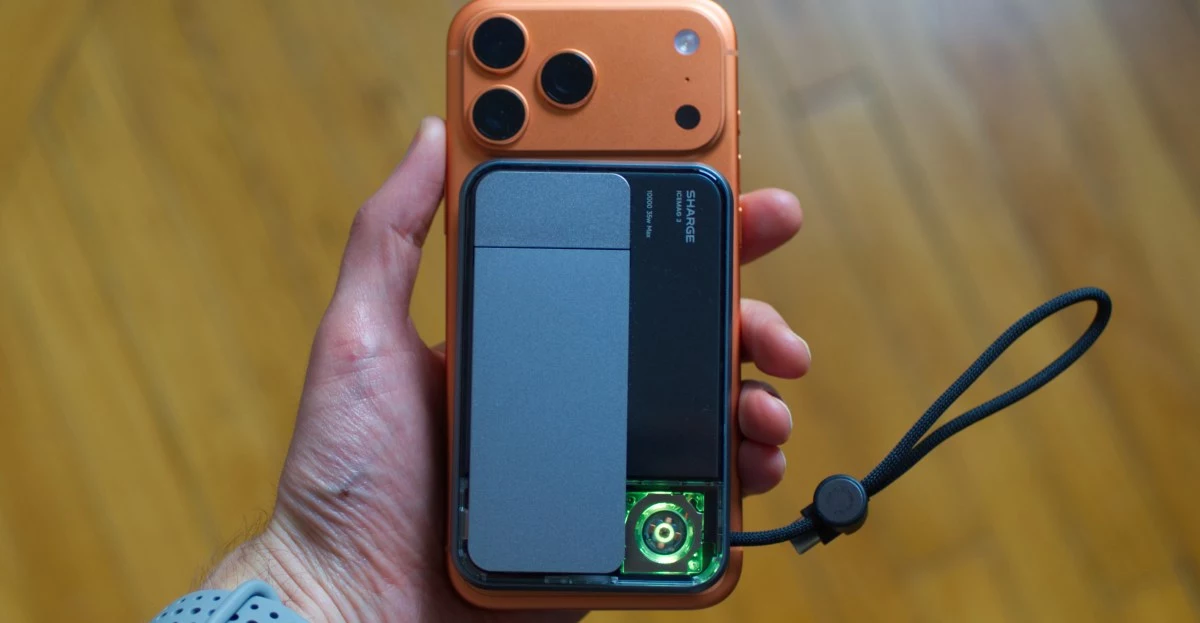

A Qi2-first magnetic power bank arrives as iPhone charging expectations reset
Sharge’s Icemag 3 lands at a moment when portable power is being redefined less by raw capacity and more by standards alignment, magnetic ergonomics, and thermal credibility. Built around a 10,000 mAh cell and optimized for the iPhone 16 series and later, the product’s headline is its Qi2 magnetic wireless charging with up to 25 W output, paired with USB‑C wired and passthrough charging for users who move between desk, commute, and travel without wanting to rethink cables.
That positioning matters because Qi2 is not merely a spec bump—it is a market signal. Qi2’s tighter magnetic alignment and more predictable power transfer are pushing the accessory ecosystem toward a more interoperable “MagSafe-like” experience, even as Apple’s gravitational pull continues to shape consumer expectations. In that context, Icemag 3 reads as a deliberate bet: win trust through standards compliance and usability, then differentiate through industrial design and visible engineering.
Key product elements that reinforce this strategy include:
- Magnetic Qi2 wireless charging (up to 25 W) designed for consistent alignment and reduced “dead-zone” frustration
- USB‑C wired charging with passthrough, enabling simultaneous device charging and power bank replenishment
- Integrated kickstand, reflecting the reality that charging and viewing are now a single use case (video, calls, standby modes)
- A 35 W dual-purpose USB‑C lanyard cable, blending accessory convenience with a higher-power wired option
For SEO and retrieval clarity: this is a Qi2 magnetic power bank for iPhone, with 25W wireless charging, 10,000mAh capacity, USB‑C passthrough, and a kickstand—a feature set increasingly treated as table stakes in the premium end of the portable charger market.
Visible thermal management becomes a product feature, not an internal detail
Perhaps the most distinctive move is Sharge’s decision to make thermal management both functional and legible. The Icemag 3’s transparent, LED-illuminated fan window is not just aesthetic theater; it is a response to a practical constraint: as wireless charging power rises, heat becomes the limiting factor that governs speed, battery longevity, and user confidence.
In the wireless charging category, consumers have learned—often through experience—that performance can be inconsistent. Devices throttle, charging slows, and the phone warms in hand or pocket. By externalizing thermal behavior through a visible window, Sharge is effectively turning a hidden engineering problem into a trust-building interface. It communicates, “this device is actively managing heat,” which can matter as much psychologically as it does technically.
This approach also hints at where the category may go next:
- Thermal transparency as reassurance: users increasingly want cues that a charger is operating safely and efficiently
- Higher-density electronics demand active cooling: as compact power banks chase higher wattage, passive enclosures face limits
- Design language as differentiation: in a commoditized market, “showing the work” can become a brand signature
There is, however, an implicit trade-off. Active cooling and structural elements can add thickness and complexity, raising the broader industry question: should premium power banks prioritize ultra-thin profiles, or accept modest bulk in exchange for sustained performance and reduced throttling? Sharge is clearly choosing the latter, aligning with power users who value consistency over minimalism.
Pricing, promotions, and channel tactics reveal how crowded the power-bank market has become
At roughly $68–70, supported by Amazon Prime promotions and Sharge’s own direct-to-consumer incentives (including discount codes and bundled accessories), Icemag 3 is priced to sit below the psychological resistance that often forms around the sub-$80 accessory tier. That’s not accidental. Portable chargers are a high-competition category with:
- low switching costs (most power banks “work,” at least superficially)
- margin pressure from lookalike OEM products
- rapid refresh cycles driven by new phone launches and charging standards
Sharge’s two-channel approach—marketplace scale via Amazon and margin control via direct sales—also reflects a modern hardware playbook. Amazon provides reach and conversion velocity; direct sales provide customer data, repeat-purchase pathways, and pricing agility. For a brand trying to build loyalty in a segment known for commoditization, that data loop can be as valuable as the unit economics.
The promotional structure also suggests a keen awareness of how consumers now evaluate accessories: not just on specs, but on bundle completeness. A power bank that includes a high-power cable, a kickstand, and a magnetic charging experience reduces friction at checkout because it feels like a “finished solution,” not another item that will require add-ons.
Strategic signals: ecosystem alignment today, services and consolidation tomorrow
Zooming out, Icemag 3 can be read as a strategic node in three converging trends: Qi2 ecosystem expansion, design-led differentiation, and the gradual shift from one-off hardware sales toward longer-lived customer relationships.
By aligning closely with Apple-adjacent expectations—magnetic attachment, iPhone-first ergonomics, and predictable wireless charging—Sharge is targeting a premium user base that is more likely to pay for perceived reliability. That alignment can also open doors to broader retail opportunities where certification and consumer trust matter, even if the product’s long-term defensibility will depend on how well Sharge can keep innovating beyond the spec sheet.
Several forward paths are implied by the product’s design choices and market posture:
- Companion software and analytics: usage insights, charge optimization, and battery health signaling could turn a charger into a lightweight “power platform”
- Certification and retail leverage: deeper participation in recognized certification programs can translate into shelf space and bundle partnerships
- Modular accessory ecosystems: interchangeable stands, mounts, or capacity variants could extend the Icemag line into a family rather than a single SKU
- Sustainability as differentiation: recycled materials, repairability cues, and end-of-life programs increasingly influence premium accessory purchasing
In a category where many products compete on identical numbers—mAh, watts, ports—the Icemag 3’s real wager is that engineering visibility, Qi2-first magnetic convenience, and bundle-ready usability can carve out durable brand preference. If Sharge can sustain that differentiation while the market accelerates toward higher wattage and tighter interoperability, the Icemag 3 may be less a standalone gadget than an early marker of what consumers will soon treat as the new normal in portable power.

 By
By
 By
By
 By
By
 By
By


 By
By
 By
By







