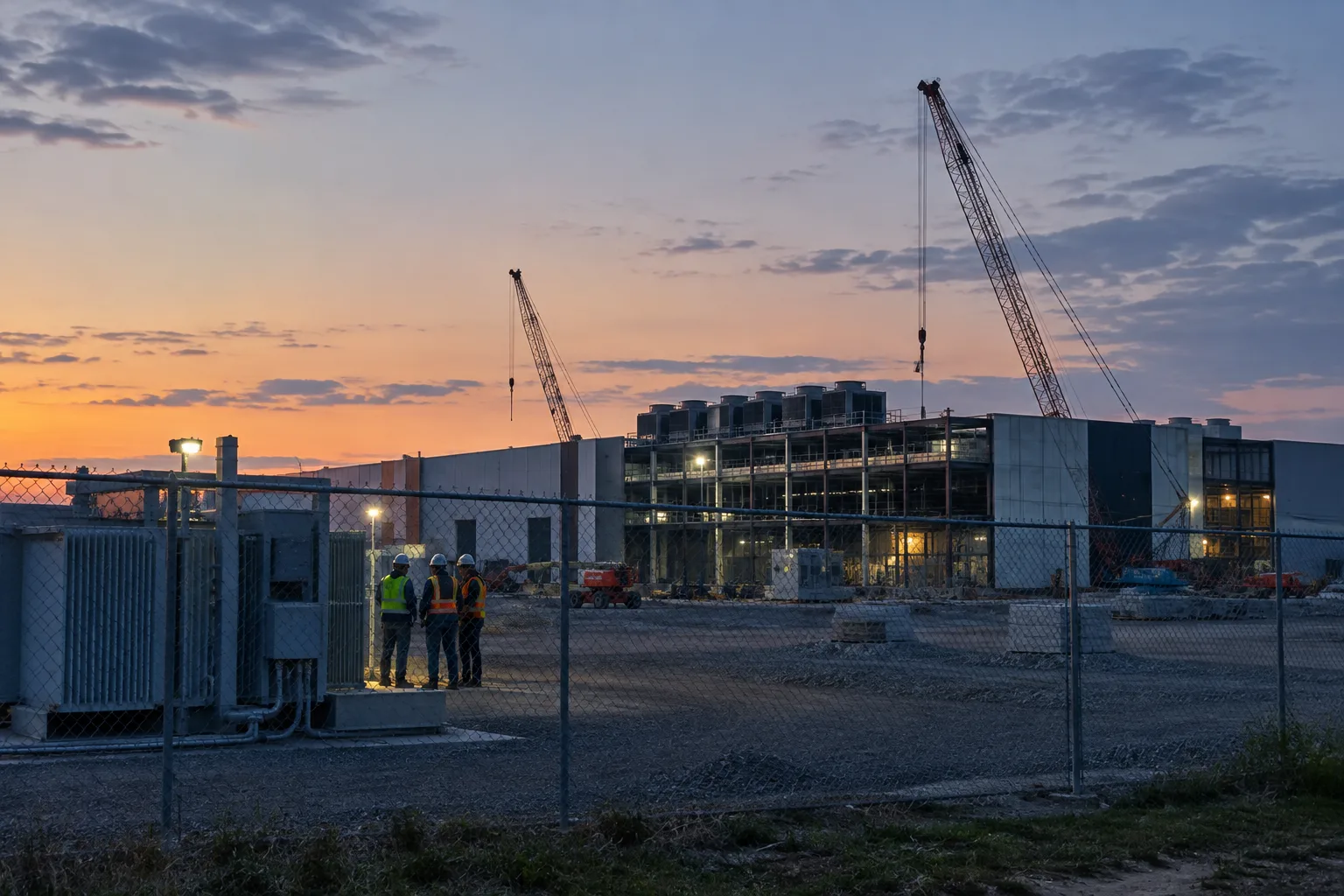

Samsung Electronics and five affiliates have committed a combined $1 billion to Helix Digital Infrastructure, the AI-infrastructure company established by KKR, in a move that pushes the AI race further down the stack from chips to the harder problem of physical delivery. The money, announced by Samsung on September 29 after KKR described the commitment on September 28, matters because it backs a platform designed to assemble power, data centers, cooling, storage, connectivity, and financing under one roof.
The real question for cloud and AI buyers is straightforward: does this make usable capacity arrive sooner, or does it mostly create another well-capitalized platform that still has to fight through permits, grid queues, construction schedules, and customer commitments?
That question matters more than the headline number. Helix says its strategy already had more than $10 billion of committed capital before Samsung’s commitment. Yet the public announcements do not name the first projects, locations, customers, target megawatts, power sources, interconnection status, or date of first operating capacity. In AI infrastructure, those are the milestones that separate financing from compute.
Why this is bigger than a data-center investment
Helix was launched in June by KKR with anchor investors including the Kuwait Investment Authority, NVIDIA, and Vistra, and is led by former Amazon Web Services CEO Adam Selipsky. Its pitch is not simply to own data centers. It aims to invest in, deliver, and manage a full chain of AI-enabling infrastructure: hyperscale campuses, baseload and flexible power generation, transmission and distribution, fiber, connectivity, and related assets.
That structure responds to the central constraint in the current market. A cloud provider may know it wants GPUs, but chips are only one dependency. It still needs land, power, interconnection, transmission, cooling, water planning, construction labor, network links, and permits. Any one of those can delay a launch. Helix’s model is meant to reduce the handoffs among separate developers, utilities, financiers, equipment vendors, and operators.
If it works, the value is obvious. Cloud customers get a shorter path from demand to available capacity. Utilities and local governments deal with a counterparty trying to coordinate large-load planning more coherently. Suppliers may get earlier visibility into procurement. Investors get exposure to a broader set of AI bottlenecks than semiconductors alone.
But the model also shifts power toward the platform. A developer backed by capital, preferred suppliers, a power partner, and a compute ecosystem can move faster in theory. It can also make customer neutrality harder to judge, narrow technology choices, and blur whether Helix is acting as a landlord, an integrated developer, or a strategic procurement vehicle.
What Samsung adds to the Helix formula
Samsung’s announcement is notable because it is not just a balance-sheet check from one corporate parent. Samsung Electronics is providing $500 million, while Samsung C&T, Samsung SDS, Samsung SDI, Samsung Life Insurance, and Samsung Fire & Marine Insurance are providing the other $500 million.
That affiliate mix hints at what Samsung wants from the relationship. The company said it intends to use Helix to accelerate global AI data-center deployment and explore collaboration across group capabilities. Those capabilities are broad enough to matter if projects materialize: Samsung Electronics brings semiconductor expertise; the DX division, through FläktGroup, supplies data-center cooling systems including coolant-distribution units; Samsung C&T brings engineering, procurement, and construction; Samsung SDS operates data centers and a GPU-as-a-service business; and Samsung SDI supplies batteries and uninterruptible-power equipment.
Taken together, that begins to look like an industrial supply chain rather than a passive investment. KKR provides infrastructure-investing experience and access to capital markets. NVIDIA, according to Helix’s June launch materials, is a strategic partner for NVIDIA DSX-aligned AI-factory infrastructure. Vistra is Helix’s preferred power partner. Samsung could become a source of components, cooling, construction, batteries, and operating services.
That combination is strategically attractive because the scarce input in AI today is often not demand or even accelerator supply in isolation. It is coordinated delivery. A platform that can reserve equipment, line up contractors, shape design choices, and work power issues in parallel could have an edge over a customer assembling the stack contract by contract.
Still, none of that is yet the same as a project award. Samsung said it will explore synergies; it did not announce that its affiliates have been selected for a named Helix site or that their participation guarantees lower costs or faster commissioning.
The proof points Helix still owes the market
For now, the strongest evidence is at the announcement level. Samsung has disclosed the participating affiliates and the $500 million/$500 million split. KKR has said the commitment adds to more than $10 billion already committed to the Helix strategy. The partner roster is credible, and the operating logic is clear.
The missing evidence is operational. Helix has not publicly identified its first sites, the amount of capacity it expects to build, how much power is secured, where interconnection stands, what permits are in hand, which customers are signed, or when the first megawatt will be energized. The companies also have not disclosed the form of Samsung’s commitment, Samsung’s ownership stake, governance rights, return targets, or whether customers will face bundled pricing tied to preferred partners.
Those omissions do not negate the strategy. They define the test.
The best way to read this deal is as a deliverability wager. Helix now has a larger capital base and an unusually dense web of strategic partners. The business case is that tighter coordination can shorten the time between a customer’s compute demand and an operational AI site. The risk is that the classic delays remain stubbornly local and physical: grid constraints, generation lead times, permitting, water and cooling plans, labor availability, and community acceptance.
That is why buyers, utilities, contractors, and investors should watch for a specific scorecard rather than more scale language. The important milestones are named projects, secured land, interconnection progress, firm power and cooling plans, construction starts, fiber routes, tenant commitments, capital actually deployed, and an accountable energization date.
Until Helix starts publishing some of those markers, Samsung’s $1 billion commitment is best understood as a serious vote for integrated AI infrastructure, not yet proof that integrated AI infrastructure can beat the market’s delivery bottlenecks. The next meaningful disclosure is not another funding figure. It is the first project that shows capital turning into powered, permitted, customer-ready capacity on schedule.
 By
By
 By
By
 By
By

 By
By
 By
By