

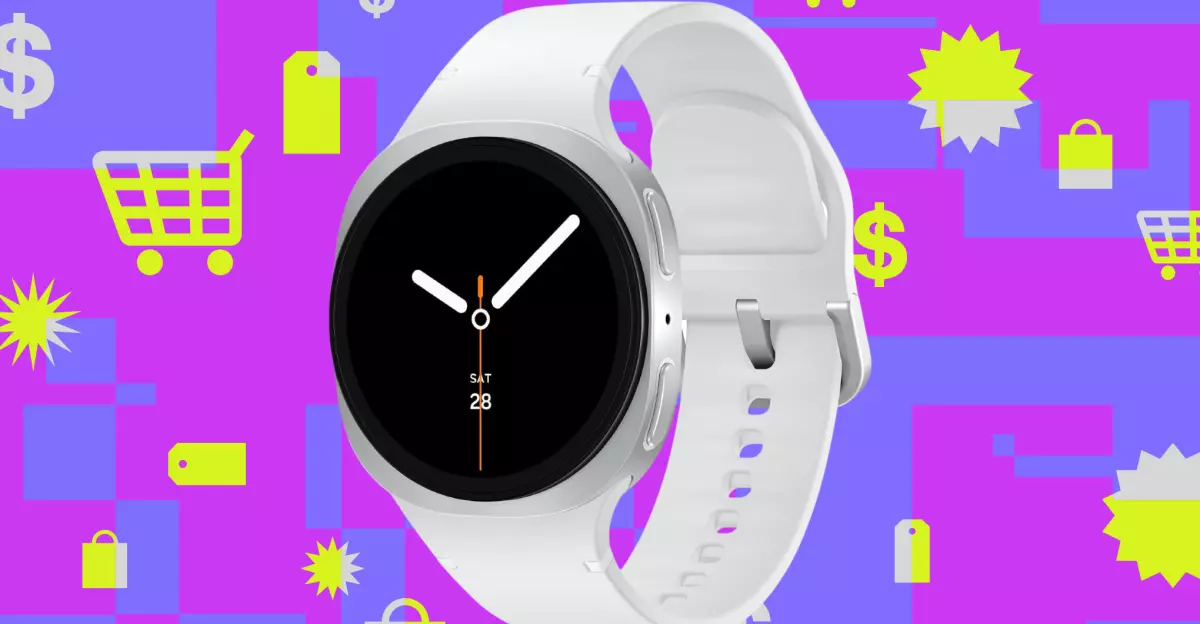

The Galaxy Watch 8: Redefining the Edge of Wearable Intelligence
Samsung’s Galaxy Watch 8, debuting at a striking $299.99—already $50 under its official list price—arrives not as a mere iteration, but as a statement of intent. In an era where the boundaries between hardware, artificial intelligence, and healthcare blur, this device emerges as a harbinger of the next phase in wearable technology. The new “squircle” chassis, a deft compromise between tradition and modernity, signals more than aesthetic evolution; it is a vessel for richer interaction, deeper sensing, and a recalibrated approach to the consumer electronics value chain.
Form, Function, and the New Language of the Wrist
The shift from a classic round face to the squircle form factor is not simply a stylistic flourish. It is a calculated engineering decision, one that expands display real estate for AI-driven prompts and health dashboards while maintaining the analog watch’s cultural cachet. The thinner housing, enabled by mechanical simplification, liberates precious internal volume—space now available for denser batteries and an expanding array of sensors. As the industry moves toward non-invasive glucose, blood pressure, and hydration monitoring, every cubic millimeter matters.
Yet, the true leap is not just physical. The Galaxy Watch 8’s integration of on-device Google Gemini AI marks a watershed moment for edge computing. By localizing generative AI inference, Samsung reduces latency and sidesteps the spiraling costs and privacy risks associated with cloud-based LLMs. This wrist-level deployment is more than a technical feat; it is a strategic maneuver, allowing Samsung to harvest granular intent data while maintaining user trust. The collaboration with Google, after years of Android ecosystem fragmentation, hints at a new détente—one that positions Samsung as a credible counterweight to Apple’s seamless vertical integration.
Health, Data, and the Expanding Clinical Perimeter
The Galaxy Watch 8’s biometric arsenal is formidable. FDA-cleared EKG and sleep-apnea detection (for Galaxy phone users) extend Samsung’s regulatory moat, foreshadowing a future where wearables are not just fitness companions but clinically adjacent devices. The promise of nutritional-color sensors, while still nascent, gestures toward a horizon where optical spectroscopy could unlock real-time macro- and micronutrient tracking. Such capabilities may soon underpin employer wellness initiatives and insurer partnerships, transforming the watch from a personal gadget into a node within the healthcare ecosystem.
Behind these features lies a powerful data flywheel. Every incremental sensor, every new metric, feeds Samsung’s burgeoning health cloud. This reservoir of de-identified biometric data is a strategic asset—one that could power longitudinal care management, inform pharmaceutical research, or even reshape the contours of digital health regulation. The implications for healthcare, insurance, and beyond are profound.
Economic Undercurrents and the New Platform Play
Samsung’s aggressive launch-phase discounting—compressing margins to accelerate installed-base growth—reveals a broader pivot: from hardware profits toward recurring, high-margin services. The Galaxy Watch 8 is not just a device; it is a distribution channel for Samsung Health+, cloud storage, and AI-enhanced coaching. Early price cuts also serve as a bulwark against softening consumer demand, as economic headwinds and post-pandemic gadget fatigue reshape the market.
Meanwhile, the democratization of high-efficiency peripherals—evidenced by the $17.99 GaN charger—reflects falling component costs and a strategic push to bundle value across the accessory ecosystem. By offering deals on controllers and earbuds, Samsung not only locks users into its protocols but also blunts the gravitational pull of Apple’s proprietary standards.
Looking ahead, the Galaxy Watch 8’s architecture is clearly designed for extensibility. As generative AI becomes the default interface for smart-home and mobility platforms, and as sensor stacks approach clinical precision, the watch is poised to become the biometric authentication layer for spatial computing and connected environments. The challenge will be to scale these capabilities while navigating an increasingly complex regulatory landscape—where data privacy, AI ethics, and global compliance standards converge.
Samsung’s latest wearable is, in essence, a strategic beachhead. It compresses the intelligence of the cloud to the intimacy of the wrist, redefines the boundaries of personal health technology, and sets the stage for a future where the watch is not just an accessory, but the orchestrator of our digital and physical lives. For leaders across technology, healthcare, and mobility, the Galaxy Watch 8 is a clear signal: the platform wars are migrating to the edge, and the wrist is their new frontier.

 By
By
 By
By
 By
By


 By
By

 By
By







