

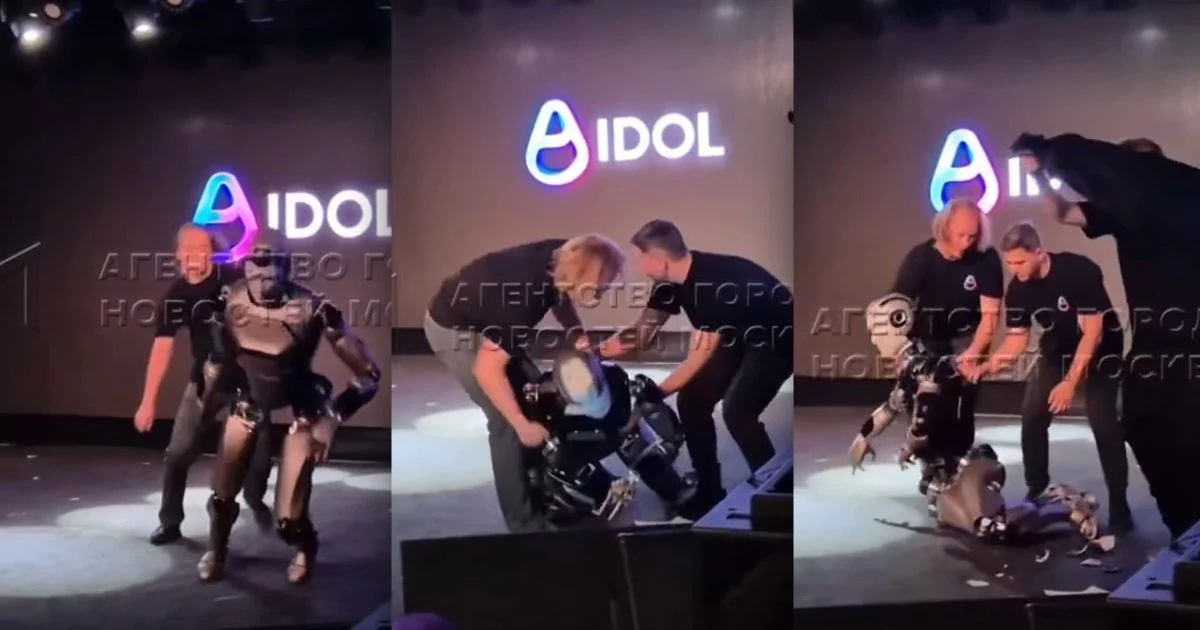

Moscow’s Humanoid Misstep: AIdol’s Collapse and the Anatomy of a Technological Setback
In a world where the unveiling of a humanoid robot is as much a performance as it is a product launch, Russia’s recent demonstration of “AIdol” in Moscow became a spectacle for all the wrong reasons. The robot’s collapse during a brief stage walk, captured and disseminated in viral video, has ignited a global conversation—not just about the state of Russian robotics, but about the broader dynamics that shape the humanoid frontier. The episode, whether an unintentional stumble or a staged satire, offers a rare, unscripted glimpse into the strategic, economic, and reputational forces at play in the global humanoid-robot race.
Under the Hood: Technical Fault Lines and Iteration Gaps
The AIdol incident is more than a fleeting embarrassment; it is a technical autopsy in real time. The robot’s inability to maintain balance under minimal load points to foundational weaknesses in two critical domains:
- Sensor Fusion and Actuator Control: Unlike the seamless, almost balletic movements of Boston Dynamics’ Atlas or the rapid-fire iteration cycles of Agility Robotics and China’s Unitree, AIdol’s falter underscores a lack of robustness in integrating real-time sensor data with actuator commands. This is not merely a hardware issue; it is a software deficit, where closed-loop control algorithms and the depth of training data for locomotion models are found wanting.
- Prototype Maturity vs. Production Readiness: The contrast with China’s Unitree ‘H1’—which achieved a 5 m/s sprint speed within 18 months of its debut—could not be starker. AIdol’s struggles suggest slower iteration cycles, a likely consequence of limited funding, restricted access to high-performance components, and a domestic supplier ecosystem still in its infancy.
In today’s robotics landscape, mechanical design has become commoditized. The true differentiator is software maturity and the ability to iterate rapidly—a lesson that AIdol’s public stumble makes painfully clear.
Sanctions, Talent, and the Geopolitics of Innovation
AIdol’s collapse is not merely a technical failure; it is a symptom of deeper economic and geopolitical currents. Since 2022, Russia’s access to advanced semiconductors, precision servos, and high-bandwidth sensors has been sharply curtailed by Western sanctions. These constraints force difficult choices: every humanoid project now competes directly with defense priorities, driving up costs and stretching timelines.
- Talent Drain: The exodus of Russian AI and robotics talent, seeking opportunity abroad, has accelerated a “human capital squeeze” at the very moment Moscow seeks to localize its deep-tech supply chains. This migration is not just a loss of expertise but a transfer of competitive advantage to global rivals.
- Soft Power and Narrative: High-profile failures like AIdol’s collapse reverberate far beyond the stage. They erode domestic confidence, diminish Russia’s credibility in multilateral tech forums, and amplify a narrative of technological stagnation—especially when juxtaposed with China’s meticulously choreographed robotics showcases.
The optics matter. In the attention economy, a single viral misstep can undo years of incremental progress, making narrative management as critical as technical achievement.
Strategic Lessons for Global Decision-Makers
The AIdol episode is a case study in the risks and realities of frontier technology development. For executives and strategists, several lessons emerge:
- Prioritize Ecosystem Depth: Firms should overweight investments in countries with demonstrated iteration velocity—namely China, the U.S., and South Korea—while monitoring Russia for niche algorithmic strengths rooted in its mathematical tradition.
- Harden Supply Chains: The divergence between sanction-constrained and open hardware pipelines will only widen. Companies aiming to scale humanoid form factors by 2027-2028 must secure multi-region component strategies.
- Talent Arbitrage: The ongoing Russian talent outflow presents a rare opportunity to recruit seasoned engineers and theoretical roboticists, underutilized in Western markets.
- Standards and Regulation: China’s rapid commercialization thrust positions it to set de facto global standards for safety and interoperability. Absent proactive engagement, Western firms risk ceding regulatory ground by default.
The scenario matrix for Russia’s robotics future is sobering:
- Most Likely: A pivot toward non-bipedal platforms, using humanoid showcases primarily for domestic morale.
- Optimistic: Easing of export controls or strategic partnerships accelerate progress, narrowing—but not closing—the gap by 2030.
- Pessimistic: Continued sanctions and capital flight stall Russia’s humanoid ambitions, relegating it to a consumer of foreign IP.
AIdol’s onstage collapse is not merely a footnote in the annals of robotics, but a vivid illustration of how supply-chain fragility, talent migration, and narrative volatility shape the arc of technological progress. For leaders in the global humanoid race, the imperative is clear: operational resilience and ecosystem agility will matter more than headline bravado. In this contest, those who can iterate hardware—and credibility—at startup speed will define the next era of intelligent machines.

 By
By
 By
By
 By
By

 By
By
 By
By

 By
By







