
Rural backlash meets the AI compute boom: why “where” now matters as much as “how much”
A quiet but consequential shift is unfolding across rural America: communities that once courted industrial development are increasingly challenging large-scale AI data centers on environmental, economic, and quality-of-life grounds. The flashpoint in Gilroy, California—where Amazon began building a 438,500-square-foot facility under older zoning rules and without residents’ awareness for years—captures a broader national tension. The AI economy is expanding at hyperscale speed, yet the physical infrastructure that powers it is colliding with local expectations about transparency, resource stewardship, and shared prosperity.
For hyperscalers, the strategic logic of rural siting is straightforward: cheaper land, comparatively accessible power, and fewer constraints than dense urban corridors. But the Gilroy episode underscores a new reality: legal compliance is no longer synonymous with legitimacy. Communities are demanding what amounts to a “social license to operate,” and they are increasingly willing to use public meetings, permitting processes, and political pressure to enforce it.
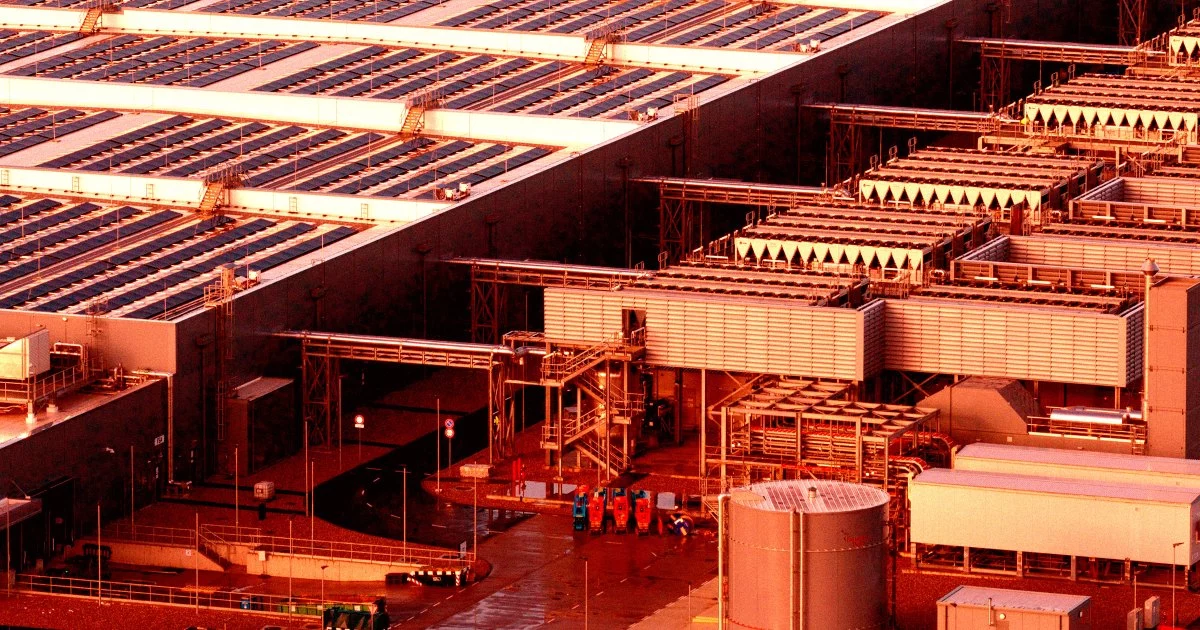
The objections voiced—electricity rate impacts, greenhouse-gas emissions, noise, water risk, and limited long-term hiring—are not merely emotional reactions to unfamiliar infrastructure. They map directly to the core externalities of modern AI compute. As generative AI and large language models push demand for GPU clusters and specialized accelerators, the data center has become less like a warehouse and more like an always-on industrial plant—one whose inputs and outputs are now visible enough to mobilize local opposition.
The resource equation behind AI data centers: power, water, and the next wave of efficiency
AI workloads are changing the engineering profile of data centers. Training and inference at scale require dense compute, which translates into higher electricity draw and more complex cooling. The resulting footprint is prompting communities to ask a pointed question: if the benefits are global, why should the costs be local?
At the same time, the technology stack is evolving in ways that could reduce friction—if operators adopt them credibly and early. Key technical dynamics shaping this debate include:
- Power intensity versus efficiency innovation
– AI clusters can drive unprecedented load growth, stressing rural grids and potentially shifting costs onto residential and agricultural customers.
– Countervailing trends—liquid cooling, more efficient AI ASICs, and smarter workload scheduling—offer measurable pathways to reduce energy per unit of compute.
- Cooling and water scrutiny
– Water use is becoming a frontline issue, especially in regions sensitive to drought and supply volatility.
– This is accelerating interest in closed-loop cooling, zero-liquid-discharge approaches, and more transparent reporting of water metrics.
- Carbon and grid alignment
– Communities are increasingly skeptical of vague sustainability claims, particularly where grid power is carbon-intensive.
– Operators that pair expansion with renewable-linked procurement, onsite generation, and AI-driven energy management may gain both regulatory and reputational advantage.
The emerging competitive frontier is not only compute availability; it is verifiable environmental performance. In practical terms, that means data center operators may soon be benchmarked locally on carbon intensity, water accounting, and noise mitigation as much as on uptime and latency.
The economics communities are contesting: tax revenue, jobs, and utility rate pressure
Data centers are often presented as engines of local development. The reality is more nuanced. They are capital-intensive and labor-light, creating a burst of construction employment but relatively modest ongoing staffing. That mismatch is central to the backlash: residents are weighing long-lived environmental and infrastructure impacts against benefits that can feel incremental or unevenly distributed.
In Gilroy, AWS has responded with a familiar toolkit—highlighting wastewater infrastructure upgrades, tax contributions, construction jobs, and community sponsorships. Those measures can be meaningful, but they also reveal the new baseline for acceptance: communities want commitments that are material, durable, and enforceable, not simply promotional.
Several economic fault lines are driving the national pattern:
- Utility rate politics
– Large new loads can require grid upgrades and capacity planning that ripple into rate structures.
– If residents perceive they are subsidizing industrial growth through higher bills, opposition hardens quickly.
- Land-use arbitrage and real estate volatility
– Hyperscale facilities can reprice land and trigger rezoning battles.
– Some property owners may benefit, while others fear noise, traffic, and long-term industrialization of rural character.
- ROI fragility under permitting risk
– With higher interest rates and tighter capital discipline, delays and legal challenges can erode project economics.
– “Community risk” is increasingly a financial variable, not a public-relations afterthought.
This is where the debate becomes less about a single facility and more about who captures value in the AI supply chain—and whether rural regions are being asked to host critical infrastructure without a commensurate stake in the upside.
The next regulatory playbook: zoning modernization, community benefit agreements, and “social license” as strategy
Gilroy’s reliance on outdated zoning classifications is not unusual. Many municipalities still treat data centers as generic industrial uses, even though their operational profile—energy density, cooling systems, noise, and grid dependencies—can be distinct. The predictable result is a governance gap: projects can advance under legacy rules while communities feel blindsided, fueling distrust that lingers long after permits are issued.
The policy and strategy responses now taking shape point toward a more formalized framework:
- Modernized zoning and notice requirements
– Expect more jurisdictions to adopt use-specific data center categories, mandatory notice periods, and clearer thresholds for public review.
- Community Benefit Agreements (CBAs) as de-risking tools
– Voluntary or standardized CBAs can lock in local hiring targets, infrastructure investments, environmental safeguards, and reporting obligations.
– For operators, CBAs can reduce uncertainty by converting public opposition into negotiated terms.
- ESG disclosure moving from investor decks to local demands
– Institutional scrutiny of Scope 2 emissions, water use, and community impacts is converging with municipal expectations.
– Companies that cannot produce credible, auditable metrics may face higher capital costs and slower approvals.
A more ambitious path is also emerging: positioning data centers as rural digital hubs rather than isolated compute fortresses—supporting regional connectivity, education partnerships, and even public-private microgrid arrangements that share resilience benefits. The operators that win the next decade of AI infrastructure buildout may be those that treat community alignment not as a concession, but as a core deployment capability—measured in faster approvals, lower financing friction, and a brand that can scale alongside the compute.


 By
By
 By
By

 By
By
 By
By
 By
By
 By
By