

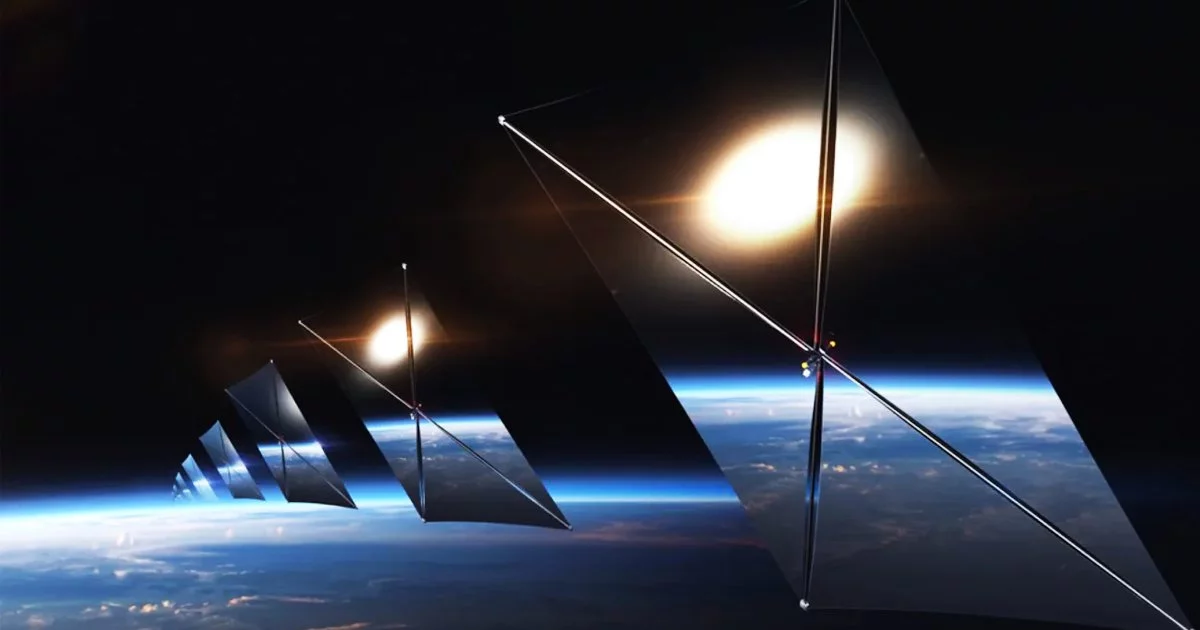

FCC scrutiny puts “sunlight-as-a-service” into the regulatory spotlight
The Federal Communications Commission’s review of Reflect Orbital’s application marks a notable inflection point for space-based energy concepts that sit uncomfortably between satellite communications policy and environmental governance. Reflect Orbital proposes a prototype satellite carrying a 60-foot reflective mirror designed to redirect sunlight to darkened areas on Earth—an early step toward a far larger ambition: a mega-constellation of up to 50,000 mirror satellites, a scale that would exceed even the most expansive commercial fleets in orbit today.
While the FCC’s remit is typically anchored in spectrum authorization, radio-frequency interference, and orbital debris mitigation, this case underscores how quickly space innovation is outgrowing traditional regulatory categories. A mirror constellation is not merely another spacecraft network; it is an attempt to operationalize directed illumination as a commercial service—effectively turning sunlight into a schedulable commodity.
Reflect Orbital’s proposed pricing—about $5,000 per hour of illumination, plus potential revenue sharing tied to incremental solar generation—signals a strategy aimed at premium, time-sensitive use cases rather than mass-market electricity. Yet the regulatory process is already revealing a broader truth: even if the FCC approves a prototype, the larger question is whether the world has an adequate framework to govern intentional modification of nighttime lighting conditions at scale.
Engineering reality check: precision optics, atmospheric loss, and orbital scale
At the heart of the concept is a deceptively simple proposition: reflect sunlight from low Earth orbit to a chosen location. In practice, the technical demands are closer to those of high-end space telescopes and precision pointing systems than conventional smallsat operations.
Key engineering constraints include:
- Optical and attitude-control complexity: A large mirror must maintain surface stability while enduring thermal cycling, vibration, and micrometeoroid exposure. Precise pointing is non-negotiable; small errors translate into large misses on the ground.
- Energy transfer efficiency limits: Even with ideal alignment, reflected sunlight disperses. Atmospheric scattering and beam divergence reduce usable irradiance. Independent analyses cited by observers suggest a ceiling around ~20% of noon-day solar intensity at the target—materially below what many commercial solar deployments would consider optimal without additional concentration systems.
- Constellation operations and space-traffic risk: Moving from one spacecraft to tens of thousands multiplies collision-avoidance complexity, demands robust inter-satellite coordination, and increases the burden of end-of-life de-orbit compliance. This intersects directly with the industry’s unresolved challenge: scalable, automated space traffic management.
Critics also point to historical precedent. Russian experiments in the 1990s demonstrated that orbital reflectors can be deployed, but they also highlighted the gap between demonstration and durable, economically meaningful service. The Reflect Orbital proposal revives the idea in an era of cheaper launches and better control systems—yet the physics of diffusion and the operational realities of large fleets remain stubborn constraints.
Business model under pressure from terrestrial renewables and verification complexity
Reflect Orbital’s commercial thesis is bold: sell illumination time and potentially participate in the value created by extra solar power generated on the ground. The concept is imaginative, but the unit economics face a tightening vise from both technology and markets.
Several market dynamics stand out:
- Competition from falling LCOE: Utility-scale solar, wind, and storage continue to decline in cost, while microgrids and demand-response systems improve reliability. These trends compress the premium customers might pay for orbital illumination except in niche scenarios.
- High CapEx and OpEx at constellation scale: Manufacturing, launching, operating, and de-orbiting thousands of satellites could push total costs into the tens of billions of dollars, especially under inflationary pressure in aerospace supply chains (composites, electronics, propulsion, and launch services).
- Revenue-sharing complexity: “Sharing downstream solar revenue” introduces measurement and verification challenges—how to attribute incremental generation to reflected light, how to audit performance, and how to handle jurisdictional differences in solar incentives and grid rules.
Where the model may find its strongest foothold is not in replacing terrestrial energy, but in high-value, time-critical illumination where alternatives are limited or slow to deploy. Potential early markets include:
- Emergency response and disaster recovery lighting
- Polar or high-latitude seasonal support (where darkness is prolonged)
- Critical infrastructure continuity in remote regions
- Bundled services paired with Earth observation and analytics for agriculture, mining, or maritime operations
Those niches may not justify a 50,000-satellite endgame, but they could support a phased approach that proves technical capability and demand before scaling.
The overlooked externalities: astronomy, ecology, and geopolitical sensitivity
The most consequential debates may arise outside engineering spreadsheets. A large mirror constellation would alter the night sky in ways that are difficult to localize, raising concerns about light pollution and the integrity of astronomy as a scientific commons. Astronomical organizations have already warned that proliferating reflective objects in orbit can increase sky brightness, complicate observations, and impose new costs on research institutions attempting to filter or avoid interference.
Environmental and biological risks are similarly non-trivial. Artificially extending daylight—even intermittently—could disrupt circadian rhythms in humans and wildlife, affecting migration, feeding patterns, and ecosystem behavior. These impacts are harder to quantify than radio emissions, yet they may become central to public acceptance and ESG evaluation.
Finally, directed illumination carries strategic overtones. Control over the timing, intensity, and targeting of reflected sunlight can be framed as benign infrastructure—or as a capability with signaling and security implications. That dual-use perception could invite scrutiny beyond the FCC, pulling in national security stakeholders and accelerating calls for international norms through bodies such as COPUOS and coordination mechanisms linked to the ITU.
Reflect Orbital’s prototype review is therefore more than a licensing event. It is an early test of whether regulators, markets, and civil society can keep pace with a new category of orbital infrastructure—one that treats sunlight not as a constant, but as a service that can be scheduled, sold, and steered.

 By
By
 By
By




 By
By
 By
By







