

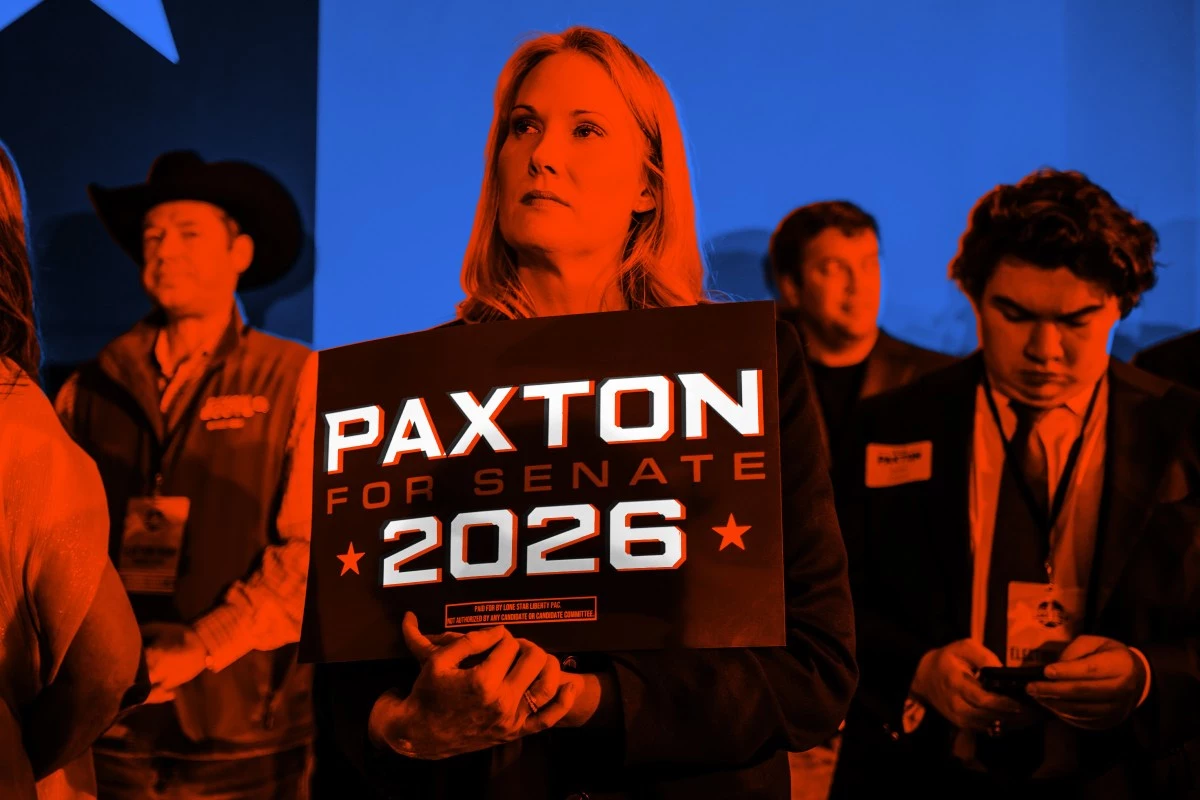

When betting odds masquerade as political certainty
Polymarket’s now-notorious call—assigning an 83% probability that Texas Attorney General Ken Paxton would win the Republican U.S. Senate primary—landed with the force of a headline, not the humility of a forecast. Yet the real-world outcome cut sharply against that implied certainty: former Senator John Cornyn, initially priced around 18%, forced a runoff. The episode is less a one-off embarrassment than a revealing stress test of what prediction markets increasingly claim to be: a fast, probabilistic layer of “truth” riding atop the news cycle.
The core issue is not that markets can be wrong—polls are wrong, analysts are wrong, and voters are famously non-linear. The issue is that market-derived probabilities are being consumed as if they carry the methodological discipline of polling or the editorial accountability of journalism, even when the platform discloses little about liquidity, concentration of wagers, or the informational quality behind the price.
In practice, a prediction market price is a tradable sentiment instrument. It reflects what participants are willing to buy and sell at a given moment, under a given set of incentives. When that price is broadcast with the cadence of breaking news, it can easily be misread as a statistically grounded projection rather than what it truly is: an equilibrium of risk-taking behavior—sometimes informed, sometimes performative, sometimes strategically distorted.
The mechanics: crowdsourced probability, engineered attention, and brittle liquidity
Prediction markets such as Polymarket translate wagers into implied odds through continuous trading. In theory, this is elegant: participants with better information profit; prices converge toward reality. In practice, the reliability of that convergence depends on market structure—especially liquidity depth, participant diversity, and resistance to manipulation.
Several design dynamics matter:
- Crowdsourced probability discovery (with caveats): Prices can incorporate dispersed information quickly, but only if the crowd is sufficiently broad and capital is distributed. Thin markets can behave like echo chambers with a price tag.
- Engagement loops that reward narrative velocity: Push alerts, “hot market” surfacing, and social amplification can create momentum trading—where users chase the story rather than evaluate fundamentals.
- Model risk without disclosure: Unlike polling firms that publish sample sizes, weighting, and error bars, many prediction platforms offer limited transparency into:
– market liquidity and order-book depth
– concentration risk (how much one wallet can move the price)
– susceptibility to coordinated trading or “price painting”
This is where the Paxton-Cornyn misfire becomes instructive. A market price can jump to an authoritative-looking number—83% reads like precision—while still being fragile, especially if a few large positions dominate. The resulting probability is not necessarily “wrong” in a technical sense; it may simply be overconfident relative to the information actually embedded in the market.
The media-business convergence: partnerships, legitimacy, and the click-bait temptation
The more consequential development is not the miss itself, but the strategic convergence between prediction markets and media distribution. Partnerships with legacy brands—such as Polymarket’s association with Dow Jones, and competitor Kalshi’s relationship with CNN—signal a new commercial logic: probability as content, and content as a funnel to trading.
This blurring of boundaries creates a two-sided monetization engine:
- Transaction revenue: fees or spreads on trades, amplified by higher engagement and more frequent betting.
- Attention monetization: the platform increasingly resembles an ad-friendly feed, where “news-like” alerts and sensational prompts keep users active.
The risk is that the incentives of wagering can pull information products toward the emotional register of virality. The summary’s examples—posts about Epstein-Island police activity or alleged nationwide blackouts in Iraq—illustrate how prediction platforms can adopt a newsroom aesthetic without newsroom obligations. A traditional outlet is expected to verify, contextualize, and correct. A market platform is structurally rewarded for volume, novelty, and tradability.
For media companies, the trade-off is stark. These partnerships can offer reach and relevance in a fragmented attention economy, but they also introduce reputational tail risk: audiences may conflate a licensed brand presence with editorial endorsement of the market’s implied “truth.”
Strategic and regulatory stakes: from information arbitrage to AI-driven opacity
As prediction markets expand beyond elections into geopolitics, macroeconomics, and corporate events, they begin to resemble retail-facing micro-derivatives—products that are emotionally intuitive (“bet on the outcome”) but structurally complex (liquidity, settlement rules, manipulation risk). That evolution raises several second-order implications:
- Information asymmetry and insider leakage: Campaign operatives, policy insiders, or corporate employees could exploit informational edges, and rapid price moves may themselves become signals—creating feedback loops akin to thinly traded financial instruments.
- Regulatory classification pressure: Whether these products are treated as gambling, financial derivatives, or a hybrid will determine consumer protections, reporting requirements, and enforcement jurisdiction (including the role of the CFTC and state regulators).
- AI-augmented market making and narrative acceleration: As large language models and automated agents ingest social chatter at scale, platforms can surface “weak signals” faster—while making price formation more opaque. Speed improves; explainability declines.
What emerges is a new kind of platform power: the ability to convert uncertainty into a tradable interface, then distribute that interface as if it were a news product. The Paxton-Cornyn episode is a reminder that markets can inform public understanding—but they can also distort it when probability is packaged as certainty and engagement is treated as epistemology. The next phase of this sector will be defined by who builds credible guardrails: transparency around liquidity and concentration, clearer editorial firewalls in media tie-ups, and product design that respects the difference between informing an audience and activating a bettor.

 By
By

 By
By
 By
By
 By
By

 By
By
 By
By







