

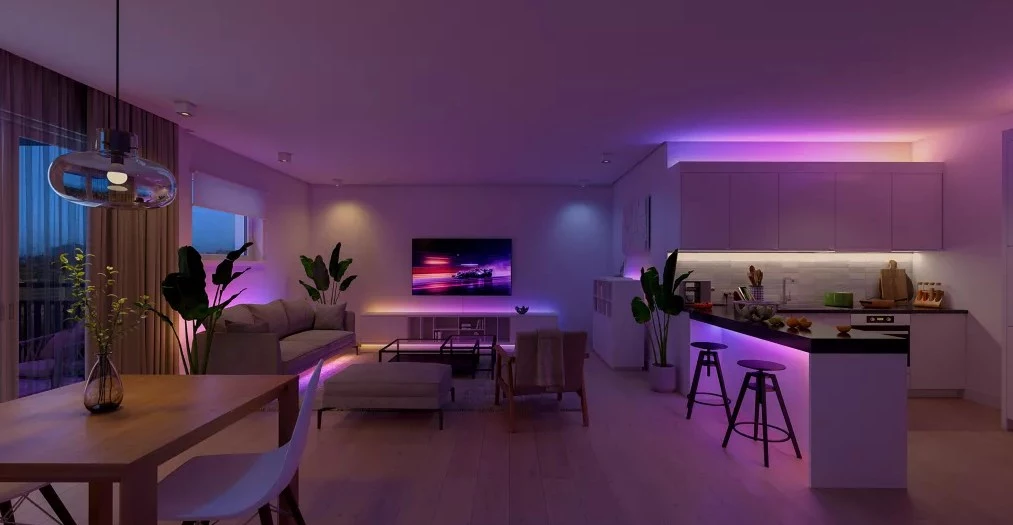

Prime Day pricing as a deliberate ecosystem on-ramp for Philips Hue smart lighting
This year’s Prime Day has effectively become a strategic acquisition moment for Philips Hue, with discounts that reach well beyond routine promotional pricing. Cuts of roughly 40% on starter kits—including examples like $67.99 down from $142.99—lower the psychological barrier for first-time smart-lighting buyers, while 20%–30% reductions on higher-value devices (sleep-wake lamps, portable lamps, motion sensors, and programmable switches) encourage existing users to deepen their setups.
What stands out is the channel choreography: several of the most aggressive deals are reportedly offered directly by Philips Hue rather than exclusively through Amazon. That matters because it signals more than a sales event—it suggests a calculated effort to:
- Accelerate install-base growth (more homes running Hue as the default lighting layer)
- Increase accessory attach rates (sensors, switches, sync devices that raise lifetime value)
- Capture first-party customer relationships via direct-to-consumer (D2C) purchasing, rather than ceding the data and margin to marketplaces
In practical terms, Philips Hue appears to be using Prime Day’s attention as a high-velocity funnel—one that converts price-sensitive shoppers into long-term ecosystem participants.
Interoperability, Matter/Thread gravity, and the “lighting layer” play
Smart lighting is increasingly less about bulbs and more about platform gravity. Hue’s portfolio spans entry-level products (bulbs and LED strips) through premium devices such as the Play HDMI Sync Box and advanced controls like the Tap Dial Switch. Discounting across that range is consequential: it nudges consumers not only to “try smart lighting,” but to adopt Hue as the control plane for a broader ambient environment.
The timing is also notable in the context of Matter, Thread, and Bluetooth mesh. As the smart-home market consolidates around interoperability standards, the competitive advantage shifts from “does it connect?” to “what experience does it enable once connected?” Hue’s promotions can be read as an attempt to expand its footprint ahead of wider Matter normalization—making Hue harder to displace once households standardize their connected-home routines.
Key technology implications embedded in the discount strategy include:
- Platform consolidation through accessories: Devices like sync boxes, sensors, and programmable switches increase switching costs by embedding Hue into daily behavior, not just décor.
- Edge intelligence via ambient inputs: Motion sensors and smart buttons push the system toward environment-aware lighting, where automation becomes the default interaction model.
- Data feedback loops: More deployed sensors and controls can generate richer usage telemetry, enabling adaptive lighting behaviors and potentially future service layers (energy optimization, predictive scenes, or wellness routines).
This is the quiet shift underway in smart homes: lighting becomes the ambient computing substrate—always present, always used, and increasingly responsive.
Wellness lighting moves from “nice-to-have” to measurable value proposition
Among the discounted categories, the presence of sleep-wake and circadian-oriented lamps—such as the Twilight sleep-wake concept referenced—highlights a broader industry pivot: lighting is being positioned as a health and wellness technology, not merely an aesthetic upgrade.
Circadian-aligned illumination reframes the purchase decision. Instead of competing only on brightness, color, or app features, Philips Hue can compete on outcomes consumers increasingly care about:
- Sleep quality and wake routines
- Evening wind-down and reduced harsh lighting
- Daytime focus and mood support through tuned spectra
If consumers begin to treat circadian lighting as a wellness investment, Philips Hue gains a path to sustain premium pricing in future generations—especially if it can credibly connect lighting patterns to user outcomes through better personalization and evidence-backed design. The Prime Day discounts, in that sense, may be less about clearing inventory and more about seeding behavior change: getting households accustomed to biologically informed lighting so that “standard bulbs” feel like a downgrade later.
The business logic: price elasticity, margin control, and the smartphone-style attach-rate model
The economic subtext is hard to ignore. In a market still shaped by inflationary pressure and cautious discretionary spending, deep discounts reflect heightened price sensitivity—and a willingness by Philips Hue to meet consumers where they are. But the structure of the deals suggests discipline rather than desperation.
Several forces appear to be converging:
- Value sensitivity in a soft consumer environment: Aggressive starter-kit pricing can pull buyers away from budget smart-lighting brands, especially those competing primarily on cost rather than reliability and ecosystem depth.
- Channel margin optimization through D2C: Offering standout deals directly helps Philips Hue reduce marketplace fees, improve margin capture, and gather richer first-party data for lifecycle marketing.
- Hardware as a lead funnel: Starter kits function as “Trojan horse” entry points—once a bridge and bulbs are installed, the household is primed for higher-margin add-ons like sensors, switches, and entertainment sync products.
This resembles the smartphone ecosystem playbook: subsidize the entry, then monetize through expansion—whether that expansion is accessories, premium features, or future subscription services.
The competitive layer is equally important. Amazon, Google, and Apple all want to be the smart-home orchestrator. Philips Hue’s approach—partner broadly while strengthening its own storefront and ecosystem indispensability—acts as a hedge against platform lock-in risk. If Hue remains the most trusted lighting experience across platforms, it can retain leverage even as voice assistants and smart-home hubs jockey for control.
Finally, the ability to discount at scale hints at favorable cost-curve and supply-chain conditions. Component pricing for LEDs, controllers, and system-on-chip parts has faced downward pressure amid capacity shifts, giving Tier-1 brands more room to promote aggressively without collapsing margin floors.
Prime Day, then, reads less like a one-week sales spike and more like a coordinated bid to make Philips Hue the default ambient interface for the connected home—where the real competition is no longer the bulb, but the experience layer that surrounds it.
 By
By
 By
By
 By
By

 By
By
 By
By

 By
By







