


A new municipal actor enters the labor-tech arena in New York City
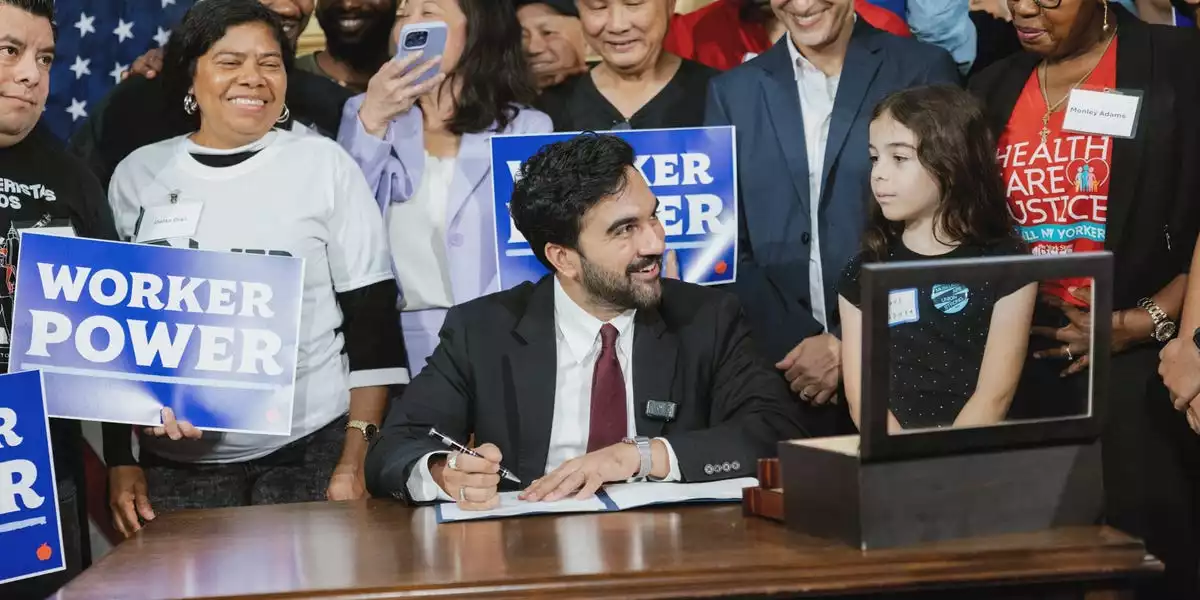
New York City’s decision to launch the Office of Worker Power (OWP) under Mayor Zohran Mamdani, with veteran labor organizer Tony Perlstein as inaugural director, signals a notable shift in how the nation’s largest city intends to engage with work in the platform era. Rather than positioning labor issues solely as matters for courts, state agencies, or federal regulators, the city is building a dedicated civic institution designed to educate workers, convene public hearings, and strengthen organizer networks—especially in sectors where traditional union density has historically been low.
The OWP’s remit is explicitly oriented toward workers most exposed to volatility: gig workers, contract labor, and other precarious employment categories. That focus aligns with the mayor’s broader affordability agenda, which has already included efforts aimed at wage violations in the gig economy, platform-worker safety standards, and legal action involving major delivery platforms such as Uber Eats. In practical terms, the OWP appears designed to become a connective tissue between worker complaints, public visibility, and policy momentum—an institutional amplifier for issues that often remain fragmented across industries and boroughs.
Yet the initiative also arrives with open questions that matter to both labor advocates and business leaders. Budget allocations and staffing beyond Perlstein have not been disclosed, leaving uncertainty about whether the OWP will function primarily as a convening and education hub or evolve into a more muscular policy engine. Business groups, meanwhile, have raised concerns about regulatory headwinds and cite delays in forming a business advisory council and appointing leadership at the Economic Development Corporation—an early indication that the city’s economic narrative may be contested in parallel with its labor narrative.
Inequality, affordability, and the economics of fragmented work
The OWP’s launch is inseparable from New York’s widening income divide. A recent NYC Comptroller report found that in 2024 the top 10% captured 60% of citywide income, while the top 1% alone captured 37%. These figures provide political and economic context for why a city government might treat worker power not merely as a social objective, but as an instrument of macroeconomic stabilization—particularly in a high-cost environment where household budgets are already strained.
Two structural forces converge here:
- The shift away from stable, middle-income employment toward gig, contract, and platform-mediated work. Nationally, an estimated 16%–20% of jobs fall into non-traditional categories, often characterized by variable hours, limited benefits, and weaker career ladders.
- New York City’s cost structure, where housing can consume over 40% of median household income, amplifying the consequences of income volatility and pushing many workers into multiple jobs or overlapping gigs.
In this environment, the OWP’s emphasis on rights education and public hearings can be read as an attempt to reduce informational asymmetry—helping workers understand wage calculations, safety obligations, and complaint pathways. For policymakers, it also creates a mechanism to translate diffuse worker experiences into a more legible public record, potentially shaping future legislation or enforcement priorities.
Algorithmic management meets city-backed transparency pressure
For technology and platform businesses, the most consequential dimension of the OWP may be its potential to challenge the opacity of algorithmic management. Gig platforms commonly rely on dynamic pricing, automated dispatch, performance scoring, and deactivation systems that can be difficult for workers—and sometimes regulators—to interpret. A city-backed office that convenes hearings and aggregates worker reports could increase pressure for explainability in areas such as:
- How pay is calculated across time, distance, tips, and incentives
- How safety standards are operationalized in real-world workflows
- How performance metrics trigger penalties, reduced visibility, or deactivation
- How disputes are handled and whether appeals are meaningful
If the OWP becomes a consistent forum for surfacing patterns—wage theft allegations, safety gaps, or discriminatory outcomes—its outputs could function as a quasi-market signal. Even without direct enforcement authority, recurring public documentation can influence investor perceptions, consumer sentiment, and the posture of other regulators.
The data implications are equally significant. Public hearings and outreach can generate structured and semi-structured information that lends itself to trend detection—identifying hotspots by neighborhood, platform, occupation, or time period. That, in turn, may catalyze demand for a new layer of compliance tooling. HR-tech vendors, payroll providers, and platform infrastructure firms may see growing interest in:
- Compliance-by-design modules embedded into dispatch, pay, and scheduling systems
- Audit trails that support wage transparency and dispute resolution
- Safety and incident reporting workflows that satisfy evolving city expectations
- Third-party tools for algorithmic fairness and labor compliance auditing
In effect, the OWP could accelerate a broader market shift: from viewing labor compliance as a back-office legal function to treating it as a product requirement—especially for platforms whose core value proposition depends on automated coordination of labor.
Strategic implications for business leaders, investors, and urban policy watchers
For companies operating in New York City, the creation of the Office of Worker Power changes the stakeholder map. Labor organizers and worker advocates may increasingly function as formal civic counterparts, not only as external critics. That reality creates both risk and opportunity.
Key strategic considerations include:
- Stakeholder engagement as risk management: Firms that wait for public hearings to become adversarial may face reputational and operational volatility. Proactive engagement—listening sessions, transparent pay practices, and credible safety commitments—can reduce escalation risk.
- Competitive differentiation through worker-centered design: Businesses that can credibly demonstrate lower churn, safer operations, and clearer pay rules may earn a brand premium with consumers and institutional investors focused on ESG and human-capital metrics.
- Cost modeling across the urban economy: If worker-power initiatives contribute to higher effective labor standards, sectors with thin margins—delivery, retail, hospitality, building services—may need to revisit pricing, staffing models, and automation roadmaps. Commercial real estate stakeholders may also need to factor potential operating-cost changes into tenant viability assumptions.
Beyond New York, the OWP will be watched as a potential template. The city often serves as a bellwether for progressive labor policy; platform firms and HR-tech providers may treat developments here as early indicators for policy diffusion to other major metros such as Chicago and Los Angeles, and potentially into federal debates around portable benefits, wage floors, and algorithmic accountability.
The unanswered question is not whether the OWP will matter, but how quickly it will acquire operational capacity—through staffing, budget, and the scope of its convening power. If the office becomes a durable civic platform for worker voice and labor-market experimentation, New York may be positioning itself to shape the next phase of the social contract for platform work: one where affordability, algorithmic governance, and worker representation are negotiated not only in boardrooms and courtrooms, but in the city’s own institutional architecture.

 By
By
 By
By
 By
By
 By
By



 By
By







