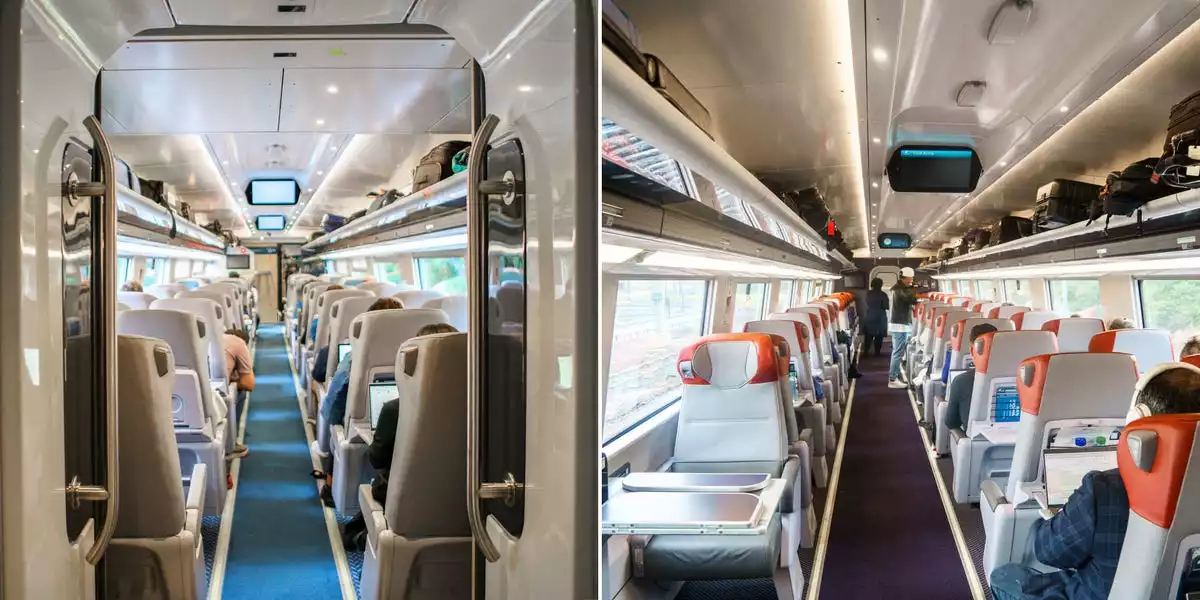

A New Era for American Rail: Acela’s Premium Gambit on the Northeast Corridor
Amtrak’s unveiling of the Next-Generation Acela is more than a technological leap—it’s a bold wager on the future of American intercity rail. The Northeast Corridor, long the nation’s most lucrative and congested rail artery, will soon play host to a service that upends decades of conventional wisdom about what U.S. rail can be. Gone is the familiar three-class hierarchy; in its place, a streamlined, premium-focused offering that aims to seduce business travelers from the skies and redefine the very notion of rail travel in America.
Technology as Catalyst: Engineering a Faster, Smarter, Greener Acela
At the heart of this transformation is the Alstom Avelia Liberty platform—a marvel of modern engineering, bristling with features that place it squarely in the league of Europe’s and Asia’s high-speed titans. The new Acela’s articulated trainsets and active tilting technology promise not just higher speeds (up to 160 mph in initial service, with a design ceiling of 186 mph) but also a smoother, more stable ride through the NEC’s notoriously sinuous alignments. Lightweight composites and distributed traction further enhance acceleration and energy efficiency, while the digital nervous system—anchored by ACSES II Positive Train Control and future-ready ETCS-Level 2 overlays—ushers in a new era of safety and operational flexibility.
But the innovation doesn’t stop at the rails. Predictive maintenance sensors and condition-based analytics aim to slash unplanned downtime, while passenger-facing upgrades—seat-embedded power, dynamic lighting, and advanced HVAC telemetry—signal a commitment to comfort and productivity. These are not mere amenities; they are strategic differentiators, positioning rail as a credible alternative to short-haul air, especially on journeys under 500 miles.
The Economics of Exclusivity: Redefining Yield and Value
Amtrak’s decision to eliminate coach class and collapse its fare structure into two tiers—Business (as the new baseline) and a premium First—marks a radical departure from tradition. The calculus is clear: the NEC’s dense, affluent catchment area, with its high concentration of corporate travelers, can potentially sustain a premium-only, high-speed service. First-class fares, set at 150–180% above the new Business baseline, are calibrated to tap into the robust willingness to pay among business travelers, whose average spend on domestic air shuttles hovers around $320 per leg.
This upmarket repositioning is not without risk. The $2.4 billion capital investment in new rolling stock and depot upgrades is partially offset by federal grants, but ongoing operating costs—while roughly 40% lower per seat-mile than the air shuttle—demand disciplined capacity utilization. Initial models suggest a breakeven load factor in the low 60% range, aligning with airline industry benchmarks. Yet, by densifying seating in Business and enhancing the First-class experience with lounge access and onboard meal service, Amtrak is not merely chasing yield—it is attempting to recast rail as a hospitality-infused mobility product, encroaching on the territory of premium airline shuttles.
Strategic Ripples: Competitive Dynamics and Policy Winds
The implications of this strategic pivot reverberate far beyond Amtrak’s balance sheet. For airlines and airport operators, the prospect of an 8–12% erosion in shuttle market share is real and immediate. The new Acela’s sub-three-hour Manhattan-to-Capitol Hill travel time crosses the psychological threshold at which rail routinely displaces air in Europe and Asia. Code-sharing and intermodal partnerships, akin to Lufthansa’s tie-ups with Deutsche Bahn, may soon become necessary defenses for U.S. carriers.
Meanwhile, the broader policy environment is tilting decisively in rail’s favor. The $66 billion rail allocation in the Bipartisan Infrastructure Law, coupled with tightening ESG mandates, is funneling capital and regulatory momentum toward electrified, high-speed corridors. The NextGen Acela’s compliance with Tier III standards sets a template for future projects, from Brightline West in California to the Texas Triangle. The environmental calculus is equally compelling: a Washington–NYC Acela trip emits roughly 85% less CO₂ per passenger than a comparable regional jet—a statistic that is rapidly gaining salience as corporations scrutinize Scope 3 emissions in their travel policies.
Watching the Tracks: Stakeholder Implications and the Road Ahead
For corporate travel managers, the launch of the new Acela is a clarion call to re-examine air-rail mixes in mandated corridors. Early engagement with Amtrak could secure favorable fare ceilings before dynamic pricing algorithms take hold. Real estate developers and transit-oriented investors will find new opportunities in enhanced station amenities and ancillary revenue streams, while rolling-stock vendors and signaling suppliers eye the NEC as a proving ground for next-generation technology.
Yet, the most profound impact may be philosophical. By betting on premiumization and modal shift, Amtrak is stress-testing the price elasticity of American rail—and, by extension, the nation’s appetite for a new kind of mobility. The first six quarters post-launch will be watched closely by stakeholders across the spectrum, from regulators to infrastructure investors, as the NextGen Acela stakes its claim as both a technological marvel and a harbinger of the future of American transportation.
In this crucible of innovation and ambition, the Northeast Corridor stands not just as a conduit between cities, but as a laboratory for the next chapter of U.S. rail—a chapter that, if successful, could redraw the map of American intercity travel for decades to come.

 By
By
 By
By

 By
By
 By
By


 By
By