

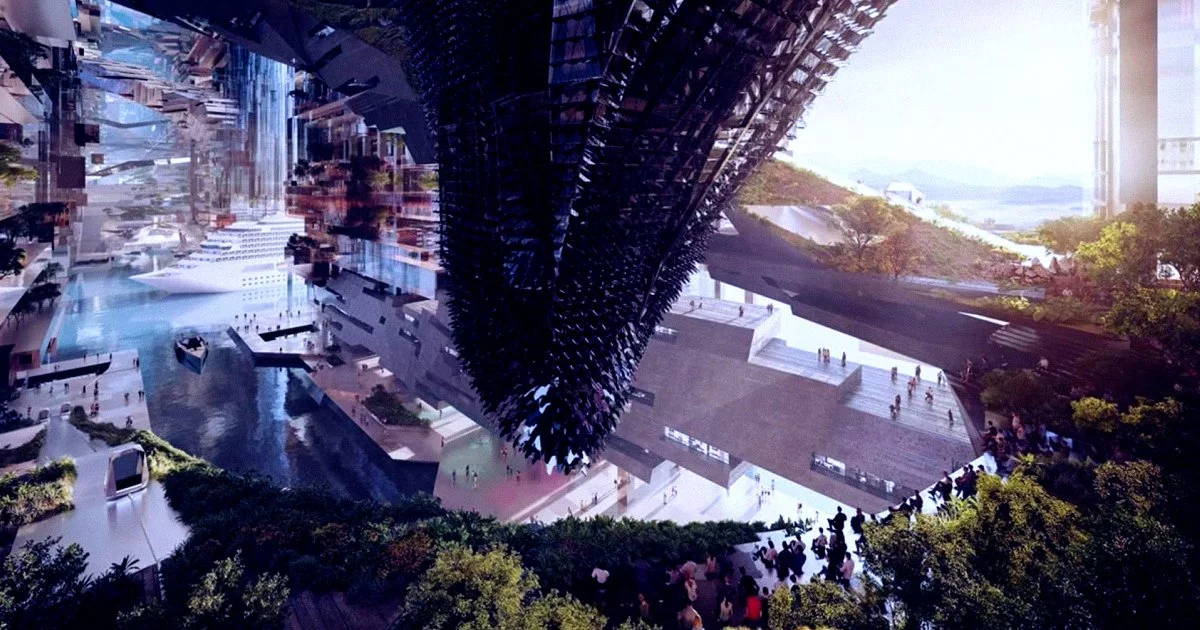

The Unraveling of a Linear Dream: Neom’s Line at a Crossroads
Saudi Arabia’s Neom project—heralded as a paradigm shift in urbanism—has always been more than a city. Conceived as a 105-mile ribbon of glass, steel, and silicon, “The Line” promised to leapfrog centuries of urban evolution, collapsing the chaos of concentric sprawl into a single, perfectly rational vector. But as the dust settles on its marina-side construction sites, the gap between vision and reality grows ever more pronounced. The world watches as the project’s scope contracts, timelines slip, and the very logic of its execution is called into question.
Visionary Urbanism Meets the Machinery of Reality
The Line’s audacity lies not only in its form but in its function—a seamless integration of:
- Vertical urbanism: Stacked infrastructure compresses the city’s footprint, promising walkability and zero-car mobility.
- AI-directed logistics: Every movement, delivery, and service is orchestrated by algorithms, a digital twin pulsing beneath the surface.
- Carbon-free energy and regenerative design: Sustainability is not an afterthought but the city’s operating system.
Yet, the ambition of merging all these systems at once has proven a double-edged sword. While each domain—be it high-speed transit or digital governance—has been validated in isolation, their concurrent deployment at this scale introduces interface risks that even the most seasoned systems integrators struggle to quantify. The linear topology, meanwhile, upends the economic logic of cities. By eschewing the agglomeration benefits of traditional urban cores, The Line demands massive upfront capital with little room for the adaptive phasing that investors crave.
Supply-chain turbulence has further exacerbated these challenges. The project’s reliance on just-in-time delivery of bespoke components collided headlong with global logistics bottlenecks and inflationary pressures, widening the financing gap and testing the patience of both domestic and foreign stakeholders.
Capital, Governance, and the Specter of ESG
The financial underpinnings of Neom are no less fraught. Saudi Arabia’s Public Investment Fund, though formidable, faces competing demands—from welfare spending to international energy ventures. As global interest rates climb and oil prices fluctuate, the appetite for long-duration, high-risk infrastructure plays has waned. Private capital, once eager to align with Gulf megaprojects, is now recalibrating toward shorter, less volatile horizons.
Complicating matters is a growing deficit of trust. The suspension of a 2023 internal audit, coupled with reports of worker fatalities, has cast a shadow over Neom’s governance. In an era where ESG (Environmental, Social, and Governance) metrics are non-negotiable for institutional investors, such opacity is more than a public relations issue—it’s a gating factor for capital. The project’s insistence on a “full steam ahead” narrative, even as visible slowdowns emerge, only widens the perception gap.
Comparisons with regional peers are inevitable. Dubai’s incremental “2040 Urban Master Plan” and Abu Dhabi’s adaptive Masdar City offer a counterpoint: smaller, modular, and more transparent models that increasingly set the benchmark for Gulf smart-city performance.
Strategic Inflection: From Grandiosity to Resilience
Yet, within Neom’s apparent faltering lies a trove of strategic options and latent value. The digital infrastructure already developed—petabytes of simulation and environmental data—could be spun into urban-planning SaaS platforms or climate-resilience toolkits, particularly attractive to emerging markets. The project’s talent pool, now at risk of diaspora, represents a critical asset in a region hungry for expertise in AI, sustainability, and megaproject delivery.
Decision-makers face a menu of paths:
- Concentrated Demonstrator: Re-scope to a 10-mile pilot, focusing on demonstrable KPIs and unlocking concessional debt.
- Financial Ring-Fence: Spin off revenue-ready assets—ports, logistics, data centers—into independently governed vehicles, inviting investor participation without The Line’s headline risk.
- Write-Down and Redeploy: Accept partial sunk costs and redirect capital toward distributed urban-renewal projects with swifter socioeconomic returns.
Strategically, embedding agile phasing and transparent governance—voluntary third-party audits, IFRS-style reporting—could restore credibility. Regional co-creation, inviting Gulf and Asian sovereign partners to co-design sub-districts, might diffuse geopolitical risk and align capital with expertise. Above all, prioritizing workforce welfare through IoT wearables and AI-driven safety analytics could turn ESG vulnerabilities into innovation showcases.
Lessons in Ambition, Risk, and Adaptation
The Line stands as a parable for 21st-century megaprojects—a vision so compelling it bends the world’s gaze, yet so complex it teeters on the edge of its own ambition. The lesson for global executives and technology strategists is clear: radical urban concepts demand not only radical design, but equally radical approaches to financing, governance, and risk management. Even if the physical city contracts, the intellectual property, data, and talent generated along the way can be harvested for enduring value.
For those willing to recalibrate and embrace modular resilience, Neom’s experiment remains a crucible of innovation. Its outcome will echo far beyond the sands of the Red Sea, shaping the contours of urban imagination for decades to come.

 By
By

 By
By
 By
By
 By
By
 By
By









