


Artemis schedule slippage exposes the hidden complexity of “commercial-plus” spaceflight
NASA’s decision to push the first crewed lunar landing from Artemis 3 (2027) to Artemis 4 (around 2028) is more than a calendar adjustment—it is a stress test of the modern U.S. space enterprise. The Artemis architecture is intentionally distributed: NASA sets mission requirements and safety standards, while a web of prime contractors and commercial partners deliver critical subsystems. That model can unlock speed and innovation, but it also concentrates risk in the seams between organizations.
The immediate drivers—integration challenges, propulsion delays, and evolving mission objectives—underscore a central reality: NASA is acting as a systems integrator across heterogeneous platforms, a role that is fundamentally different from the vertically integrated Apollo era. When one node slips, the schedule impact cascades.
Key pressure points now visible to industry and policymakers include:
- Multi-provider dependency risk: With major elements spanning SpaceX, Blue Origin, Lockheed Martin, Northrop Grumman, and others, Artemis behaves less like a single program and more like an ecosystem—powerful, but brittle when interfaces are not mature.
- Propulsion and engine readiness: Delays tied to engines and propulsion systems are rarely isolated; they ripple into testing windows, launch manifests, and certification timelines.
- Mission creep vs. mission learning: “Evolving objectives” can reflect strategic ambition—Gateway, refueling concepts, and longer-duration operations—but each added requirement increases integration burden and verification complexity.
For investors and commercial suppliers, the Artemis delay is a reminder that space is now a supply-chain business as much as it is an exploration endeavor. The winners will be those who can deliver not only breakthrough hardware, but also repeatable integration discipline—documentation, interface control, and test cadence that scales.
China’s lunar site selection is a scientific play with strategic leverage
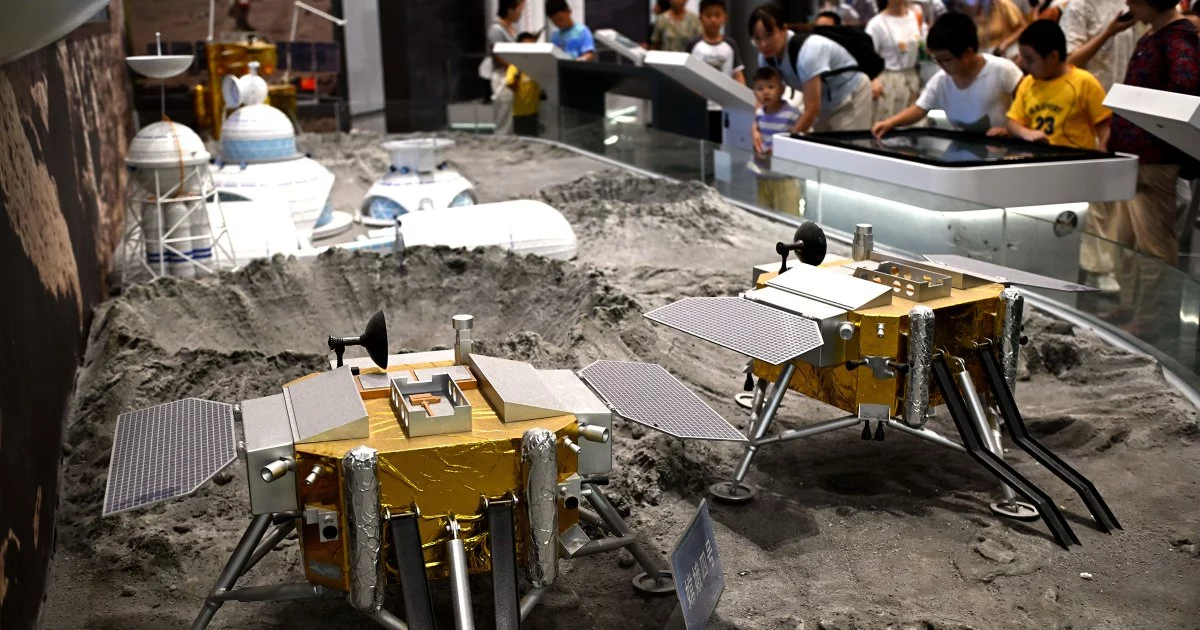
While NASA recalibrates, China is accelerating. An uncrewed south-pole lander is expected later this year, and a crewed mission by the end of the decade remains the stated target. Yet the most strategically revealing detail is not the timeline—it is the geography.
Chinese researchers, working with international experts, have identified four high-value landing candidates in Sinus Aestuum and Rimae Bode, regions associated with volcanic glass, mare basalts, and impact ejecta. These are not merely photogenic terrains; they are scientifically dense targets that can generate outsized returns in both knowledge and capability.
What makes these sites consequential:
- Volcanic glass beads and basalts can illuminate lunar volcanic history and potentially enable regolith processing pathways relevant to oxygen extraction and construction materials.
- Impact ejecta and breccias help refine lunar chronology and crustal evolution—data that informs everything from academic models to engineering assumptions about surface operations.
- A “data moat” strategy: By prioritizing geologically rich mid-latitude regions—rather than only the technically punishing polar extremes—China can accumulate a broad, high-quality dataset that becomes a reference point for future missions and international collaborators.
This approach also hedges operational risk. Polar landings promise water ice and long-term habitation potential, but they impose harsh lighting conditions, thermal extremes, and communications constraints. By building scientific capital in comparatively accessible regions, China can strengthen mission confidence while shaping global understanding of lunar resources and geology.
Two lunar coalitions are forming—and standards may matter more than flags
The emerging split between the U.S.-led Artemis Accords and China’s proposed International Lunar Research Station (ILRS)—in partnership with Russia and select allies—signals a deeper contest: who sets the rules of the lunar economy.
U.S. law currently restricts bilateral space cooperation with China, effectively ensuring that the Moon develops along parallel governance tracks. That bifurcation resembles terrestrial alliance dynamics, but with a technical twist: lunar leadership will be determined not only by landings, but by interoperability standards and operational protocols.
Areas where standards-setting could become decisive include:
- Communications and navigation infrastructure: relay networks, timing standards, and beacon systems that become “default” for coalition partners
- Payload and docking interfaces: the practical mechanics that determine whether international hardware can plug into a shared architecture
- Resource utilization norms: how partners interpret extraction, processing, and “use rights” in the absence of universally accepted property regimes
- Data access and scientific reciprocity: who gets samples, who gets telemetry, and under what terms
In this context, Artemis delays carry geopolitical cost only if they translate into lost institutional momentum or fragmented partner confidence. Conversely, China’s acceleration becomes strategically meaningful if it results in durable infrastructure and widely adopted technical norms—especially among emerging space powers seeking affordable pathways to lunar participation.
The lunar race is becoming an industrial policy contest—budgets, supply chains, and ISRU will decide durability
The macroeconomic backdrop is tightening. NASA’s FY25 request implies flat real funding, forcing trade-offs between near-term Artemis cadence and longer-horizon cislunar infrastructure such as Gateway and refueling depots. At the same time, commercial actors face a harder question from capital markets: Where is the revenue before permanent lunar settlement?
That pressure is likely to elevate business models tied to nearer-term monetization:
- Lunar communications relays and navigation services
- On-orbit servicing and docking technologies
- Robotics, autonomy, and surface mobility platforms
- In-situ resource utilization (ISRU) demonstrations that reduce dependence on Earth launch mass
China’s interest in lunar materials—often discussed in terms of ilmenite and even speculative helium-3 narratives—also aligns with a broader terrestrial strategy: securing leverage over critical minerals and industrial inputs. Even if lunar mining remains distant, the Moon can serve as a proving ground for extraction and processing techniques that later translate into Earth-based resilience for supply chains involving cobalt, nickel, and rare earths.
For the U.S. and its partners, the strategic response is less about matching headlines and more about engineering resilience into the Artemis ecosystem:
- Modular certification of propulsion, guidance, and communications subsystems to reduce single-contractor bottlenecks
- Expanded transatlantic scientific coalitions to diversify lunar geology leadership beyond the south pole
- Milestone-based incentives for ISRU to bridge science missions with scalable industrial capability
- Active monitoring of ILRS technical protocols to ensure U.S. standards remain interoperable and attractive to partners
The next phase of lunar competition will reward the actors who can turn exploration into repeatable operations, and operations into economic gravity—the kind that pulls allies, suppliers, and standards into orbit around a durable cislunar strategy.

 By
By
 By
By

 By
By
 By
By


 By
By







