

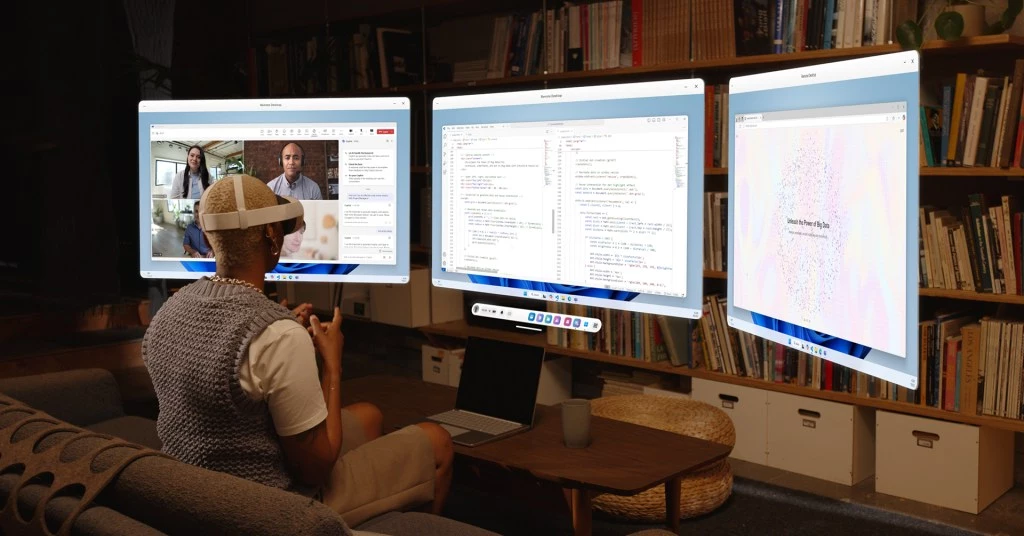

Spatial Computing’s New Beachhead: Windows 11 Arrives on Meta Quest
The landscape of enterprise computing is shifting beneath our feet, as Microsoft and Meta quietly redraw the boundaries of the modern workspace. With the official release of Windows 11 for Meta Quest 3 and 3S—no longer in preview, but now broadly available—users can project up to twelve virtual 2-D monitors or a single, enveloping ultrawide desktop inside their headset. This isn’t just a technical milestone; it’s a strategic gambit that reframes the economics, usability, and competitive dynamics of spatial computing.
The Strategic Chessboard: Microsoft, Meta, and the Spatial PC
The implications of this partnership ripple far beyond the technical. For Microsoft, the Quest integration is a hedge against irrelevance in a future where spatial environments could otherwise sideline Windows. It’s a second major hardware beachhead for spatial Windows, following the HoloLens, and it opens a licensing path for Windows 365 Cloud PC streaming—enabling enterprises to deploy cloud-native desktops inside immersive headsets.
Meta, meanwhile, gains access to the gravitational pull of the Windows ecosystem—a critical asset as it seeks to diversify revenue streams beyond advertising and woo productivity-focused buyers. By leveraging Microsoft’s OS stack, Meta sidesteps the herculean task of building a business-ready desktop environment from scratch, instead positioning the Quest as a credible tool for knowledge work. The result: a formidable alternative to Apple’s $3,500 Vision Pro, with a combined hardware and software entry point closer to $500–$650, plus a Windows license.
Key strategic dynamics include:
- Mutual hedging: Each company insulates itself from future platform risk while expanding its enterprise footprint.
- Pricing disruption: The hardware cost delta—seven-to-one in Meta/Microsoft’s favor—puts pressure on Apple to justify its premium, likely accelerating its own TCO narrative.
- Subscription upsell: Both firms are poised to drive recurring revenue, whether through Windows 365, Teams Immersive Workspaces, or Quest for Business MDM.
Under the Hood: Technological Convergence and Hardware Enablement
The technical architecture behind this leap is as significant as the business calculus. The new Mixed Reality Link PC client, enabled by Meta’s Horizon OS v81, transforms the Quest into a high-fidelity thin client. Compute-intensive workloads—full-resolution rendering, application execution—remain on the Windows PC, while the headset acts as a wireless, spatially aware display. This mirrors the approach of NVIDIA’s CloudXR and AWS Nimble Studio, but with a consumer-friendly twist.
The user experience borrows liberally from Apple’s design language: curved ultrawide screens, floating windows, hand-anchored controls, and instant “Full Passthrough” for physical workspace awareness. This convergence of UX standards is more than cosmetic; it signals a coming consolidation in developer tooling, as Unity and Unreal increasingly optimize for Quest-class devices first.
The hardware, too, is up to the task. The Quest 3’s Qualcomm XR2 Gen 2 chipset delivers enough pixel throughput for multiple high-resolution monitors at 90–120 Hz. As on-device NPUs shift from AI demos to real-time reprojection and foveated rendering, expect even smoother experiences—and fewer bottlenecks on the PC GPU.
The Road Ahead: Economic Forces and Enterprise Transformation
The downstream effects are already materializing. Enterprise IT buyers now face a stark choice: a $650 headset that can replace a multi-monitor setup, or a $3,500 Vision Pro. This cost delta will force Apple to sharpen its value proposition, and may well tilt the market toward more affordable, subscription-driven models.
Looking forward, several trends are emerging:
- Workplace transformation: Early adopters are using Quest 3 as portable multi-monitor rigs; by 2026, cloud PCs streamed over 5G could commoditize the laptop dock, while AI-driven spatial UIs unlock use cases flat screens can’t match.
- Security imperatives: CISOs will demand end-to-end encryption, integration with Azure Conditional Access, and data-loss prevention controls for immersive screensharing.
- Developer ecosystem tipping point: As the install base grows, enterprise ISVs will target Quest-class runtimes, relegating ultra-premium headsets to niche roles.
- Supply chain and M&A: Surging demand for XR2 Gen 2-class chips could strain TSMC’s 5-/4-nm capacity, while virtual desktop orchestration and spatial UI analytics firms become prime acquisition targets.
For decision-makers, the calculus is shifting. CTOs should pilot Quest 3 with Windows 365, benchmarking real productivity gains. CFOs must weigh the capex/opex trade-offs—sub-$1,000 headsets and subscriptions may undercut traditional desktop setups when factoring in real estate and energy costs. CHROs and CISOs, meanwhile, will need to update ergonomics policies and zero-trust frameworks for this new paradigm.
The arrival of Windows 11 on Meta Quest marks the moment when spatial computing steps out of the lab and into the enterprise mainstream. By fusing Microsoft’s desktop ubiquity with Meta’s aggressive hardware economics, the partnership doesn’t just lower the barrier to entry—it redefines the playing field, setting the stage for a new era of immersive, subscription-driven productivity. Early movers will seize a critical advantage, capturing both the learning curve and the cost arbitrage before the next wave of hardware and licensing resets.

 By
By
 By
By
 By
By
 By
By



 By
By







