

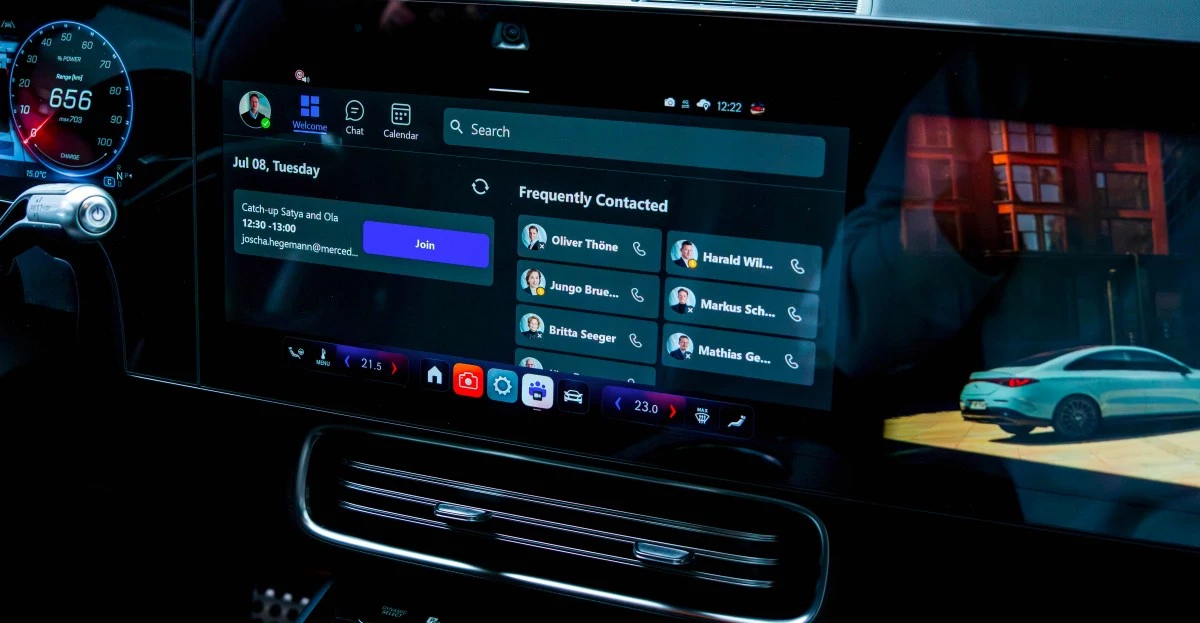

Reinventing the Automobile: Mercedes-Benz and the Rise of the “Third Workspace”
Mercedes-Benz is poised to redraw the boundaries of both mobility and productivity with its forthcoming CLA, which will debut a seamless integration of Microsoft Teams and Microsoft 365 Copilot directly into the vehicle’s digital cockpit. This move, which transforms the car into a bona fide “third workspace,” is more than a technological flourish—it is a strategic wager on the future of work, mobility, and the software-defined vehicle. As the lines between office, home, and transit dissolve, the German automaker’s initiative signals a new chapter in the convergence of enterprise software, automotive engineering, and the hybrid work revolution.
The Software-Defined Vehicle: Where Cloud, AI, and Mobility Converge
At the heart of this transformation lies MB.OS, Mercedes’ Linux-based operating system, which abstracts vehicle hardware from cloud services and enables rapid, over-the-air feature deployment. This architecture does not merely mimic the flexibility of a smartphone—it reimagines the car as a modular, upgradable platform where software becomes the primary locus of value creation.
Key technological vectors include:
- Generative AI as Middleware: The integration of Microsoft 365 Copilot is a harbinger of generative AI’s migration into the cabin, promising future applications in trip-planning, real-time coaching, and personalized concierge services.
- Edge Connectivity and Compute: Real-time video conferencing and AI-powered task management in a moving vehicle demand robust 5G/LTE coverage and on-device inference. Electric vehicle architectures, with their ample battery reserves, are uniquely suited to support these compute-intensive features.
- Safety and Human-Machine Interface (HMI): Mercedes’ decision to block incoming video and slide sharing while the car is in motion is a regulatory compromise, yet the cognitive demands of active participation in meetings remain a concern. The true potential of these features will be unlocked only as Level-3+ automated driving becomes commonplace, allowing drivers to safely disengage from the road.
Strategic Stakes: Subscription Economics and the Corporate Fleet
Mercedes’ foray into in-car enterprise collaboration is as much a business model innovation as it is a technological one. The automaker is already monetizing features like rear-wheel steering and seat heating via monthly subscriptions; now, by embedding Microsoft Teams and Copilot, it opens a new revenue channel, targeting corporate travel and executive fleets with services priced to enterprise budgets.
Strategic implications include:
- Corporate Fleet Capture: By aligning with the Microsoft 365 ecosystem, Mercedes is courting CIOs and fleet managers who value seamless integration with existing productivity tools—a direct challenge to rivals like BMW and Audi in the lucrative executive segment.
- Platform Convergence Pressures: For Microsoft, this partnership is a defensive play against the encroachment of Apple’s next-gen CarPlay and Google’s Android Automotive OS. Automakers lacking proprietary OS ambitions may find themselves relegated to white-label SaaS integrations, accelerating commoditization in infotainment hardware.
- Data and Telemetry: Enhanced connectivity and identity management position Mercedes as a potential data provider for usage-based insurance and carbon tracking, deepening its entanglement with enterprise mobility platforms.
Navigating Risk: Distraction, Privacy, and the New Work-Life Frontier
The promise of vehicular productivity is shadowed by complex questions of safety, liability, and privacy. As cars become rolling offices, automakers and regulators must grapple with the implications of enabling work during transit.
Critical challenges include:
- Distraction Liability: By facilitating work activities behind the wheel, Mercedes and its peers may face heightened scrutiny from regulators and insurers, who must recalibrate risk models to account for cognitive distraction.
- Data Privacy: The capture of biometric video, voice transcriptions, and geolocation data for enterprise collaboration triggers a thicket of GDPR and CCPA compliance obligations. Explicit consent and robust data sovereignty frameworks are non-negotiable.
- Work-Life Boundaries: The encroachment of work into every corner of daily life may provoke cultural and legislative pushback, particularly in regions with strong right-to-disconnect protections.
Competitive Ripples and the Road Ahead
While rivals like BMW and Volvo have dabbled in leisure and productivity integrations—AirConsole, Apple Fitness+, and Google Workspace—Mercedes’ direct tie-in with a dominant enterprise collaboration platform sets a new benchmark for “office-grade” in-car experiences. Tesla’s resistance to third-party ecosystems may prove untenable if Mercedes demonstrates meaningful revenue and retention gains.
For automakers, cockpit software is now a strategic battleground, demanding agile partnerships with SaaS leaders and vigilant preservation of API sovereignty. Enterprise IT leaders must treat vehicles as secure endpoints, while telecom operators and insurers recalibrate their offerings for a world where the car is as much a productivity node as a transport asset.
Mercedes-Benz’s “third workspace” gambit is not a novelty—it is a calculated move to claim a central role in the software-defined mobility economy. The outcome will reverberate far beyond the dashboard, shaping the future interplay of automakers, cloud providers, and enterprise customers in an era where mobility and productivity are inextricably linked.

 By
By

 By
By

 By
By
 By
By

 By
By







