

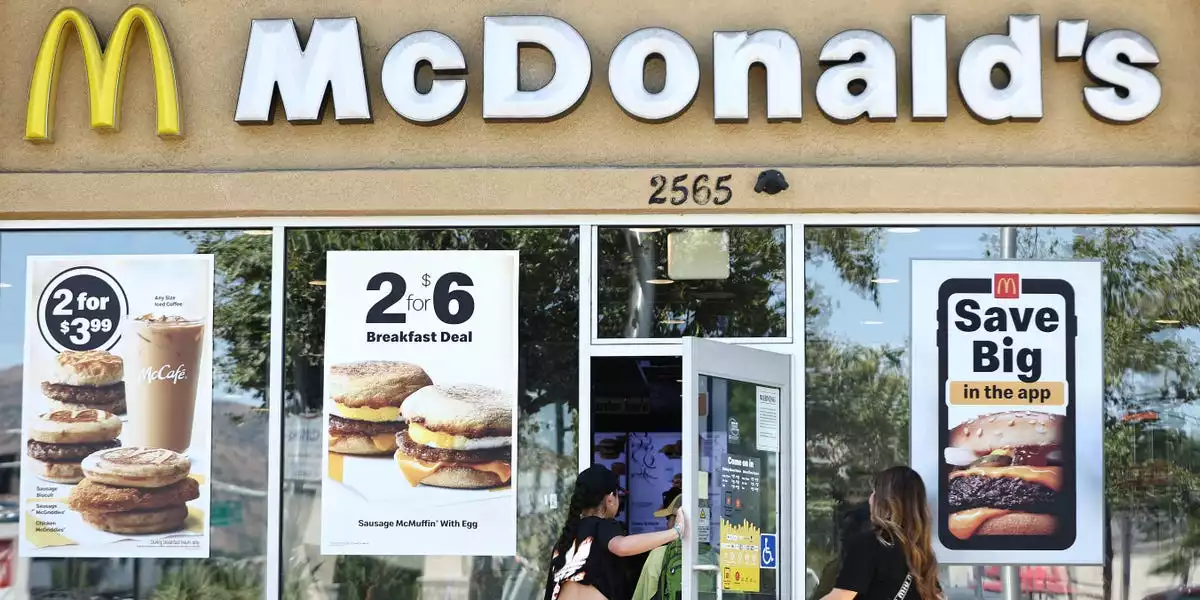

A stress test for McDonald’s value engine in a K-shaped economy
Fresh consumer-analytics signals point to a meaningful inflection for McDonald’s U.S. business among its most price-sensitive customers. Spending from households earning $40,000 or less fell 2.4% year over year, implying roughly $310 million in lost quarterly sales tied to that cohort. Notably, this is described as the first quarterly decline in low-income patronage in more than a year, a break from a period when McDonald’s largely held its ground as inflation reshaped dining habits.
The broader context matters. The U.S. recovery has increasingly resembled a K-shaped trajectory: higher-income consumers remain comparatively insulated, while lower-income households face sharper trade-offs across essentials, transportation, and food. For McDonald’s—long positioned as a reliable “everyday value” option—this environment turns value from a marketing theme into an operational promise that must be delivered consistently, store by store, day by day.
McDonald’s U.S. comparable same-store sales rose just 0.8%, a modest gain that reads less like momentum and more like resilience under pressure. The critical issue is not whether the brand still draws traffic—it does—but whether it can credibly win the value conversation at the exact moment when value is being redefined by competitors, grocery economics, and consumer psychology.
Competitive value wars: when “cheap” isn’t enough, execution becomes the product
The competitive comparison is telling. Burger King posted a 0.3% sales gain, while Chili’s delivered stronger growth supported by its own value-led positioning. These are not blockbuster numbers across the board, but they highlight a key dynamic: value is increasingly judged by clarity, consistency, and perceived fairness, not merely by a low headline price.
McDonald’s challenge appears less about strategy on paper and more about in-market execution—particularly around its $3-and-under value menu. CEO Chris Kempczinski has acknowledged uneven adherence at the store level, and that inconsistency can be corrosive in a value cycle. When customers see an advertised deal but encounter friction—limited availability, confusing mechanics, or store-to-store variability—the brand’s value equity erodes faster than it can be rebuilt through advertising.
Several forces are converging:
- Trade-down pressure is intensifying. Lower-income diners are not only trading down within fast food; they are trading across brands and channels, including to at-home meals.
- Competitors are packaging value more effectively. Tiered bundles, loyalty-linked discounts, and simpler “always-on” deals reduce cognitive load and increase trust.
- In-home substitution is rising despite grocery inflation. Even with elevated food prices, home cooking can feel more controllable—especially when restaurant pricing feels unpredictable.
At the same time, McDonald’s brand strength remains a strategic asset. The company still benefits from unmatched scale, convenience, and consumer familiarity. But in a value war, brand recognition doesn’t automatically translate into value leadership—particularly when rivals can match price points and sometimes exceed McDonald’s on perceived portion, bundle logic, or promotional transparency.
Promotions, trust, and the signal hidden in the apple pie bump
One of the more intriguing data points is the performance of the fried apple pie relaunch, which reportedly reached 11.7% of U.S. households. That kind of penetration underscores that McDonald’s still has the ability to create broad-based excitement across income brackets. It also highlights a subtle but important distinction: novelty can drive trial, yet trial does not necessarily translate into repeat visits among low-income customers if the everyday value proposition feels unreliable.
This is where the narrative becomes less about a single menu item and more about trust architecture:
- Value requires predictability. Price-sensitive consumers plan tightly; inconsistency functions like a hidden surcharge.
- Promotions must be operationally “true.” If a deal exists in marketing but not at the counter, the customer experience becomes adversarial.
- Loyalty is increasingly transactional. In the current market, loyalty is often rented through offers rather than earned through habit—meaning the best offer wins the next visit.
McDonald’s uneven performance suggests that the company is not facing a demand collapse so much as a precision problem: the brand can still generate interest, but it is struggling to convert that interest into sustained frequency among the consumers who historically anchored its value identity.
The technology playbook: AI, personalization, and alternative models to rebuild value leadership
McDonald’s has one advantage many competitors can’t replicate quickly: data scale across point-of-sale, drive-thru throughput, mobile ordering, and loyalty engagement. The next phase of competition is likely to be shaped by how effectively that data is translated into localized, real-time value—without confusing customers or triggering backlash.
High-impact opportunities include:
- AI-driven bundles and hyper-local offer design
Using store-level demand patterns to tailor bundles by daypart, region, and inventory conditions could improve both affordability and margins—especially if offers are framed simply and delivered consistently.
- Personalized digital engagement that reduces promotional waste
Segmentation based on purchase history and location can target discounts to the most price-sensitive customers while protecting profitability elsewhere, improving ROI versus broad national promotions.
- Digitized inventory and operational controls
IoT-enabled tracking and tighter supply-chain visibility can reduce stockouts and ensure value-menu availability—critical for restoring confidence in advertised pricing.
More experimental ideas—such as fintech partnerships (micro-credit or deferred payment mechanics) and ghost kitchens/virtual brands in underserved neighborhoods—signal how far “value” could evolve beyond a menu board. These concepts carry reputational and regulatory considerations, but they also reflect a market reality: for many households, affordability is becoming a financial workflow problem, not just a pricing problem.
For McDonald’s, the immediate imperative is straightforward and unforgiving: make value real at the store level, then use technology to make it smarter, more targeted, and more dependable. In a K-shaped economy, the brands that win won’t be those that simply discount the most—they’ll be the ones that deliver the cleanest, most trustworthy value experience at scale.

 By
By
 By
By


 By
By
 By
By

 By
By







