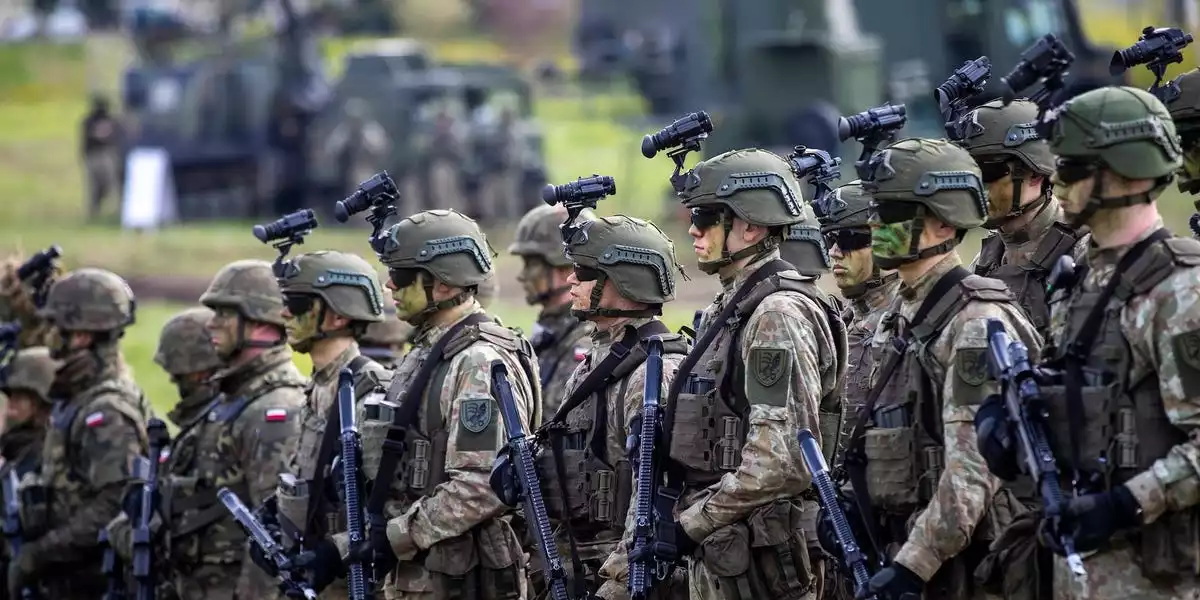

The Baltic Shield: Lithuania’s $1.2 Billion Bet on Fortress Europe
In a move that reverberates far beyond its pine-forested borders, Lithuania has unveiled a $1.2 billion, decade-spanning project to transform its 420-mile frontier with Russia and Belarus into one of the most formidable defensive lines in modern Europe. This sweeping initiative, co-financed by the European Union and underpinned by Germany’s commitment to station a full brigade on Lithuanian soil, signals a tectonic shift in NATO’s posture on its north-eastern flank. The Baltic states, long seen as vulnerable trip-wires, are rapidly recasting themselves as the alliance’s pre-positioned denial zone—a living laboratory for 21st-century deterrence.
From Symbolic Trip-Wires to Forward Denial: Rethinking NATO’s Eastern Doctrine
For decades, the Baltic defense paradigm rested on the slender hope that a modest allied presence would suffice to deter Russian adventurism—a “trip-wire” force, its very vulnerability a kind of insurance policy. Lithuania’s new fortification program, however, marks a doctrinal pivot toward “forward denial.” This is not mere symbolism. The lessons from Ukraine are stark: rapid seizure of border regions can grant an aggressor bargaining leverage before NATO can mobilize. By hardening the frontier with layered anti-tank obstacles, minefields, and demolition-ready bridges, Lithuania is raising the costs of invasion and compressing NATO’s response timeline.
The Suwałki Corridor—a narrow, 65-kilometer strip between Belarus and the Russian exclave of Kaliningrad—has long haunted alliance planners as the Achilles’ heel of Baltic security. Lithuania’s fortification efforts, synchronized with Latvia and Estonia, are designed to complicate any Russian attempt to sever this vital artery. The result is a multi-tiered deterrent: physical barriers to slow armor, integrated air defenses, and forward-deployed German brigades ready to counter-punch. The north-eastern flank of NATO is being recast from a symbolic red line into a tangible wall of steel and resolve.
Engineering the Modern Fortress: Technology, Industry, and Economic Ripples
Unlike the static Maginot Lines of the past, Lithuania’s blueprint fuses Cold War-era engineering with digital-age precision. Classic obstacles—dragon’s teeth, anti-tank ditches—are now paired with networked sensors, loitering munitions, and ISR drones. These static defenses, once seen as liabilities in the era of precision strikes, are being reimagined as sensor-fused magnets, feeding real-time targeting data to HIMARS and Euro-ART rocket systems already deployed in the region. Bridges and rail nodes are pre-cabled with smart detonators, allowing for remote, rapid demolition—compressing reaction times and reducing risk to combat engineers.
The economic implications are equally profound. The $1.2 billion pipeline is catalyzing a new defense industrial base in the Baltics, nudging Lithuanian SMEs into NATO supply chains and diversifying economies long dominated by services and fintech. Even as Vilnius locks in elevated defense outlays—already among the highest in NATO—the EU’s cost-sharing mechanisms and the prospect of pan-European demand for fortification tech offer a measure of fiscal insulation. Should front-line states like Finland or Romania follow suit, Baltic suppliers may find themselves at the forefront of a continent-wide surge in anti-access infrastructure.
Beyond Concrete and Steel: Cyber, Energy, and Human Capital
The hardening of Lithuania’s borders is not merely a physical endeavor; it is a catalyst for broader societal and technological transformation. As physical barriers rise, so too does the strategic value of Lithuania’s energy and telecom networks—prime targets for hybrid threats. Anticipating this, fortification budgets discreetly earmark funds for SCADA segmentation, satellite backup links, and quantum-resistant encryption, opening new opportunities for cybersecurity vendors and tech partnerships. The integration of micro-grid capable forward bases, powered by dual-use renewables, further diminishes Russia’s leverage over energy supply.
Perhaps most quietly significant is the program’s impact on talent retention. Large-scale engineering and data analysis projects are absorbing graduates who might otherwise emigrate, nurturing a defense-savvy workforce and marginally easing the chronic brain-drain that has long plagued the region. This convergence of physical fortification and human capital development is, in many ways, the most enduring legacy of Lithuania’s gambit.
As the first earth is turned and concrete poured, the Baltic frontier is being transformed—not just into a line of defense, but into a crucible for innovation, resilience, and alliance cohesion. For decision-makers and investors attuned to these undercurrents, the evolving security-industrial landscape offers both imperatives to hedge and opportunities to lead. In the shadow of history, Lithuania’s new wall is less a barrier than a bold reimagining of what it means to be secure in an age of uncertainty.

 By
By
 By
By
 By
By
 By
By
 By
By

 By
By