


LeapMove’s Edge: Rethinking Motion, Privacy, and Play in the Children’s Console Market
LeapFrog’s latest foray into educational technology, the LeapMove motion-tracking console, arrives at a moment of convergence—where privacy anxieties, economic pressures, and shifting attitudes toward screen time collide. Priced at $69.99, LeapMove is not just a toy, but a carefully engineered response to the demands of parents, regulators, and a market hungry for alternatives to both premium gaming and passive edtech. Its launch signals a subtle, but significant, recalibration of what “connected” play can mean for young children.
Edge Computing and the New Minimalism in XR for Kids
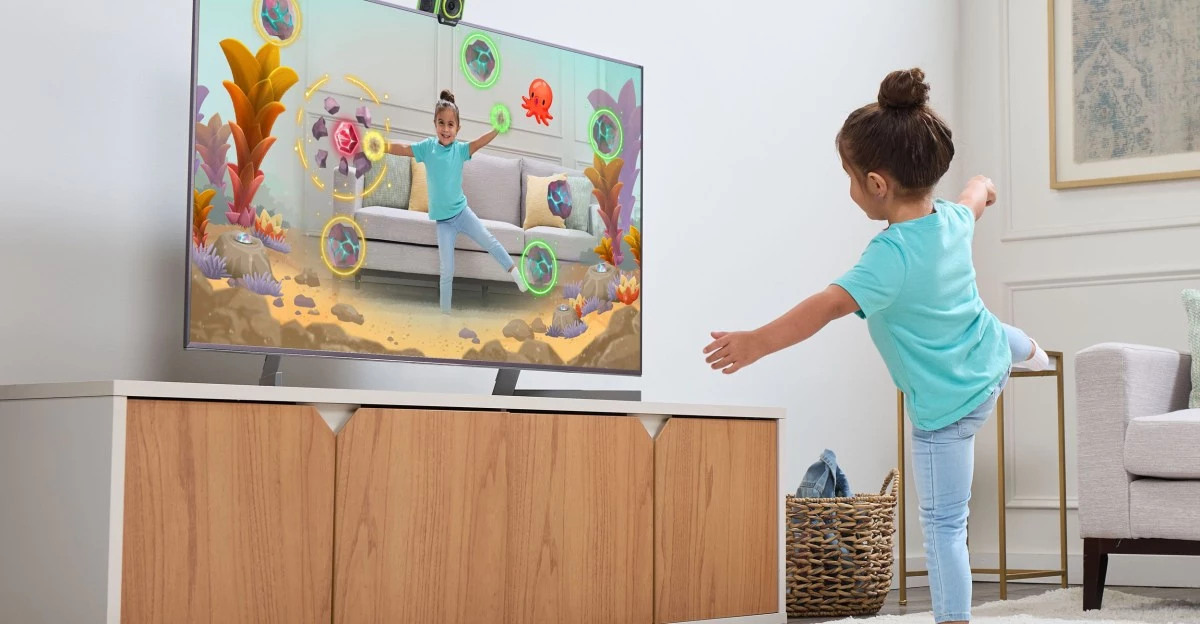
At the heart of LeapMove’s innovation is its edge-only motion capture system. Eschewing the depth sensors and cloud-based analytics that dominate high-end VR/AR, LeapMove leverages a straightforward CMOS camera and on-device computer vision. This approach slashes both bill-of-materials costs and privacy risks, sidestepping the regulatory minefields of COPPA and GDPR. The result is a device that transforms any living room TV into a motion-responsive learning environment—no internet required, no data streaming to distant servers.
This “good-enough XR” philosophy is more than a technical compromise; it’s a strategic pivot. As households postpone big-ticket console upgrades amid economic uncertainty, LeapMove’s ambient, screen-based interactivity offers a middle path. Children, aged four to seven, become on-screen avatars, their movements mapped in real time to curriculum-aligned games in math, reading, and spelling. The experience is immersive enough to engage, yet simple enough to reassure parents wary of both cost and complexity.
Crucially, LeapMove’s offline-first architecture is not a limitation, but a feature. In the wake of previous privacy controversies—most notably around children’s messaging platforms—LeapFrog positions its new console as a safe harbor. With no cloud connectivity, no subscriptions, and local-only data storage for up to three players, the device anticipates the tightening grip of children’s data legislation in the U.S. and Europe. For procurement officers and privacy-conscious parents alike, this is a compelling differentiator.
Economic Positioning and the Razor/Blade Reimagined
LeapMove’s $69.99 price point is a masterstroke in recession-sensitive retailing. At a fraction of the cost of mainstream consoles, it nestles comfortably within the discretionary budgets that survive even during economic downturns. The promise is twofold: educational return on investment and a nudge toward physical activity, addressing the dual anxieties of learning loss and childhood obesity.
Yet, the business model is as notable for what it omits as for what it includes. Unlike the subscription-heavy offerings of ABCmouse or Noggin, LeapMove opts for a razor/blade model without recurring fees. Additional games are sold as one-time purchases via the LeapFrog Connect desktop app. This sidesteps the growing “subscription fatigue” among parents, even as it sacrifices the predictability of annual recurring revenue. The bet is that parents will reward transparency and control over billing, especially in an era when every household budget line is scrutinized.
From a supply-chain perspective, LeapMove’s reliance on mature, widely available semiconductor components insulates it from the volatility that has plagued other consumer electronics launches. By building on established 28-nanometer imaging tech and entry-level system-on-chips, LeapFrog contains its cost of goods and ensures stability in a turbulent market.
Strategic Ripples: Beyond Edtech, Toward Health and Transmedia
LeapMove is not merely an educational tool; it is a quiet competitor in the broader landscape of digital health and childhood engagement. By embedding physical movement into gameplay, the console challenges not only the likes of Roblox and Nintendo Switch, but also youth fitness trackers and even school-based PE programs. The potential for partnerships—with insurers, school districts, or wellness initiatives—is palpable, as stakeholders seek tech-enabled solutions to sedentary lifestyles.
Moreover, LeapMove’s approach to character and content development hints at a longer-term play. By making children the heroes of their own on-screen stories, the platform begins to assemble a first-party library of characters and gamified learning paths. Should these prove sticky, the door opens to licensing opportunities across streaming, merchandising, and beyond—a transmedia flywheel reminiscent of the industry’s most successful franchises.
For technology strategists and investors, LeapMove offers a glimpse into an alternative future: one where connectivity is a spectrum, not a default, and where value is measured not just in engagement metrics, but in the alignment of educational, physical, and privacy outcomes. As regulatory scrutiny intensifies and families demand more from their screens, the LeapMove experiment will be watched closely—not just by its competitors, but by an industry in search of its next paradigm.

 By
By
 By
By

 By
By
 By
By


 By
By







