


The Cosmic Web’s Rotating Filament: A New Blueprint for Technology and Industry
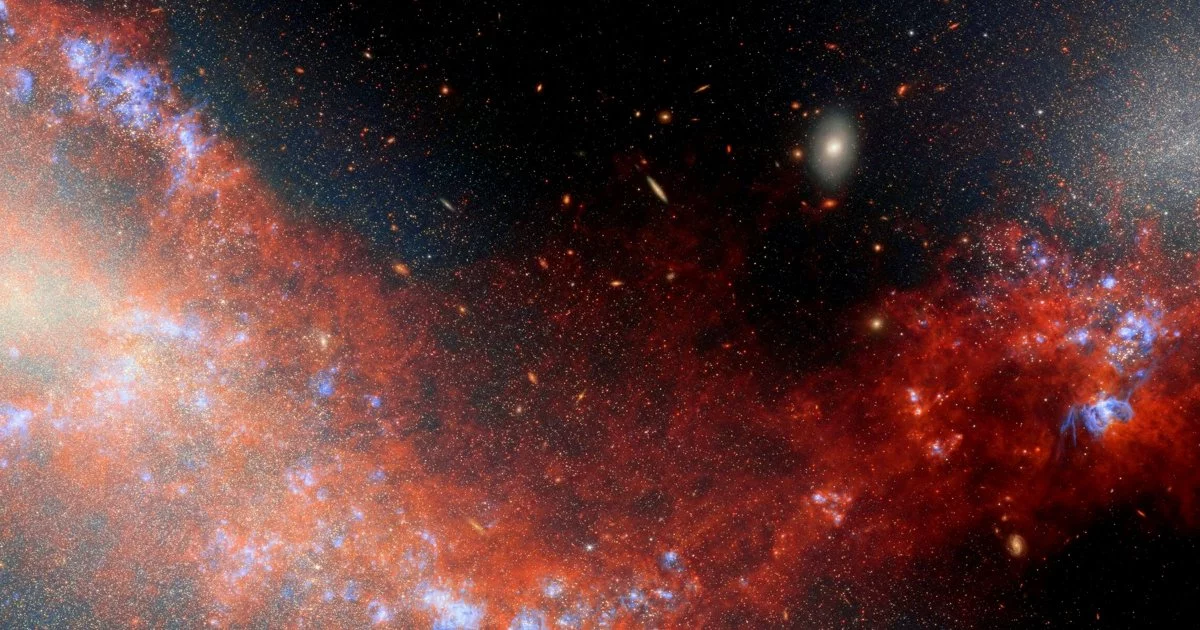
In the silent vastness of the cosmos, a discovery has emerged that is reshaping not only our understanding of the universe but also the technological and economic strategies of industries on Earth. An Oxford-led team, wielding the formidable capabilities of South Africa’s MeerKAT radio telescope, has mapped a galactic filament so immense—5.5 million light-years in length, razor-thin, and composed of a string of 14 galaxies—that its very rotation offers a rare glimpse into the mechanics of the universe’s grand architecture. Nested within a 50-million-light-year filament containing 280 galaxies, this structure is more than an astronomical marvel; it is a living laboratory for the interplay between cosmic dynamics and industrial innovation.
Software-Defined Sensing and the Rise of Exascale Data
At the heart of this discovery lies a technological leap: the maturation of software-defined instrumentation at planetary scale. MeerKAT’s 64-dish array, orchestrated by cloud-native digital back-ends, represents a paradigm shift. The telescope’s architecture is not merely a feat of engineering; it is a harbinger of trends already rippling through private-sector domains:
- Disaggregated 5G RAN: The same principles enabling MeerKAT’s synthetic aperture are now core to next-generation telecom infrastructure.
- Autonomous Vehicle LiDAR Fusion: Distributed sensor fusion, once the province of astrophysics, is now foundational in the race for safe autonomy.
- Industrial IoT: Real-time, software-defined sensing is the backbone of modern manufacturing and logistics.
The data volumes involved are staggering. A single night’s raw visibility data from MeerKAT rivals the daily output of a mid-size hyperscale data center. This exabyte-class pipeline is stress-testing GPU clusters, refining machine learning workflows, and setting new standards for real-time radio-frequency interference excision—capabilities that are directly transferrable to enterprise AI and ML operations. The hardware innovations—cryogenic-grade RF components, high-dynamic-range ADCs—are already filtering into satellite communications, quantum computing, and defense, compressing innovation cycles across sectors.
Economic Stimulus and Data-Sovereignty: The Southern Hemisphere’s New Leverage
The implications for global industry are profound. The €15 billion Square Kilometre Array (SKA), with MeerKAT as its operational prototype, is more than a scientific endeavor; it is a semiconductor-grade industrial policy, catalyzing high-frequency electronics, precision machining, and fiber backhaul across the Southern Hemisphere.
- Open Interfaces as Export Foothold: Suppliers who standardize on SKA’s open protocols are poised for early-mover advantage when commercial satellite constellations demand similar ground-segment scale.
- Data Sovereignty: South Africa’s SKA hosting has triggered a cascade of data-protection frameworks and cloud investments, mirroring patterns now emerging in Latin America. Astute technology leaders are mapping astronomical site announcements to future edge data center buildouts and subsea cable routes.
This is not merely about infrastructure; it is about talent. The scientific cachet conferred by MeerKAT is redirecting global PhD flows, creating a reservoir of exascale-trained STEM talent in the Global South—an opportunity multinationals are already moving to exploit.
Cross-Industry Synergies: From Cosmic Fluid Dynamics to Swarm Robotics
What might seem esoteric—galactic filaments, baryonic matter flows, rotational coherence—has become a wellspring for cross-industry innovation:
- Hydrogen Economy: Algorithms developed for modeling intergalactic hydrogen flows are now optimizing terrestrial hydrogen pipeline routing and renewables siting, with licensing opportunities for HPC software vendors.
- Insurance and Risk Modeling: Bayesian models for dark-matter parameter fitting are structurally akin to catastrophe-risk models in insurance, accelerating climate-loss projections and remote-sensing analytics.
- Swarm Robotics: The rotational coherence observed in the filament mirrors emergent behavior in drone swarms, inspiring aerospace primes to fund astrophysicists translating galactic-spin mathematics into congestion-free flight-path algorithms.
Forward-thinking executives are already moving to capitalize:
- Open, Modular Observatory Stacks: Contributing to open-source pipelines such as SARAO’s Stimela or CASA NextGen offers reputational capital and early access to portable algorithmic IP.
- Anticipating GPU Demand: The forthcoming data releases from ESA’s Euclid mission and the Vera C. Rubin Observatory will drive unprecedented demand for edge AI inferencing hardware.
- Hydrogen-Fueled Partnerships: Joint ventures between astrophysics labs and green-hydrogen consortia are emerging, with corporates leveraging these for both R&D credits and ESG-driven reputational upside.
The Rotating Filament as a Catalyst for Deep-Tech Renaissance
The newly charted galactic filament is more than a cosmological curiosity; it is a proof point that investment in “Big Science” radiates multi-industry optionality. As public science projects like SKA evolve into dual-use innovation engines, they not only expand the frontiers of human knowledge but also seed the next generation of AI, advanced manufacturing, and energy-transition markets. For those with the foresight to internalize this dynamic, the cosmic web is not just a map of the universe—it is a blueprint for the future of industry itself.

 By
By


 By
By
 By
By

 By
By
 By
By







